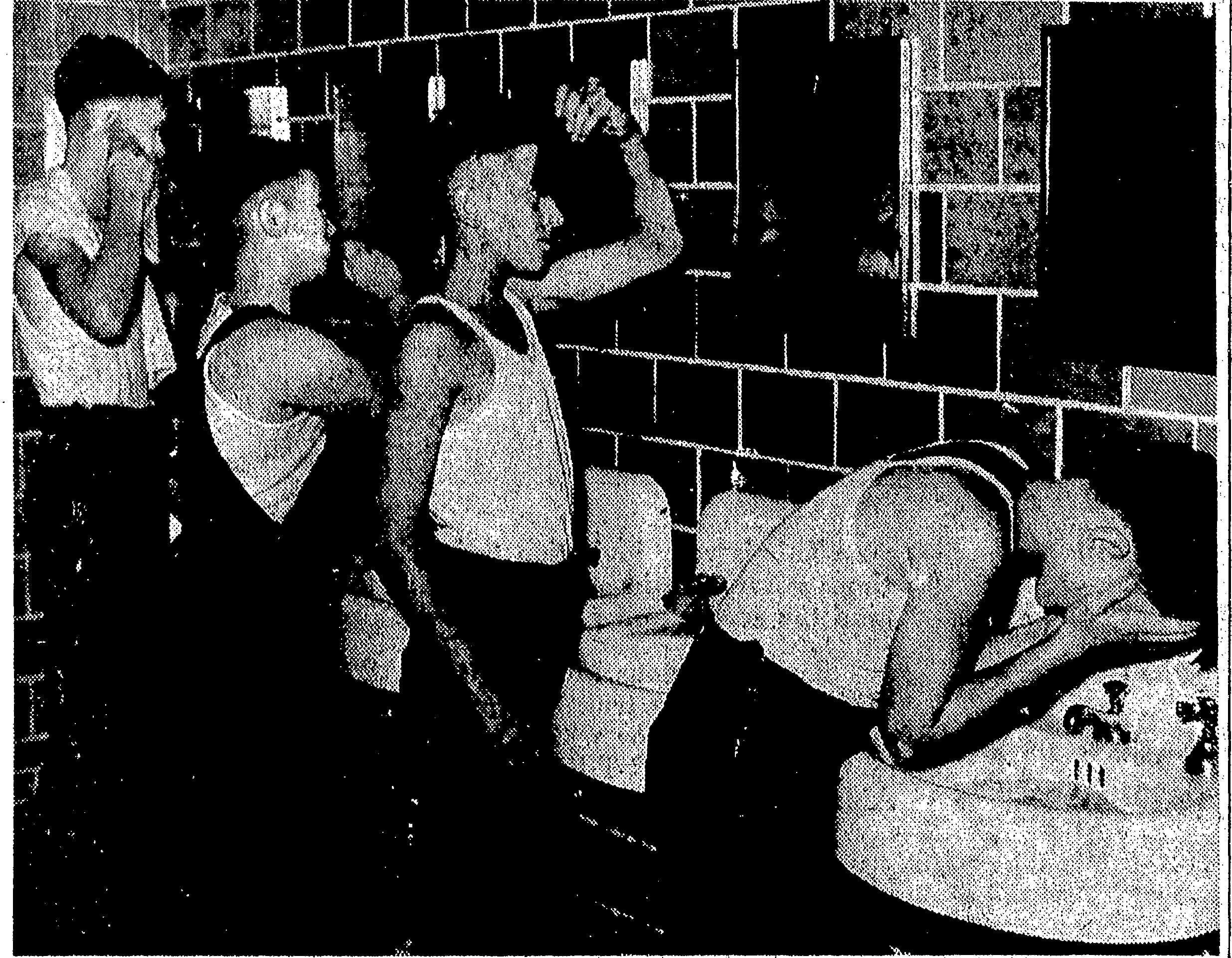
Four 1939 state fair campers wash up in the new Junior Home Economics Building. From left, they are Floyd Walker of Gibson City and Donald Montgomery, Robert Dirks and Robert Beauchamp, all of Greenview (Courtesy State Journal-Register)
The Junior Home Economics Building and its counterpart, the Junior Livestock Pavilion, were big improvements for the Illinois State Fairgrounds in 1938, the Illinois State Register reported that June.
This year, activities formerly carried on in the poultry building will be moved to the auditorium and the ground floor of the new home economics building, the “tent army” will be replaced with ten modern dormitories, five on either side of the home economics building, and the long rows of livestock exhibition tents will be supplanted by the junior livestock pavilion.
Demolition of the home economics building – known more prosaically in its final years as “Building 29” – began in June 2026. The livestock pavilion, which has been expanded and modernized over the years, remained.
The two structures, located west of Eighth Street across from the Swine Barns, cost a little over $600,000 to build in 1938-39. State government paid about half the cost. The rest came from a Depression-era federal agency, the Public Works Administration. (Demolition, including removal of hazardous waste, was expected to cost $2.1 million in 2026.)
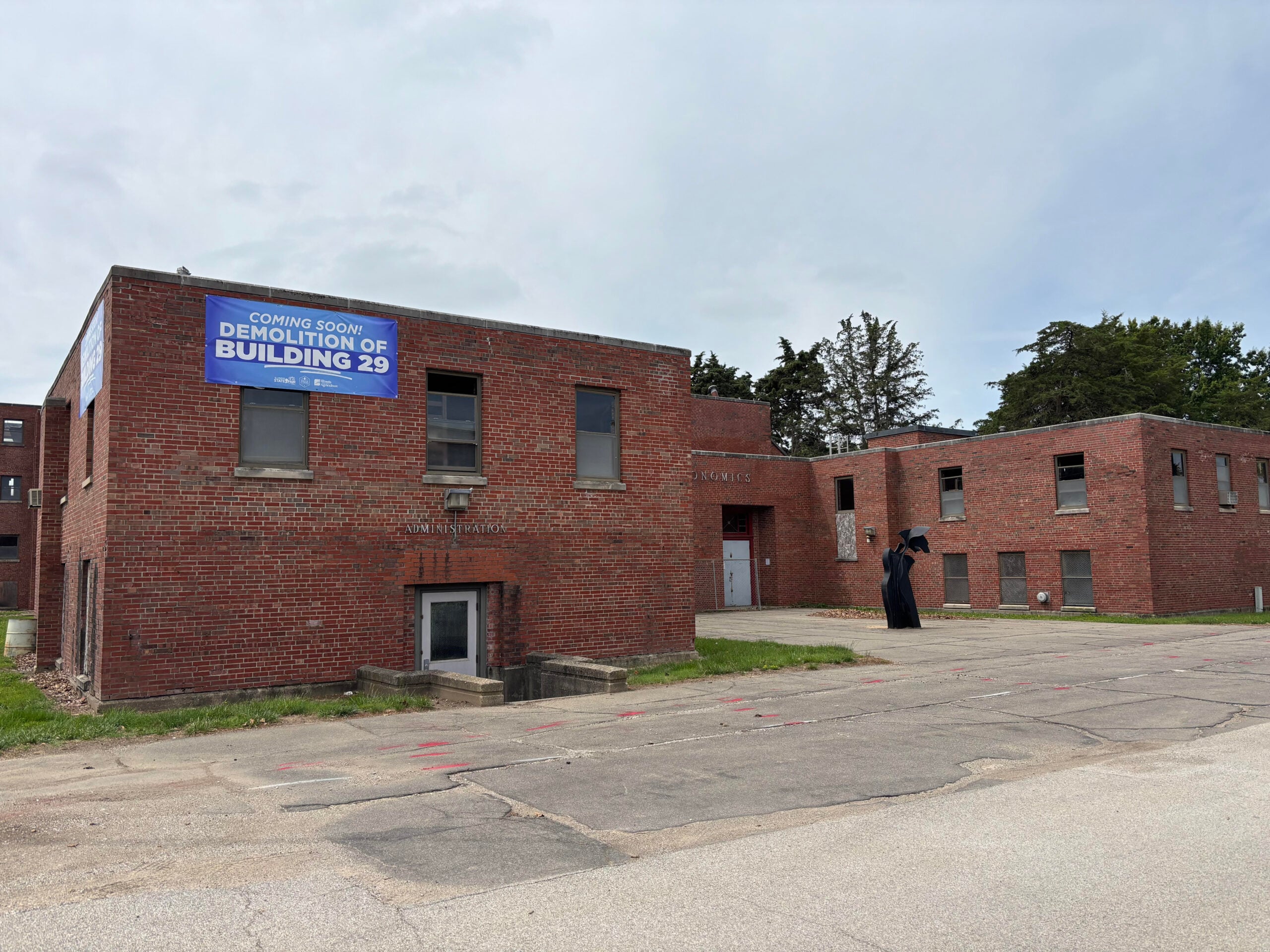
The derelict Building 29 a few weeks before demolition (SCHS)
The Register story outlined the features of the Junior Home Economics Building.
The center section, which faces north, will have administration offices on the northeast side of the central lobby and public rest rooms on the northwest side.
Back of the lobby is a 79-foot by 100-foot auditorium for assemblies, dramatic and musical events. The auditorium, flanked on either side by corridors leading to the dormitories and cafeteria, has a stage with a 44-foot proscenium opening, 22 feet deep.
The cafeteria will be housed in an 82-foot by 100-foot hall two stories high and will be able to accommodate 500 or more diners at the same time.
The rear half of the basement will be devoted to storerooms and to a large home economics room for contests and displays.
Before the building was constructed, the hundreds of boys who attended the annual state fair boys’ school lived in tents just inside the fairgrounds’ Eighth Street gate. The school focused on farming; classes in 1920, for instance, included “The Worm’s Eye View and the Bird’s Eye View of Orchard Soil Management” and “Practical Pointers for Pig Club Members.”
The boys’ school took place during the fair. Girls attended a two-week “school for domestic science” immediately before the fair. They were housed in the since-demolished Women’s Building, although the overflow had to sleep on the building’s upstairs porch.
The Junior Home Economics Building had separate but identical dormitories for boys and girls, 162 beds each plus bathrooms, showers and lockers. Girls stayed in the east wing and boys in the west.
The two buildings went into use during the 1938 fair, although neither was complete that year. They were finished in time for the 1939 fair, however, and dedication ceremonies took place on the fair’s Youth Day, Aug. 12, 1939. The highlight was a parade by 3,000 boys and girls, “representing every youth organization in the state,” from the two junior buildings to the Grandstand.
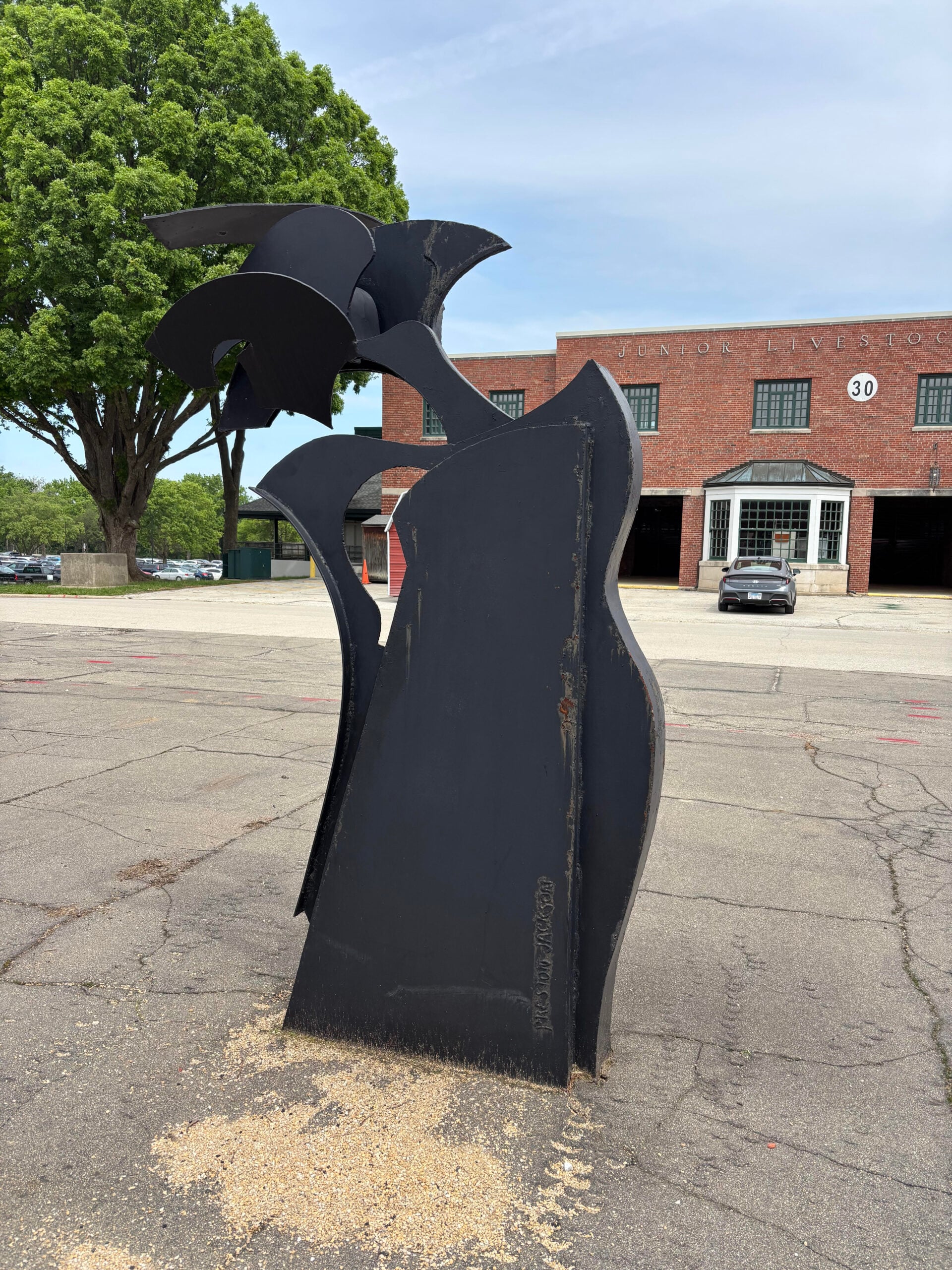
Noted sculptor Preston Jackson created “Flight Simulations,” which sat in the building’s entrance courtyard. (SCHS)
“Fair officials termed the youth day program … a huge success,” the Illinois State Journal reported.
The Junior Home Economics Building hosted its last events during the 2010 fair. In a news release when demolition started, the Illinois Capital Development Board said the space was deemed uninhabitable after utilities were disconnected in 2012.
“Bringing down Building 29 is an example of addition through subtraction, improving the grounds by removing an eyesore,” Department of Agriculture Director Jerry Costello II said in the release. The state said it had no immediate plans for the site.
The following has been updated.
Artwork inside and outside the building was removed before demolition began, according to the Capital Development Board. The most prominent was “Flight Simulations”, an Art-in-Architecture sculpture done by Peoria-based artist Preston Jackson that formerly was in the courtyard between the building’s two wings. (Jackson also created the 1908 Race Riot sculpture on Sixth Street across from the Abraham Lincoln Presidential Museum. He received the Order of Lincoln Medallion, the state’s highest honor for personal achievement, in 1998.)
 “Flight Simulations,” Jackson’s first large-scale work, was commissioned in 1981. Its future location has not been determined, CDB spokesperson Lauren Grenlund said.
Original content copyright Sangamon County Historical Society. You are free to republish this content as long as credit is given to the Society. Learn how to support the Society.