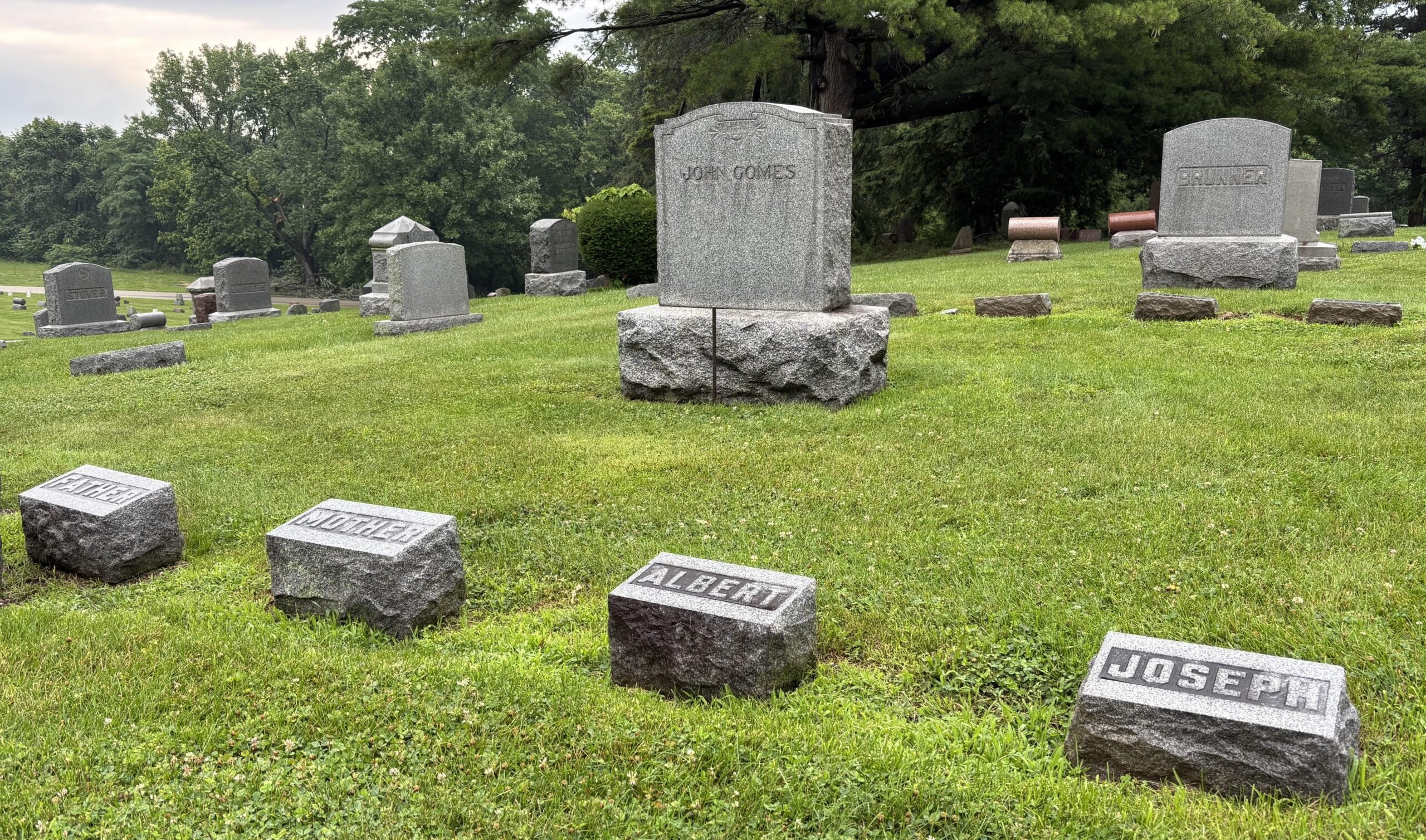
The Gomes family plot in Oak Ridge Cemetery. The headstone of aeronaut Joe Gomes is at bottom right (SCHS)
Thousands of people gathered at Ninth Street and Enos Avenue on Dec. 5, 1887, to see Springfield-born daredevil Joe Gomes parachute 3,000 feet from a trapeze attached to a hot-air balloon. Both the balloon and the parachute were handmade by Gomes himself.
Among those in the crowd was Gomes’ father, John (1829-1916). The older man adamantly opposed his son’s stunt, the Illinois State Journal reported later.
“Joe, you’re not to go up with that thing,” John yelled, according to the newspaper. “If you do, I’ll give you a tanning.” (Joe Gomes was 28 years old at the time.)
At that moment, the bag was released. Joe, hitched to the trapeeze (sic), made the run and vaulted to save himself the shock of being jerked from the earth with the clearing of the ropes.
“Come back here, you Joe,” shouted his father. But Joe was already in the air, smiling and kissing his hand to the cheering crowd below, in the midst of which his father was menacingly gesticulating.
John Gomes changed his tune once his son was fully airborne, the Journal said.
“There goes my boy Joe!” he cried. “My good boy Joe!”
Daddy Gomes was the first to greet the young aeronaut when he landed. But Joe never received that promised tanning.
Gomes landed safely in Reservoir Park, a few blocks north of his takeoff point. The Illinois State Register predicted great things for Gomes’ future.
The professor (like virtually all balloonists at the time, Gomes publicized himself as “Prof. Gomes” — ed.) is very proud of his feat, and it will make him famous with those who enjoy that kind of sport. No old professional could have more perfectly planned all the details for the attempt of such a feat nor accomplished it with more ease, grace and safety. He seems a born aeronaut.
Was John Gomes really dismayed by his son’s parachute plan? Maybe. It certainly was a dangerous stunt. But by 1887, Joe Gomes (1859?-1919) was already a veteran balloonist.
One of his earliest ascensions took place at Eighth and Jefferson streets, in the middle of Springfield’s fabled “Levee” vice district, on April 15, 1882. The Register had fun with that article.
The windows and doors of the adjacent bagnios were filled with the forms of over-dressed (or rather under-dressed) bawds, who let no opportunity pass to parade their charms (?) to a gaping and licentious crowd. …
The assembled crowd waited with great patience for the ascent, and the monotony of the affair was relieved now and then by repairing to some neighboring saloon, or by an occasional fight among the hoodlums.
Like the 1887 version, the 1882 balloon also had no basket. Instead, “Prof.” Gomes hung onto a trapeze-style bar while the balloon rose about 1,000 feet and floated a few blocks southwest. Gomes and the balloon landed harmlessly in front of the John Bressmer dry-goods store on the southeast corner Sixth and Adams streets.
“Mr. Gomes has made a contract to travel this season with a circus and make daily ascensions,” the Register’s 1882 story concluded. “We trust that he may get through with unbroken bones, but in this there are a thousand chances to one against him.”
Joe Gomes is credited with introducing parachute ballooning elsewhere around central Illinois. A couple of Peoria businessmen even turned Gomes’ stunts there into a minor industry, although Joe himself didn’t come off too well in newspaper coverage.
Findagrave.com’s entry about the death of Milton Forsman (1855-98), a Peoria balloon entrepreneur, quotes a Peoria Star article that mentioned Gomes.
While not an aeronaut himself, Forsman did more than any other man in this section to stimulate the balloon industry. The man who introduced the balloon ascension and parachute drop to Peoria was Joe Gomes, a Portuguese acrobat who struck this city in a forlorn condition, and was given employment in the rag warehouse of the Wheeler Paper company, of which Forsman was foreman for a number of years.
Professor Baldwin, of Quincy, had just introduced the parachute drop, and Gomes had successfully imitated him, but he was a shiftless sort of a fellow, and did not know how to improve his opportunity. Baldwin, who is an intelligent and enterprising man, gained a worldwide reputation, and made a barrel of money. After Gomes had been in Peoria a short time, he began to talk “parachute” to the Hagel Brothers, who were running a paper box factory, and they allowed him to make a balloon and parachute attachment, furnishing him with the material and paying him for the labor.
The first ascension of the balloon and the parachute drop which went with it was so satisfactory that the Hagel Brothers were quick to see its possibilities, and made other balloons, and soon had a number of amateur aeronauts on their staff.
They got $25.00 for each ascension and were doing a good business until Forsman entered the field, and cut the rate to $10.00. After this, the Hagels lost interest in the business, and resigned it exclusively to Forsman, who has conducted it more or less successfully ever since.*
Gomes also went west with his balloon and parachute, giving shows in Colorado, Idaho and elsewhere, although bad weather seems to have foiled many of his promised ascensions.
Gomes gave up ballooning sometime in the 1890s, but he stayed on the entertainment circuit as a singer and minstrel-show performer. He toured the U.S. with such well-known troupes as the Beach & Bowers Minstrels and the Hi Henry minstrel show. Both ensembles visited Springfield’s Chatterton Opera House several times.
Minstrel shows at the turn of the 20th century typically featured “burnt cork” acts, with white entertainers in blackface performing racist songs and skits. There’s no proof Gomes portrayed Black people in minstrelsy, but he certainly traveled with troupes that included burnt-cork acts.
For instance, a blackface skit, “The Telephone Agent,” was on the bill when Beach & Bowers played the Chatterton in February 1899. Newspaper coverage, however, suggests Gomes’ part of the show was limited to singing a sentimental number, “My Baby’s Kiss.”
“Joe Gomes, the Springfield boy who is with the show, received an ovation before and after his rendition of ‘My Baby’s Kiss,’” the Register reported. “He was compelled to render the chorus several times before his hearers would allow him to resume his seat.”
Gomes specialized in “ballads that pleased the little ones,” according to his obituary, which cited his renditions of two such songs, “Creep Baby Creep” and “The Little Rag Doll.”
After retirement, Gomes moved in with his sisters in Oshkosh, Wis., where he died. Gomes, his parents and most of his siblings are buried in the Gomes family plot at Oak Ridge Cemetery.
 * Joe Gomes’ brother James (1870?-1909), also ballooned in Peoria. James Gomes and a partner named J.A. Loomis were badly injured there in October 1892, when their descending balloon got tangled in trees and they fell 70 feet to the ground. Initial reports said their deaths were a foregone conclusion. Loomis’s fate isn’t known, but James Gomes survived. He was still ballooning as late as 1903, when another mishap dropped him into the Illinois River between Peoria and Pekin.
Original content copyright Sangamon County Historical Society. You are free to republish this content as long as credit is given to the Society. Learn how to support the Society.