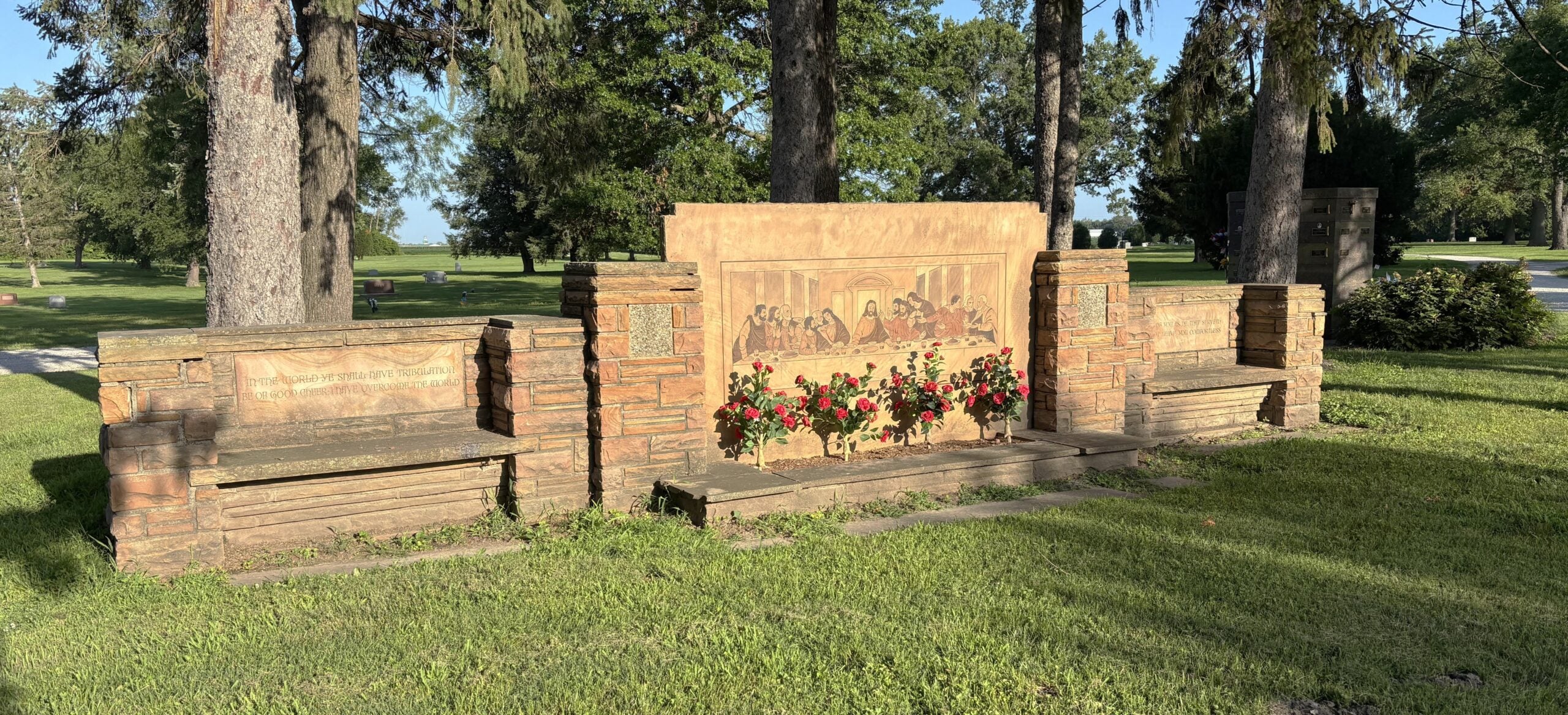
A stone reproduction of the Last Supper was one of the earliest decorative elements at Roselawn Memorial Park (SCHS)
Roselawn Memorial Park, “The Cemetery of Eternal Beauty,” was founded in 1927 by a seemingly mismatched consortium of Springfield entrepreneurs, politicians and religious leaders.
The first burial at Roselawn, that of 34-year-old Martha Ellen Stevens Johnson, took place in September 1928, about a year after the organizers incorporated the new cemetery. As of 2026, Roselawn held some 22,000 interments.
Roselawn is east of Springfield off Old Route 36, southwest of Camp Butler National Cemetery. Roselawn’s grounds take in part of the former Civil War training camp and its drill fields.
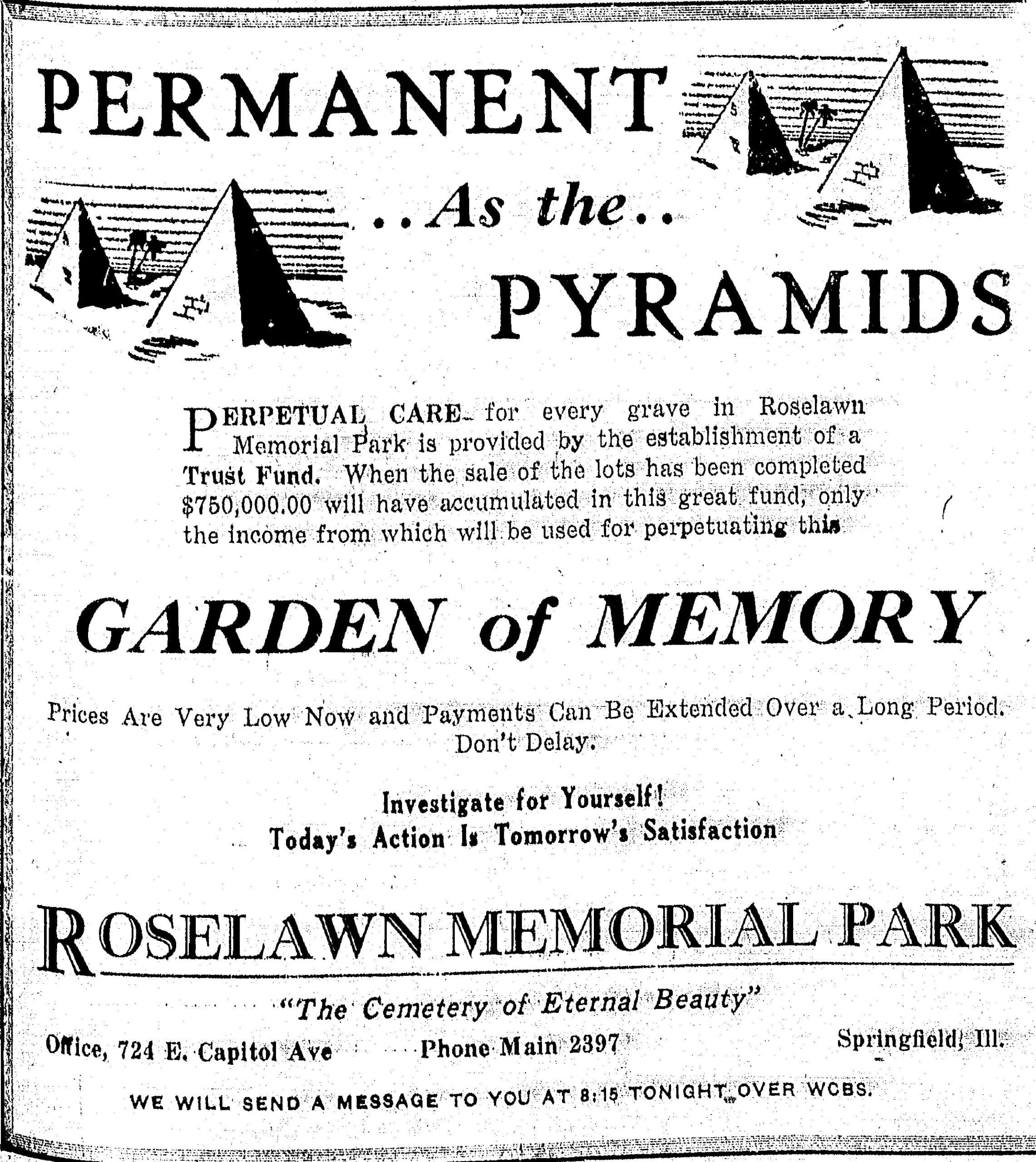
1929 newspaper advertisement (Courtesy State Journal-Register)
The founding board of directors included: A.E. Rouland (1880-1947), an educator, realty/insurance broker and politician; Louis E. Frost (1862-1953), who edited several farm publications and did mission and charitable work; the Rev. R. G. Hobbs (1854-1950), founding pastor of Kumler Methodist Church; eye specialist Dr. A.E. Morris (1892?-1967); Charles L. Koehn (1878-1933), a restaurateur and politician (Koehn served two terms as Sangamon County clerk; he was county treasurer when he died of a heart attack); and Otho L. Caldwell (1867-1943), Springfield commissioner of health and safety from 1931 to 1935 and a six-year member of the Springfield Park Board.
The board described its plans for Roselawn in a 1929 advertisement.
We shall try to create at Roselawn Memorial Park a great Park, devoid of misshapen monuments and other customary signs of earthly Death, but filled with towering trees, evergreens, sweeping lawns, singing birds, brilliant flowers and noble memorials: a place full of light and color, voicing the language that all the peoples understand – the language of beauty and harmony. We believe these things educate and uplift a community.
Roselawn Memorial Park shall become a place where lovers, new and old, shall love to stroll and watch the sunset’s glow, planning for the future or reminiscing of the past; a place where artists will study and sketch; where school teachers will bring happy children to see the things they read of in books; where a little chapel will invite and where memorialization of loved ones in sculptured marble and pictorial glass shall be encouraged, but controlled by acknowledged artists. …
This is the Builders’ Dream; this is the Builders’ Creed.
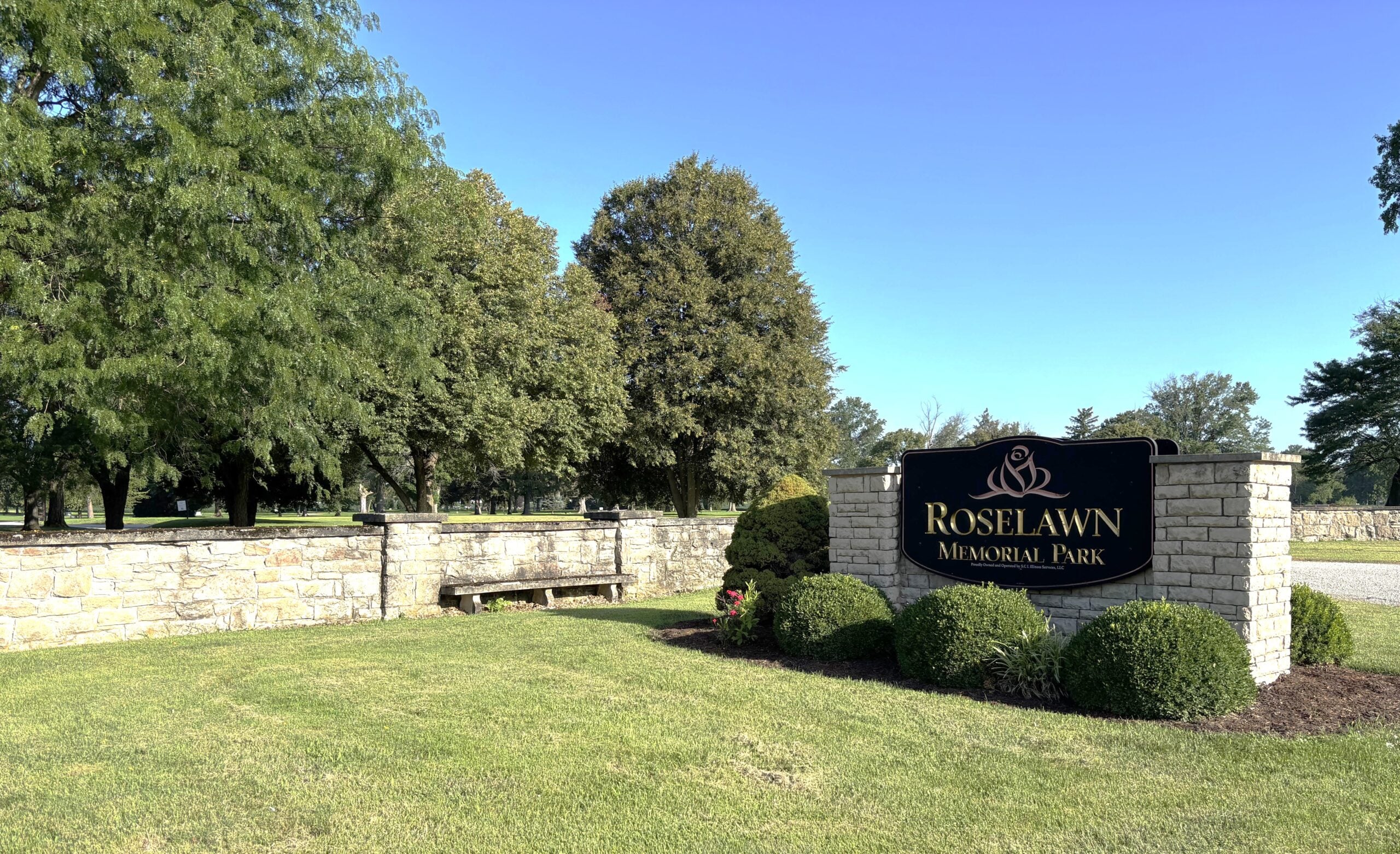
Roselawn entrance (SCHS)
W.T. Vancil (1891-1974), founder of what became the Vancil-Murphy Funeral Home, bought Roselawn in 1956; the Vancil family operated the cemetery until 2007, when it was sold to Butler Funeral Homes and Cremation Tribute Center.
Over the years, Roselawn’s management has created a variety of themed sections. In 2026, its website noted:
At the heart of Roselawn is a natural-color stone reproduction of Leonardo da Vinci’s “Last Supper.” Other notable monuments include a tribute to Lord Alfred Tennyson, a past poet laureate of the United Kingdom and one of history’s most recognized English poets.
The cemetery includes a section for members of Masonic orders and another that memorializes Abraham Lincoln. Its Greenview Terrace area is devoted to “green burials,” which involve biodegradable burial processes and caskets. Another portion is set aside as a pet cemetery.
 Roselawn’s founding board members seem to have approved of its subsequent development, as four of the six are buried there. The exceptions are Gear, who is buried at Oak Ridge Cemetery, and Morris, who moved to California; his burial place, if any, is unclear.
Original content copyright Sangamon County Historical Society. You are free to republish this content as long as credit is given to the Society. Learn how to support the Society.