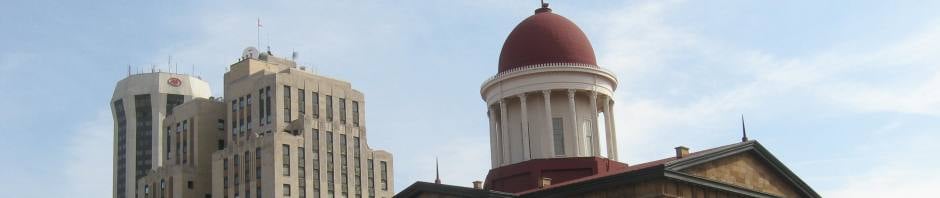
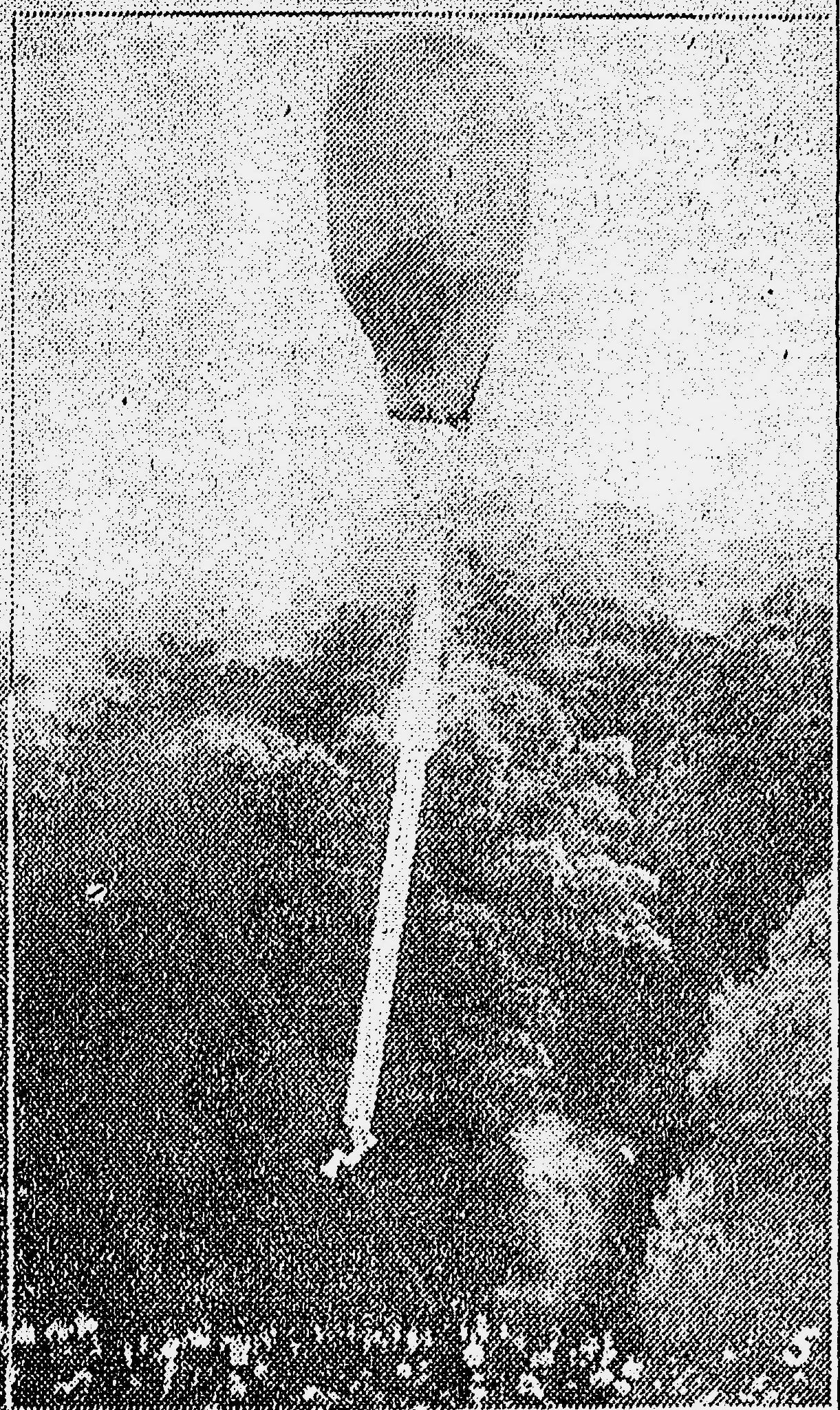
Balloon ascension, with parachute, done by pioneer Springfield balloonist Sumner Cole at Oak Ridge Park (today’s Lincoln Park), undated. Published in Illinois State Journal centennial edition, Nov. 8, 1931. See below for more on Sumner Cole. (Courtesy State Journal-Register)
Thousands of spectators saw 27-year-old Luther “Pete” Jones die when the hot-air balloon he was riding flew into a tree at Mildred Park on Sunday, June 7, 1908.
Jones (1881?-1908), an itinerant daredevil, had been hired to do stunts at the park during the summer of 1908. (Mildred Park was a privately owned amusement park on the site of today’s Bunn Park.)
Two weeks earlier, Jones won a long-distance balloon race that started at the park. The Sunday before his fatal accident, Jones undertook a different exploit, diving from 90 feet up into the Mildred Park pond.
It was “his first attempt at such a venture,” the Register reported. “He made it successfully with the exception of having two teeth knocked out.”
Jones’ plan June 7 was to float several thousand feet up and then parachute down from the balloon. As balloon exhibitions went at the turn of the 20th century, it was a fairly common stunt.
Instead of being carried in a backpack, the loose parachute was connected to the balloon via a quick-release mechanism; the aeronaut hung from a trapeze-style bar attached to the bottom of the chute. The inflated balloon would carry the contraption into the air, often while the balloonist did acrobatics, like dangling by his feet.
Once the balloon reached a suitable height, the aeronaut would disconnect the chute from the balloon. It would take a few seconds for the parachute to catch air, adding a thrilling free-fall of 1,000 feet or so to the spectacle. Then the chute would inflate, and the daredevil would float more or less gently to the ground.
At Mildred Park, however, Jones pushed his luck.
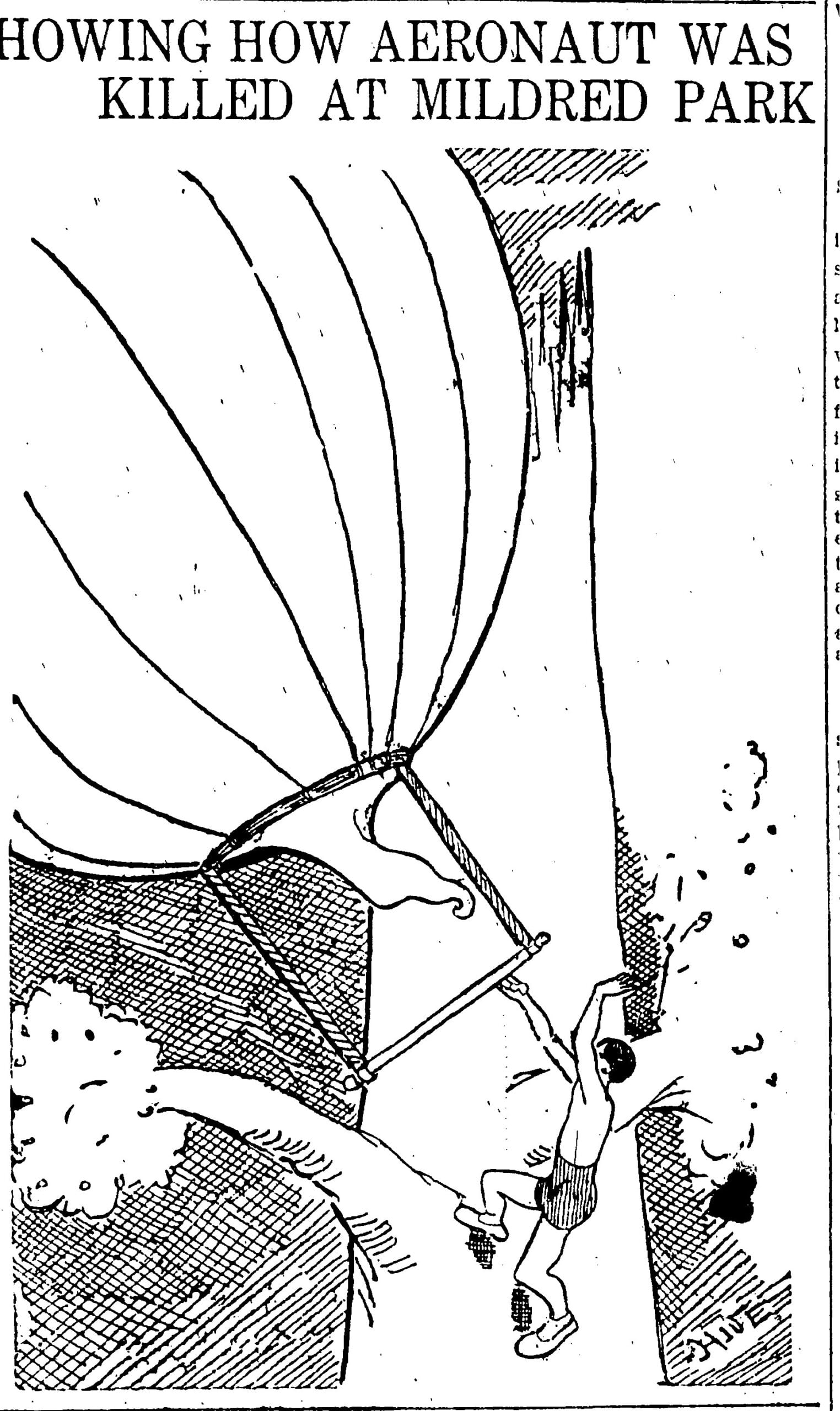
Illinois State Register sketch of Jones’ accident (SJ-R)
“It was a bad day for a balloon ascension, as the wind was very strong,” a fellow balloonist, W.L. Wersen (1874-1935), told the Illinois State Register. “At times the balloon, while being inflated, would sway and almost touch the ground.”
Both men were already in costume – balloonists usually wore tights – and Wersen said he and Jones talked briefly about which man would make the flight. “However, Mr. Jones decided that he would go up, and I said, ‘Alright, you can make a few dollars by going up.”
The Illinois State Journal and Illinois State Register both published vivid stories about the tragedy. The Register’s coverage included a rudimentary sketch (right) of the accident. According to its story:
(T)he balloon arose with a jerk in a northerly direction. Just north of where the balloon was inflated about 30 or 40 feet was a large dead tree. Toward this tree the balloon went but succeeded in clearing it. Not so with the lower part of the parachute and Mr. Jones, for the ropes of the parachute passed between the forks of the tree dragging the victim along.
Just before Mr. Jones reached the tree, several in the crowd yelled to him to look out as he was going to strike the tree, but as the balloon was going with such speed, he could not escape the awful fate that was in store for him. … As he struck the fork of the tree he was thrown with such force that he was hurled head over heels on the other side of the tree for a distance of about 20 feet.
Jones’ head hit a tree branch as the balloon pulled him through the tree. The Journal added other details.
His skull was fractured by the blow and the life belt which was attached to the parachute was torn loose.
Without his even uttering a cry, the lifeless body was hurled downward forty feet into the midst of the crowd. Men averted their heads from the sickening spectacle and several women fainted. The throng made a wild scramble to get out of the way and then as madly rushed back, surrounding the unfortunate aeronaut.
Jones had been flying balloons across the U.S. for a dozen years before his death. His wife, Lulu, also a balloonist, was in Hot Springs, Ark., when her husband was killed.
Luther Jones performed often in central Illinois, including at the Illinois State Fair, probably because of family connections to Springfield. His father, M.L. Jones, owned a blacksmith shop in Springfield before moving to St. Louis, and a brother and sister still lived here. Jones’ father, who visited his Springfield children on most Sundays, was at the Chicago & Alton railroad station (the Amtrak station in 2026) waiting to go home when his son was scheduled to perform.
“Knowing that the young aeronaut was to make the ascent at 6 o’clock, the father watched the sky in the direction of Mildred Park,” the Illinois State Journal said. “Just as he reached the station the big balloon came into sight, sailing rapidly due north. But instead of his son, whom he expected to see hanging from the parachute bars, the horrified father saw the attachment swinging loosely from the balloon.”
Jones is buried in an unmarked grave at Oak Ridge Cemetery.
Popular attractions/Sumner Cole
“A balloon ascension was a popular attraction in the old days,” the Register recalled in one of its “Family Album” photo features in 1942.
People flocked out to the Fair Grounds, old Oak Ridge Park (Lincoln Park today – ed.), the Comet Grounds* and other “commons” of the city, to watch the inflation of the big bag, the other preparations for the flight, the appearance of the balloonist in gay sport shirt and tights, the command to cast off and the dramatic release of the balloon from terra firma on its uncertain voyage, amid the huzzas of the crowd!.
The spectators, who had been munching colored popcorn and sipping lemonade and pop purchased from vendors and near-by stands, would watch the progress of the balloon for a time, make bets on its probable course and the distance it would traverse, and then slowly disperse. …
Sunday afternoons and holidays, especially the Fourth of July, were favorite occasions for such events.
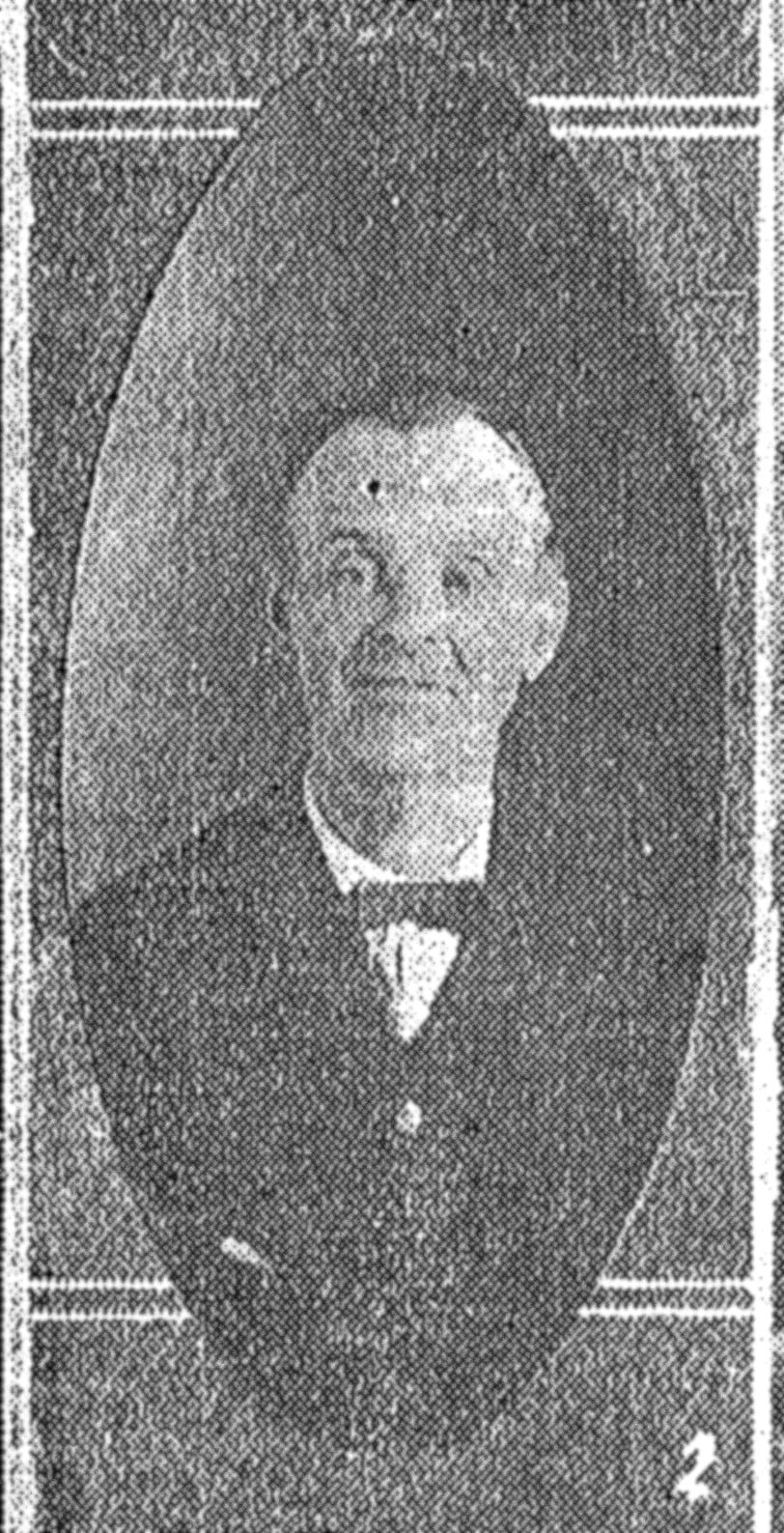
Sumner Cole, undated (SJ-R)
Sumner Cole (1863-1949), a Chicago & Alton watchman and part-time balloonist, put together the balloon/parachute apparatus Jones used in his fatal flight. Cole, probably Springfield’s best-known early balloon entrepreneur, also instructed other would-be aeronauts – including, according to another Register “Family Album” feature, at least three women.
“At an early age (Cole) became interested in balloons and constructed several hot air balloons from which he made exhibition parachute jumps throughout the United States and Canada,” Cole’s obituary said. “He made a number of jumps at the fairgrounds, at the local K of C barbecues and at Mildred park, now known as Bunn park. At one time he won a race between 12 hot air balloonists at Shelbyville.”
 *The Comet Grounds was a baseball/football/circus field along South Grand Avenue between Fourth and Fifth streets in the late 1890s/early 1900s. Buffalo Bill Cody’s Wild West Show was among attractions that performed there.
More on local ballooning: Joe Gomes’ parachute jump, 1887
Original content copyright Sangamon County Historical Society. You are free to republish this content as long as credit is given to the Society. Learn how to support the Society.