
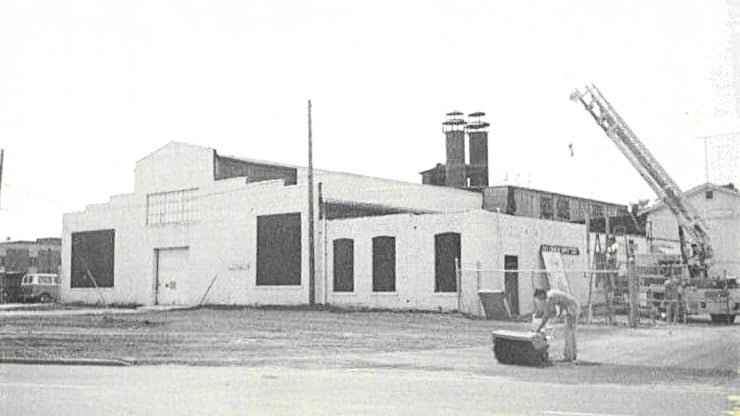
The former Illinois Foundry plant in an undated photo (Facebook/John Weinhoeft)
The Illinois Foundry Co., which operated for 50 years on South 11th Street, was part of an industrial complex surrounding Springfield’s massive Allis-Chalmers/FiatAllis manufacturing plant.
Mandelbert “M.W.” Baker (1875-1939) formed Illinois Foundry in Springfield in 1917. The foundry was an offshoot of the Baker Manufacturing Co., which M.W. Baker founded in Chicago in 1907. He moved Baker Manufacturing to Springfield in 1912. Baker Manufacturing at first produced road maintenance equipment, such as street sweepers and snowplows, but later specialized in crawler tractor attachments, with Allis-Chalmers being one of its prime customers.
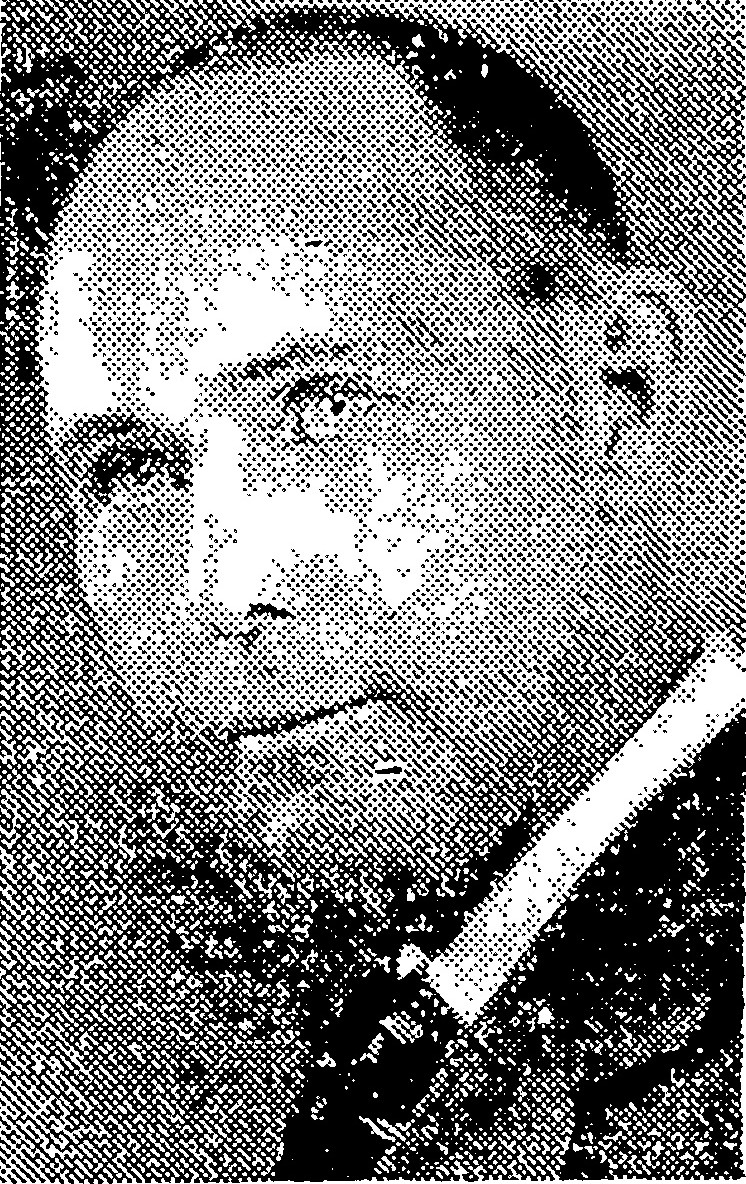
M.W. Baker (Courtesy State Journal-Register)
M.W. Baker sold Baker Manufacturing to his brother-in-law in 1920, but he continued to run Illinois Foundry until his death.
The business was known as the B&M Foundry for its first few years, and the company’s beginnings apparently were modest, to say the least – it was the first foundry, a 1931 newspaper story said, “for the canning of pickles.”
Within a couple of years, though, B&M/Illinois Foundry landed some larger customers. Its prime business became making castings for other industrial plants, such as Baker Manufacturing and Allis-Chalmers. A newspaper listing in 1931 said Illinois Foundry castings were used in “tractors, garage equipment, hay presses, lawn mowers, farm machinery, cylinder presses and power machinery.” Products ranged from “small shafts and cog-wheels to giant cylinders which in some cases weigh as much as 4,500 pounds apiece.”
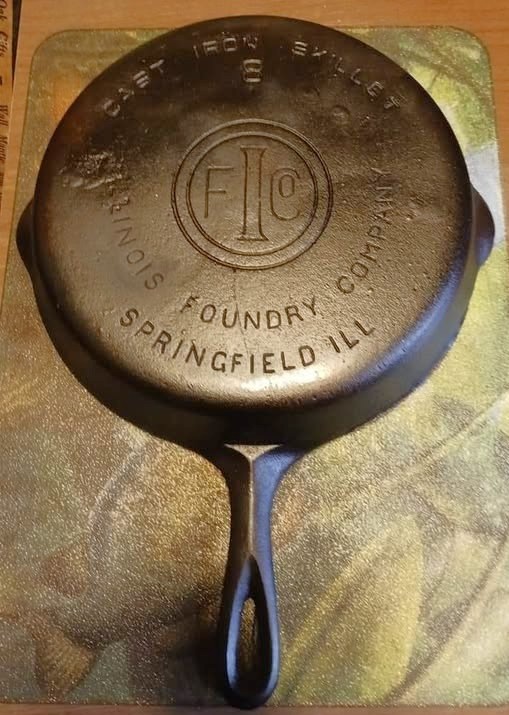
An 8-inch Illinois Foundry skillet (Facebook/Kathleen Bliss Withers)
However, the foundry also continued to make smaller items, such as window sash weights and a variety of direct-to-user products like ornamental light stands, manhole covers and, at least as a sideline, cast-iron skillets.
That 1931 story described the manufacturing process.
Two giant iron furnaces are in constant operation. Each furnace will contain seven tons of molten ore (the company got iron ore directly from mines in South Dakota and Montana, the story said).
Casting is carried on according to a definite procedure. During the forepart of each day and until 3:30 o’clock each afternoon hundreds of molds are packed and prepared. Meanwhile, the furnaces are heated with capacity loads of ore. Coke is the chief fuel. Pouring is done when all molds are ready.
When the molds are removed, the casts are washed in revolving drums. They are then transported to a finishing room, where emery wheels eliminate all rough edges. Once this process has been accomplished, the castings are made ready for shipment.
Illinois Foundry employed about 40 workers in 1931. It grew through World War II – when the foundry was declared a “Must Plant”, giving it priority status for employment – and into the U.S.’s postwar manufacturing boom. In 1953, Illinois Foundry had 100 employees and sold products to manufacturing concerns throughout the Midwest.
M.W.’s widow, Margaret “Madge” Baker (1880-1946), sold the plant in 1944 to the East Coast firm of J.L. Baugh Railroad Bridge Building Co. (Baugh Bridge’s owner, Jesse L. Baugh (1886-1961), was a colorful character whose previous enterprises including promoting boxing matches and introducing miniature golf to Brazil.)
Illinois Foundry’s fortunes began to slip after the mid-1950s. By the time the Baugh family sold the company again in 1966, employment was down to eight to 10 workers and operations had been cut back to part time.
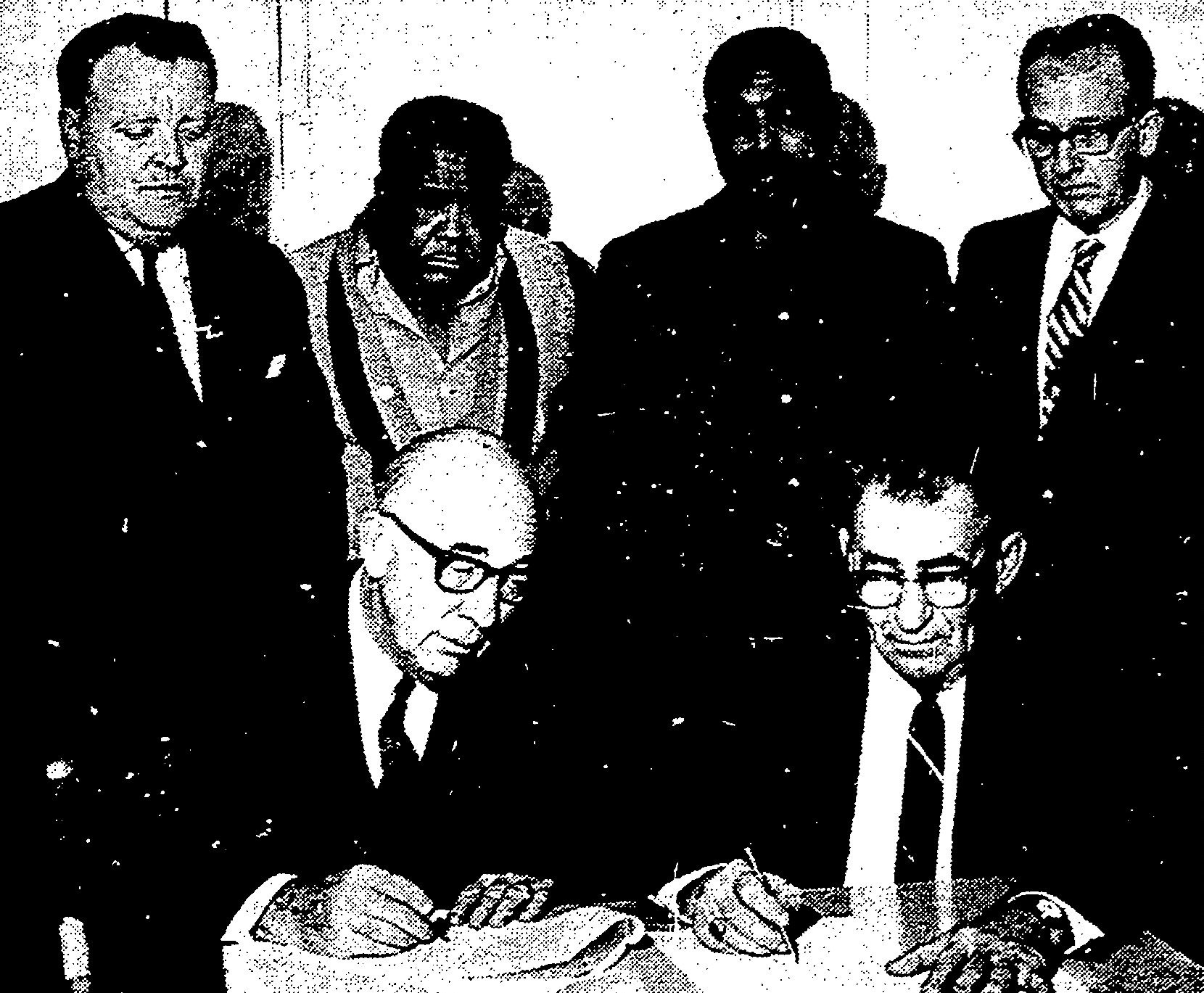
J.W. Meckenstock, foundry president, and Carniel DeVriese of the International Molders and Allied Workers union sign a new – though ultimately futile – contract in November 1966. Watching from left: Delbert Donaldson, foundry general manager, and union representatives Al Sneed, Albert Smiley and William Squires (SJ-R)
The last owners, the Independent Equity Co. of Ottawa, Ill., made a stab at reviving the foundry. Independent Equity expanded the plant, brought on a couple dozen full-time workers, and signed a new union contract that raised the foundry’s average wage to $2 an hour.
The effort failed in less than a year, however. Illinois Foundry shut down for good in July 1967.
 The foundry’s former site at 2759 S. 11th St. was a vacant lot in 2026.
Original content copyright Sangamon County Historical Society. You are free to republish this content as long as credit is given to the Society. Learn how to support the Society.
My grandmother’s cast iron skillet came from Illinois Foundry.