Four Springfield men, including a former mayor, died gruesomely in a train collision outside Chicago in 1873. At least 19* people died in the crash, which occurred when a coal freight ran into – and under – a southbound Chicago & Alton Railroad passenger train.
Three of the Springfield victims were connected to the state penitentiary at Joliet. Three-term mayor John W. Smith (1820-73) was the prison’s warden. Joshua R. Fleury (1832-73) was the institution’s purchasing agent, and Noah Divelbiss Jr. (1849-73) held what newspapers described as a “responsible position” at the penitentiary. The fourth Springfieldian, William H. Little (1833?-73), operated a livery stable and was a co-owner of the Springfield City Railway streetcar line.
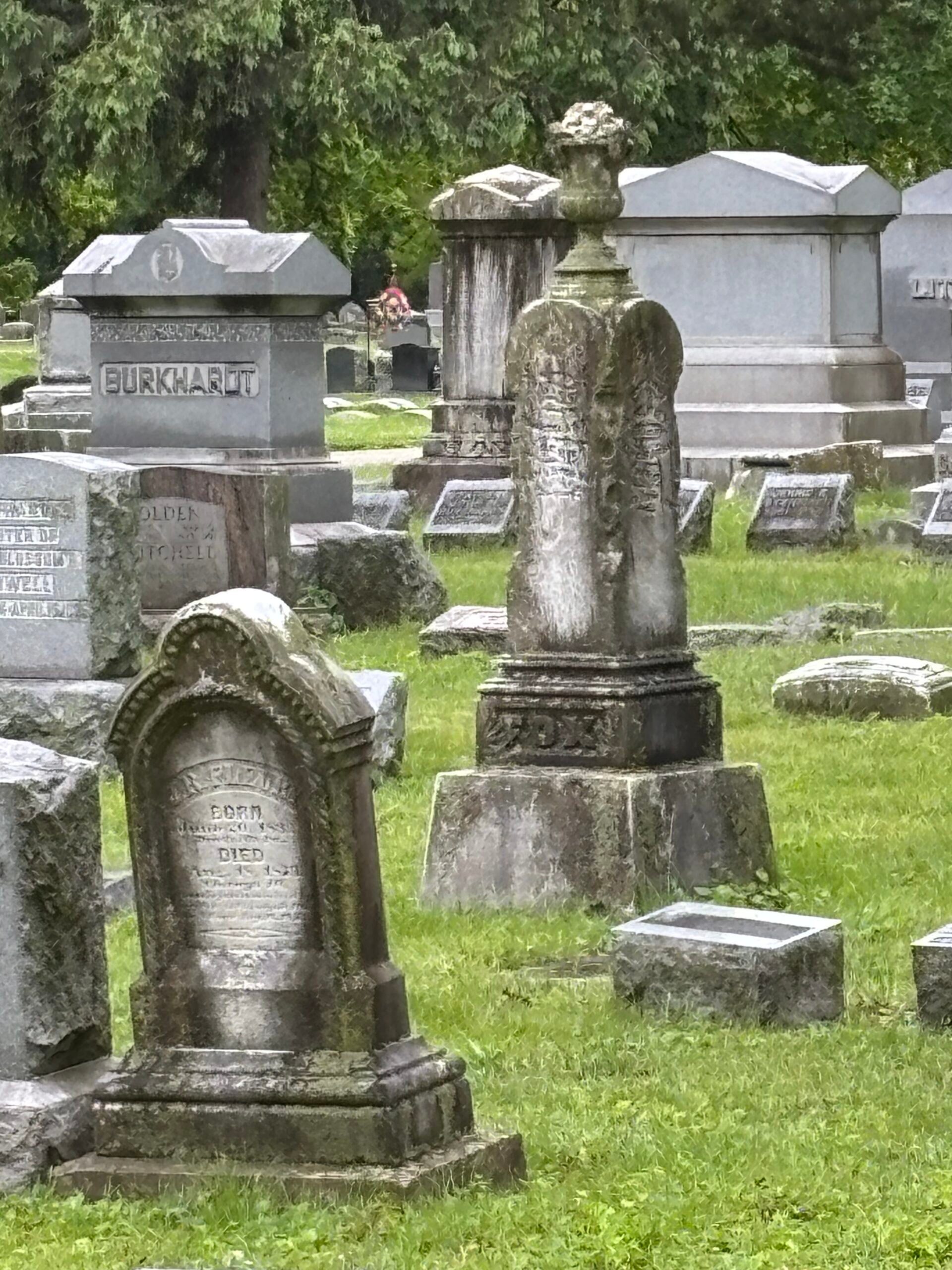
Two of the victims, coincidentally, are buried in neighboring plots at Oak Ridge Cemetery. Joshua Fleury’s tombstone, left foreground, is in front of the Fox family plot, where John W. Smith lies in an unmarked grave next to that of his wife, Ann Fox Smith. (SCHS)
All four were riding in the C&A smoking car when the two trains collided head-on about 10 p.m. Aug. 16, 1873. The accident occurred 22 miles southwest of Chicago at a water stop known at the time as Sag Bridge; the site now is in the village of Lemont.
The C&A train was carrying more than the usual number of sleeping-car passengers but started out with only a single Pullman sleeper. As a result, it stopped at Willow Station, seven miles north of Sag Bridge, to pick up a second Pullman. The delay, about 10 minutes, put the passenger train in unknowing jeopardy from the coal train, which was en route for Chicago from Joliet.
Many of those on the C&A train had been in the smoking car while waiting for the second sleeper, and some of the riders continued to socialize after the extra Pullman was attached. As the Chicago Tribune somewhat confusingly explained:
As there was no room in the rear car for these gentlemen, some forty or fifty in number, they wandered forward to the front end of the train to await the attachment of the second Pullman car. Some of them remained in the smoking car and other coaches in front, while the rest returned to their sleeping apartments to secure berths.
A combination of circumstances and mistakes led to the fatal crash. The C&A engineer apparently increased speed to make up lost time and may have missed a stop sign at Sag Bridge. Meanwhile, the conductor of the coal train likewise missed a signal to stop at Lemont until the C&A went through. Low-lying fog may have contributed to both mistakes.
The Tribune described the tragedy.
There were three concussions – first, when the engines met and were destroyed; second, when the baggage car struck and was smashed into fragments; and third, when the smoking car collided and leaped in the air, alighting on the fractured boiler of the freight engine.
The remains of the passenger-train engine were thrown from the track … and so were the ruins of the baggage car. Then came the smoking car on top of the boiler. The fore part of this car was burst open by the force with which it struck, the hind wheels remaining on the track, and there it stood at an angle of thirty degrees, the passengers imprisoned in the broken iron and wood, while the deadly steam came up with terrific force from the boiler below, scalding those whom it touched, instantly peeling off the skin and causing the most excruciating agony.
Pullman conductor A.S. Burgess told the Tribune he had been in four previous train accidents but never before had seen “such utter misery.”
In the meadows on either side of the track were lying human beings, yelling in agony, their flesh boiled off them. … A man – I don’t know who it was – ran up to me, shrieking with agony and threw himself into my arms. I tried to hold him, but his clothes tore off him, and the flesh came off with them. I was nearly stunned at the sight.
Many other smoking car passengers, including the Springfield victims, suffered similar devastating injuries. Smith “lost fully half his skin” in addition to inhaling superheated steam from the burst boiler, the Illinois State Journal said. He lingered for more than a day before dying.
Little died at the scene but was conscious long enough to dictate his will to Burgess. Little also gave Burgess his jewelry – two diamond studs, a pin and his watch and chain – to pass on to Little’s wife.
With that finished, Little said, according to Burgess, “I am sorry I have kept you so long from others; please go and look after somebody else.”
“He was a man, was Capt. W. Lettle (sic),” Burgess told the Tribune reporter. “Clear grit right through.”
Edward Beane, conductor of the coal train, originally was blamed for the collision, a conclusion reinforced by the fact that he disappeared for several weeks after the tragedy. Once he resurfaced, Beane and the train’s engineer, Joshua Puffenberger, were indicted for manslaughter. Puffenberger was acquitted in October, and a judge dismissed the charge against Beane in July 1874.
Smith, Little, Fleury and Divelbiss were memorialized in a quadruple funeral held in the rotunda of the Statehouse Aug. 19. Among the speakers was Gov. John Beveridge.
“This calamity falls upon us like a pall,” Beveridge said. “In life they had friends who loved them – in death they have friends who weep for them. … Let us forget their faults, emulate their virtues and hold them in sweet remembrance for the good they have done.”
Smith, Little, Fleury and Divelbiss are buried separately at Oak Ridge Cemetery.
*The Tribune reported the fatality count of 19 in a followup story published on March 5, 1874. However, the total number of dead remains open to question. A web account written by Lemont historian/novelist Pat Camalliere puts the number of deaths at 23. Camalliere’s article, which she based largely on information from the Lemont Historical Society, includes a number of details not reported elsewhere.
John W. Smith
John W. Smith, a blacksmith by trade, also was one of Springfield’s most prominent public officials for almost 30 years. John Carroll Power profiled Smith in History of the Early Settlers of Sangamon County (1876).
John W. Smith filled many important positions of honor and trust in Sangamon county. He discharged the duties of census commissioner in 1845 by appointment from the county court. In 1848 he was elected one of the representatives of Sangamon county in the State Legislature and was again census commissioner in 1855. He was elected sheriff of the county in 1860 for two years and mayor of the city of Springfield in 1863.
He was appointed by the United States government commissioner on the board of enrollment for military duty for the eighth congressional district in 1864 but soon resigned to accept the position of collector of internal revenue for the same district. He was one of the commissioners named in the law of Feb. 25, 1867, to manage the building of the new state house and remained on the board until the laws of March 11 and 27, 1869, reduced the number from seven to three.
He was elected Mayor of Springfield in 1871 and re-elected in 1872. He was appointed by Gov. Beveridge in 1873 warden of the state penitentiary at Joliet. While discharging the duties of that office he was on his way from Chicago to Joliet on the night of Saturday, Aug. 16, 1873. The train on which he was traveling collided with a freight train near Sag Bridge, a few miles southwest of Chicago. He was in the smoking car at the time and was terribly scalded by the escaping steam from the broken pipes.
He, with a number of others, were taken to Chicago and died there at eight o’clock on the morning of the 18th. His remains were brought to Springfield and buried at Oak Ridge cemetery, Aug. 19th.
 Smith is buried in an unmarked grave next to that of his wife, Ann Fox Smith, who had died two years earlier at the age of 43. They left five children, ranging in age from 10 to 24.
Original content copyright Sangamon County Historical Society. You are free to republish this content as long as credit is given to the Society. Learn how to support the Society.
Wow. Great stuff, Mike. I teared up reading about Mr. Little.