
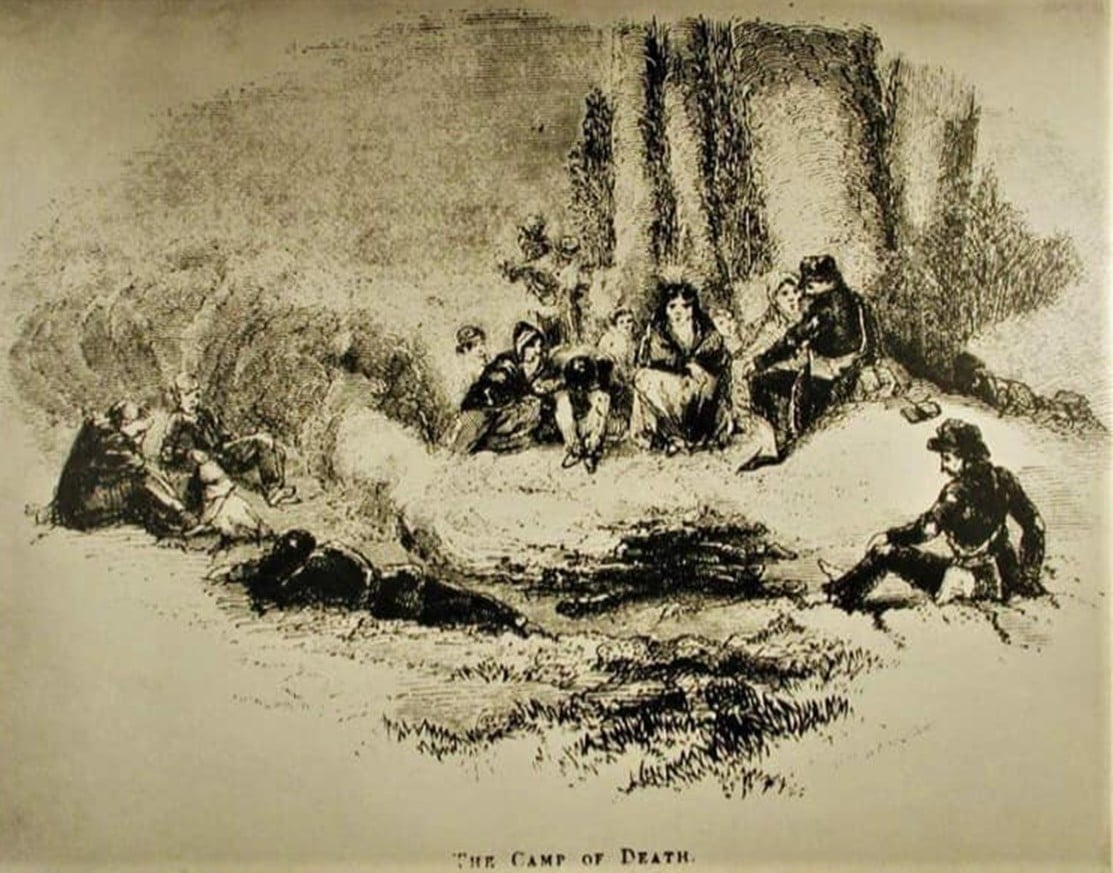
‘The Camp of Death,’ (Sacramento History Museum/Califormia State Library)
The Donner Party left Springfield to emigrate to California in mid-April 1846 but became stranded in deep snow near present-day Truckee, Calif. The group’s experience is remembered primarily because, before the surviving members of the expedition were rescued, some of the snowbound pioneers resorted to cannibalism. But there’s another aspect to the Donner tragedy. As Kristin Johnson explained in Unfortunate Emigrants: Narratives of the Donner Party (1996):
In the broader historical perspective, the disaster itself is of minor significance. … Yet if the effect of the Donner party on history has been slight, its impact on people has been profound. Since 1847 the ill-fated wagon train has figured in hundreds of works, not only histories and articles but also novels, short stories, juvenile literature, poems, plays, films, documentaries, even an opera and a ballet. Though the lurid fact of cannibalism is the Donner party’s best-known aspect, the story’s wide appeal cannot be attributed to mere prurience, for most of these works gloss over the horrors.
Instead, the motivating factor appears to lie in the human story: unlike many epics of the American West, the Donner saga is not centered on the exploits of a few exceptional men who sought adventure, but on families, on ordinary people caught up in an extraordinary situation.
As Johnson noted, the Donner story has been documented in hundreds of ways, and most Americans already know the gist of it. Instead of examining the tragedy in detail, this entry will focus on the three dozen (or so – see below) Sangamon County participants. The nuclei of the expedition were the families of George Jr. and Tamsen Donner, George’s brother Jacob and his wife Elizabeth Donner, and James and Margret Reed – ordinary families who indeed were “caught up in an extraordinary situation.”
In her 1891 memoirs, Virginia Reed, a daughter of James and Margret Reed, recalled the company’s departure:
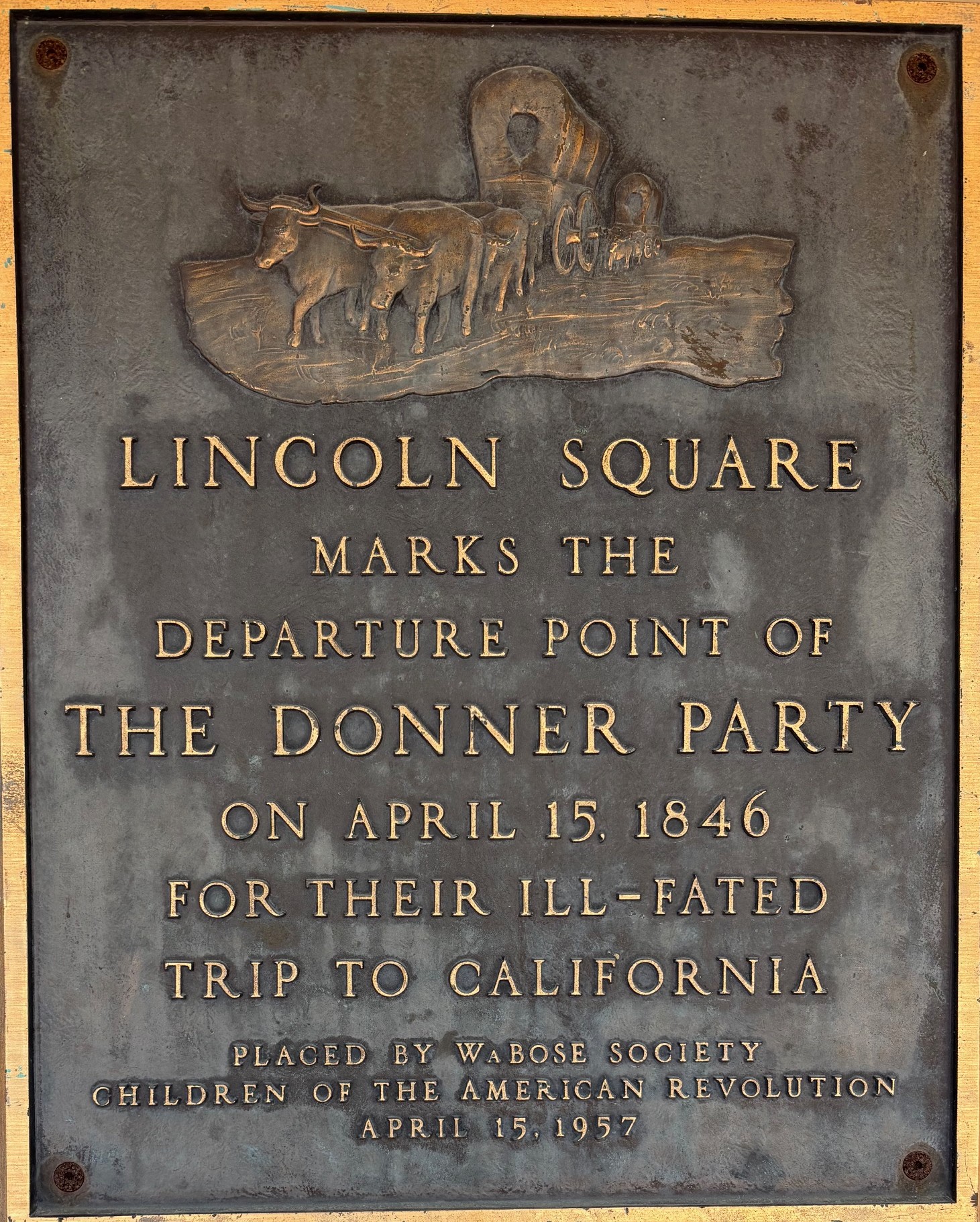
Plaque on South Old Capitol Plaza, Springfield (Sangamon County Historical Society)
Never can I forget the morning when we bade farewell to kindred and friends. The Donners were there, having driven in the evening before with their families, so that we might get an early start. Grandma Keyes was carried out of the house and placed in the wagon on a large feather bed, propped up with pillows. Her sons implored her to remain and end her days with them, but she could not be separated from her only daughter. We were surrounded by loved ones, and there stood all my little schoolmates who had come to kiss me good-by. My father with tears in his eyes tried to smile as one friend after another grasped his hand in a last farewell. Mama was overcome with grief. At last the drivers cracked their whips, the oxen moved slowly forward and the long journey had begun. … Many friends camped with us the first night out and my uncles traveled on for several days before bidding us a final farewell. It seemed to be strange to be riding in ox-teams, and we children were afraid of the oxen, thinking they could go wherever they pleased as they had no bridles.
While the expedition has become known as the Donner Party, it’s more accurate to describe it as the Donner-Reed Party, reflecting the fact that its primary leaders were George Donner Jr. and James Reed. Here is a look at those who left Sangamon County with the Donner and Reed families.
The Donners
George Donner Sr. (1752-1844), the father of George Jr. (1784-1847) and Jacob (1790-1846), was a Revolutionary War veteran from North Carolina. By 1846, moving west was almost routine for his family. George Sr., George Jr., Jacob and another son, Tobias (1788-1853), moved to Kentucky in 1799, emigrated next to Indiana in 1819 and finally arrived in Illinois in 1825.
The Georges and Jacob bought land on German Prairie east of Springfield, while Tobias landed in Menard County. George Sr. died in 1844 and is buried at Oak Hill Cemetery near Clear Lake.
George Jr. and Jacob, however, still had a touch of wanderlust. In fact, in 1838, George, Jacob and their families moved to Texas. But the soil wasn’t good, and the climate worse. They were back in German Prairie less than a year later.
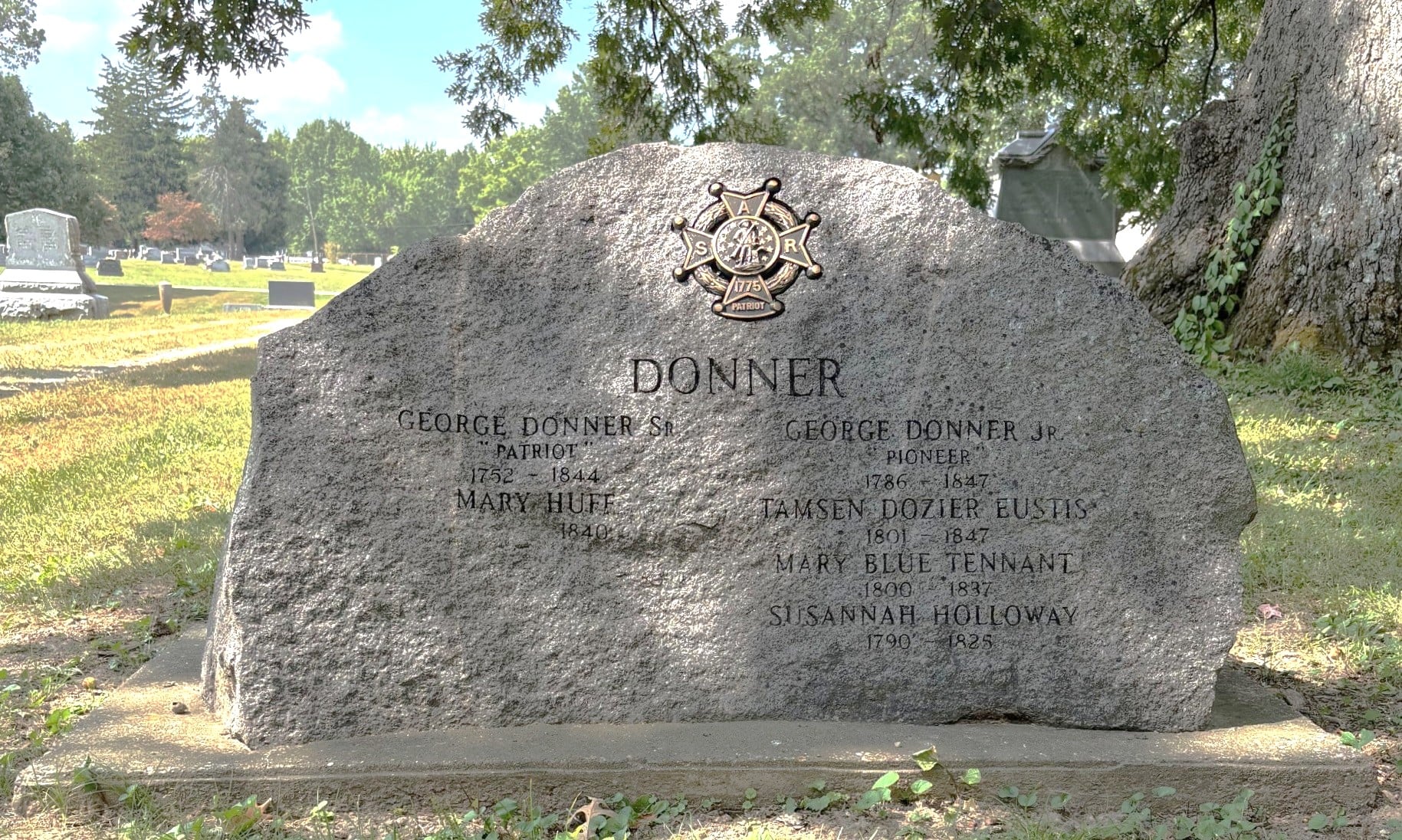
Cenotaph memorializing the Donner family, Oak Hill Cemetery east of Springfield (SCHS)
George Jr. already had buried two wives by that time. He married his third one shortly after returning from Texas. She was Tamsen, or Tamzene, Eustis Dozier Donner (1801-47), born in Massachusetts, the daughter of another revolutionary veteran. Tamsen was a widow when she moved to Illinois in 1836. She lived with her brother and taught school near Auburn.
According to Donner family lore, George Jr. was going to visit his sisters on Sugar Creek when he saw Tamsen, with her students, standing in a meadow of grass and flowers. It apparently was love at first sight. They were married on May 24, 1839.
“I find my husband a kind friend,” Tamsen wrote in a letter in 1840. “I have as fair prospect for a pleasant old age as anyone.
“His rovings,” she added, “are over. He finds no place so much to his mind as this.”
George and Tamsen Donner’s wagon group included their five daughters, two of them older girls from George’s second marriage and three of their own. Some of George’s older children stayed in Illinois.
George’s younger brother Jacob and his wife Betsy (1807-47) brought with them two sons from Betsy’s first marriage, plus their own four sons and a daughter.
The Donner families had six covered wagons, three per family, each of which was pulled by two or three yokes of oxen – a yoke was two oxen harnessed side by side. The party also included horses, mules, and both beef and dairy cattle. So when they left Springfield, the Donner group also included four teamsters – young men who presumably also wanted to emigrate – to help corral all those animals. LIST
The Reeds
Emigration was also in the blood of James Frazier Reed (1800-74). He was born in Ireland in 1800, but his family actually hailed from Poland, where their last name probably was Reednoski. Reed’s father died when he was young, and his mother brought the family to Philadelphia and then Virginia. As a young man, Reed moved first to Galena, Illinois, and then arrived in Sangamon County in 1831.
When the Black Hawk War broke out a year later, Reed joined the local militia. He saw no combat, but he and Abraham Lincoln served in the same company of scouts for about a month in 1832.
Michael Wallis, who wrote The Best Land Under Heaven: the Donner Party in the Age of Manifest Dynasty, one of the better recent books about the tragedy, characterized Reed as “a natural born entrepreneur.” Reed farmed, operated a general store, founded a starch factory at German Prairie, and built a lumber mill on the Sangamon River. The small town that grew up around the mill was named Jamestown after him, although people mainly called it “Jimtown.” (The name today is Riverton.)
Reed won a contract to produce ties for Illinois’ first railroad, the Northern Cross, which ran from Springfield to Beardstown. When the railroad failed, however, so did Reed’s mill. That may have been the catalyst that persuaded Reed to look westward for his family’s future.
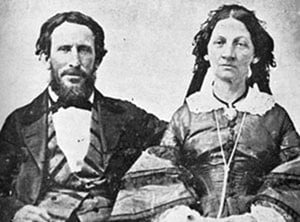
James and Margret Reed (Wikipedia)
In 1833, Reed became engaged to Elizabeth Keyes, the sister of a friend. Elizabeth died of cholera, however, and Reed then courted her older sister, Margret Keyes Backenstoe (1814-61), whose husband had also died in the cholera epidemic. Margret herself was ill when they married – in fact, the ceremony took place with the bride lying in bed and the groom standing beside her holding her hand.
The Reed family consisted of James, Margret, Margret’s daughter Virginia (1833-1921) and three younger children, plus Sarah Keyes (1776-1846), Margret’s mother. Five employees – a cook and four more teamsters – accompanied the Reeds. Like the Donner families, James Reed had three wagons of his own and dozens more oxen.
The Expedition
Eliza Donner (1843-1922), George and Tamsen’s youngest daughter, wrote about her family’s livestock many years later: “The oxen were hardy, well trained and rapid walkers. Three extra yoke were provided for emergencies. Cows were selected to furnish milk along the way. A few young beef cattle, five saddle horses and a good watchdog completed the list of livestock.”
The wagons were primarily for cargo. But James Reed did fit up one of his wagons more elaborately, partly to carry his invalid mother-in-law. He installed projecting planks on the side to create a sort of second level and added a side entry door, an iron cookstove, and bunks on the upper level. Some friends even installed a mirror opposite the door. When the wagon was abandoned in the Salt Lake desert, Virginia Reed wrote, “the glass was still unbroken.” She called that wagon the “Pioneer Palace car.”
Tamsen Donner wrote at least two letters while on the trail. The first was sent to her sister from Independence, Mo., the standard jumping-off point for western travelers.
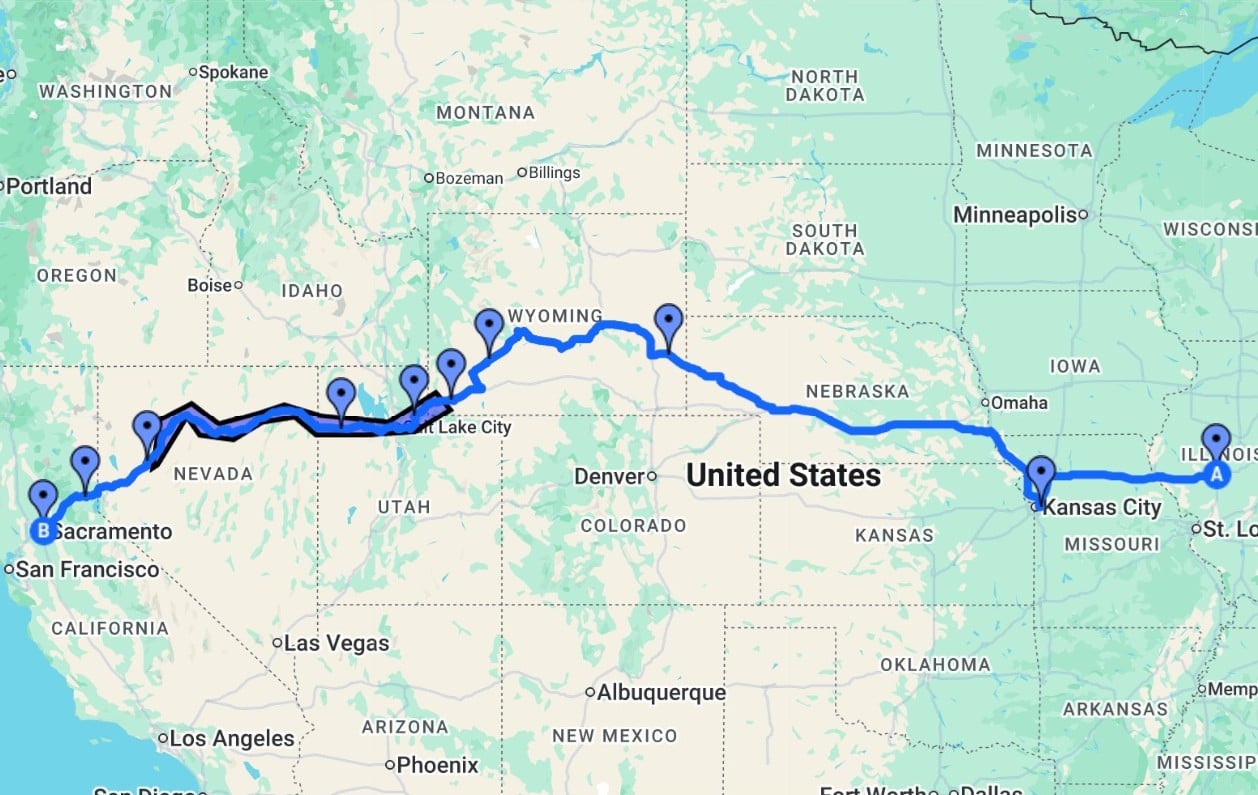
The Donner-Reed route from Springfield to California; Independence, Mo., is the second point after Springfield. The shaded area generally marks the Hastings Cutoff. The second-to-last point is the approximate location of the “camp of death.” (Google/Last Podcast on the Left)
“It is supposed there will be 7,000 wagons starting from this place this season,” she wrote. “We go to California, to the bay of Francisco. It is a four months trip. We have three wagons furnished with food and clothing etc., drawn by three yoke of oxen each. I am willing to go and have no doubt it will be an advantage to our children and to us.”
By June 16, the pioneers had reached the junction of the North and South Platte rivers, 450 miles from Independence. Tamsen wrote another letter then to a friend back in Springfield; the Illinois State Journal published it a month later.
Our journey so far has been pleasant, the roads have been good, and food plentiful. Wood is now very scarce, but buffalo chips are excellent; they kindle quickly and retain heat surprisingly. We had this morning buffalo steaks broiled upon them that had the same flavor they would have had upon hickory coals.
Indeed, if I do not experience something far worse than I have yet done, I shall say the trouble is all in getting started.
The “something far worse” started with George Donner and James Reed’s decision to leave the main California trail. Instead, they famously followed the Hastings Cutoff, which an adventurer named Lansford Hastings had claimed was a shorter, faster route.
“The new road is said to be a saving of 350 or 400 miles and a better route,” James Reed wrote on July 31, at the start of the cutoff. “It is estimated that 700 miles will take us to Capt. Sutter’s fort, which we hope to make in seven weeks from this day.”
Tamsen Donner was skeptical about both Hastings and the so-called cutoff.
Jesse Quinn Thornton, a lawyer who traveled with the Donners before making the turn to Oregon, wrote later:
The Californians were generally much elated and in fine spirits with the prospect of a better and nearer road to the country of their destination.
Mrs. George Donner, however, was an exception. She was gloomy, sad, and dispirited, because her husband and others could think for a moment of leaving the old road and confide in the statement of a man (Hastings) of whom they knew nothing, but who was probably some selfish adventurer.
About 40 other emigrants joined the Reeds and Donners on the cutoff. It turned out that Tamsen was right in her doubts. The Hastings Cutoff was no shorter than the regular route, had long stretches without water, and was definitely more difficult to travel.
“Some days,” Michael Wallis wrote, “the wagons sat still while the men hacked their way through aspen groves and ravines covered with dense brush. Large trees had to be felled and dragged off and boulders rolled aside. At times, the loads of debris were so great that it required double- and triple-yoked oxen teams to get the loads up the steep rises. The long hard days took a toll on the emigrants and the animals.”
And they still had to pass through the Great Salt Lake Desert.
“The desert had been represented to us as only 40 miles wide but we found it nearer 80,” Virginia Reed wrote. “We started in the evening, traveled all night and the following day and night – two nights and one day of suffering from thirst and heat by day and piercing cold at night.”
Donner descendant and researcher Donald Donner Springer (1938-2013) put it another way: “It was walk or die.”
The party made it through the desert and back to the California trail, but they lost animals, wagons and more time in the process.
Then, on Oct. 6 near the Humboldt River, James Reed got into a fight with John Snyder, a teamster with one of the other families. When Snyder struck out with a whip, Reed stabbed and killed Snyder.
Reed ended up being banished from the wagon train. He and one of the Donner teamsters, with just one horse and one rifle between them, decided to go ahead to California for more supplies.
The other upshot of the fight was that the Donner-Reed Party lost three active, able-bodied men just before they entered the mountains.
Three weeks later, as the rest of the emigrants approached today’s Donner Lake, George Donner’s wagon broke an axle. Donner had to trim a tree trunk to make a new one and, in the process, cut his hand. He didn’t think much of the accident – he wrapped the hand in cloth and joked about the injury – but it would prove fatal.
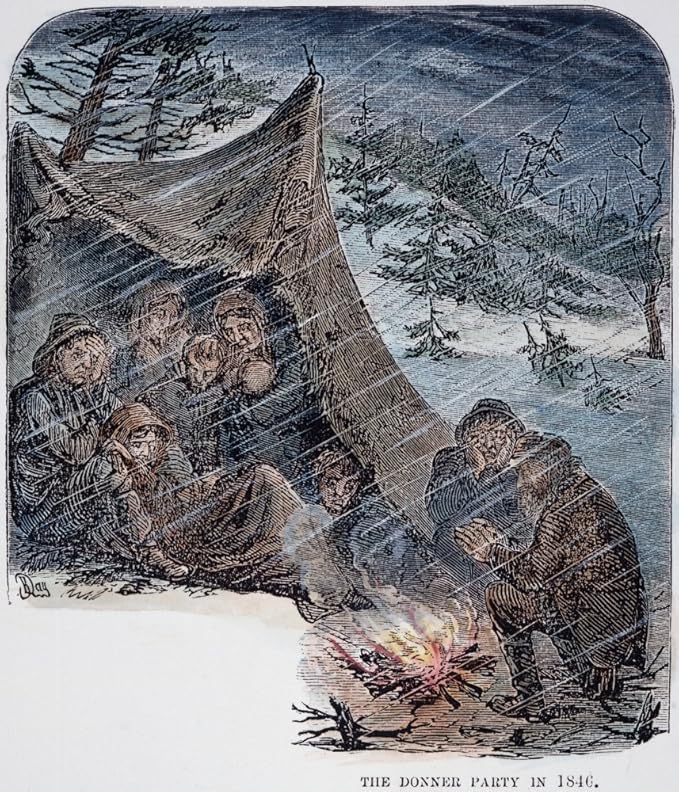
Donner Party emigrants huddled in a tent near snowy Donner Pass (19th-century poster print)
The Donner Party, strung out on the trail, straggled up to Truckee Lake – today’s Donner Lake – in late October and early November. When they arrived, the pass, now Donner Pass, was already covered in three feet of snow. The travelers knew they were in trouble, so they abandoned their last wagons and tried to cross the pass with only what they could carry on their backs.
“We camped within three miles of the summit,” Virginia Reed wrote later. “That night came the dreaded snow. We children slept soundly on our cold bed of snow. Every few moments my mother would have to shake the shawl – our only covering – to keep us from being buried alive.
“In the morning, the snow lay deep on mountain and valley. With heavy hearts, we turned back.”
The emigrants settled in for the winter in two groups. Most of the party, 60 people including the Reeds, huddled in three makeshift shelters just short of Donner Pass. The Reeds lived with others in a shack made of poles propped against a tree and covered in pine branches, wagon canvas, and buffalo robes.
The other 20-some emigrants – basically, the two Donner families and their teamsters – erected similar shelters six miles back.
Don Springer summarized the tragedy in a 2010 pamphlet published by the Sangamon County Historical Society:
“But for lack of another single day, this story would not be a story,” he wrote. “What followed for the Donner Party was a winter of entrapment that is now legendary. Accumulations of snow 22 feet deep, freezing cold, no food. Life was sustained by chewing books, shoes, hides and belts. No family had it any better than another. They all suffered and shared.”
And, of course, as the trapped pioneers suffered, some of them resorted to carving up and eating the bodies of those who had died earlier.
Eventually, four relief teams struggled one by one through the snowdrifts to the Donner Party, bringing supplies – but never enough – to the camps. When they set out to return to Sutter’s Fort, the rescue groups also traveled on short rations, since they left all the food they could with the snowed-in pioneers. As a result, each time, the relief parties were able to take out only a few of the trapped emigrants.
Women and children were the first to be rescued, although Tamsen Donner refused to leave her husband, whose injured hand had turned gangrenous. George Donner was beyond hope, but Tamsen wouldn’t let him die alone.
Years later, their daughter Eliza, age 3 when the Third Relief carried her out of the camp, remembered the last sight of her mother.
“We listened to the sound of her voice, felt her good-bye kisses, and watched her hasten away to Father, over the snow, through the pines and out of sight. We knew we must not follow.”
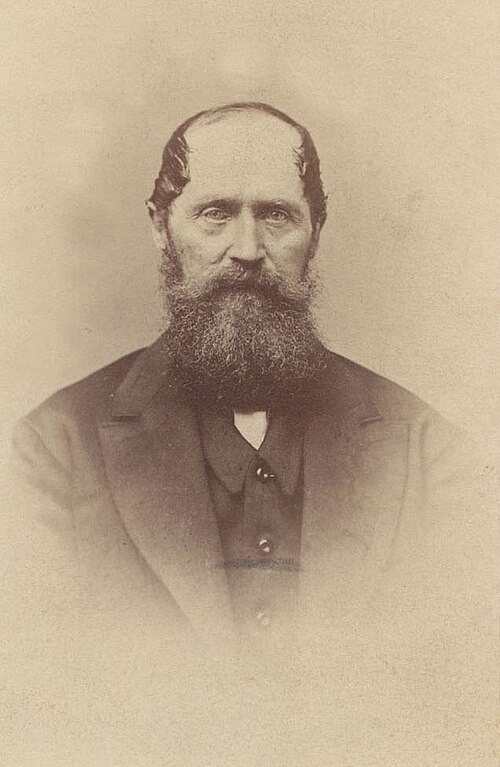
Lewis Keseberg (Wikipedia)
Only one person, Lewis Keseberg (1814-95), a German immigrant from Cincinnati, was left alive when the Fourth Relief arrived in April 1847. He told his rescuers about the last hours of Tamsen Donner. From Michael Wallis’s Best Land Under Heaven:
He told them straight out that he had survived by eating the meat of the dead. Then they demanded to know what had happened to Tamsen Donner. He looked up at their angry faces and told them what they already knew – she was dead. Keseberg told them about her final days, when they were the only two survivors left.
One night, Tamsen – soaking wet and cold – came to the cabin and told Keseberg about the deaths of her nephew Sammie and her beloved George. He recalled that she could not stop crying. She spoke of her daughters and how she longed to see them.
Keseberg said he had tried to keep her calm. He wrapped her in a blanket and put her to bed. He told her to sleep. In the morning, he checked on her and found that she was dead.
Tamsen had wanted to see her children and her grandchildren not yet born. She had wanted to cross to the other side of the mountains. She had wanted to open her school and walk through fields of flowers and smell the sea.
Instead, she died in an icy hovel, and her dreams died with her.
Of 87 people who entered the pass, only 48 lived to see Sutter’s Fort.
Sangamon County emigrants and their fates
(Deaths on the trail in bold. Ages as of death or end of 1846; complete birth dates are not available in all cases.)
Donner families and employees
George Jr., 63, and Tamsen Donner, 46
Daughters of George and previous wife Mary Blue Donner (1800-37): Elitha, 14; Leanna, 12
Daughters of George and Tamsen: Frances, 6; Georgia, 5; Eliza, 3
Jacob, 56, and Elizabeth “Betsy” Donner, 39-40
Sons of Betsy Donner from previous marriage: Solomon Hook, 15; William Hook, 12-13
Children of Jacob and Betsy: George, 10; Mary, 7-8; Isaac, 5-6; Lewis, 3-4; Samuel, 1-2
Teamsters: John Denton, 28; Noah James, 20 about 16; Hiram Miller, 29; Samuel Shoemaker, 25
Reed family and employees
James, 46, and Margret Reed, 42
(Margret’s mother Sarah Keyes, 75, died on the trail in Kansas.)
Children: Virginia, 13; Patty, 8; James Jr., 5; Thomas, 3
Employees: Milt Elliott, 28, Walter Herron, 25, James Smith, 25, and Baylis Williams, 24-25, teamsters; Eliza Williams, 22-23, cook
‘Never take no cutoffs’
Virginia Reed deserves the last word on the Donner Party. This is from a letter she wrote to a cousin back in Sangamon County in May 1847, more than a year after the nine wagons left Springfield. The grammar is Virginia’s.
I have not wrote to you half the trouble we have had, but I have wrote enough to let you know that you don’t know what trouble is. But thank God we have all got through and the only family that did not eat human flesh.
We have left everything, but I don’t care for that. We have got through with our lives.
But don’t let this letter dishearten anybody.
Never take no cutoffs and hurry along as fast as you can.
The site of the tragedy now is part of Donner Memorial State Park near Truckee, California. The park contains the Emigrant Trail Museum, and the Donner Camp Site is a National Historic Landmark (the 1978 nomination form includes an informative, though melodramatic, summary of the Donner-Reed party’s experience).
Notes
- Findagrave.com is misleading when it comes to photos of George and Tamsen Donner. As of this writing (October 2025), Findagrave’s photo of George Donner Jr. is NOT that of the co-leader of the Donner Party; it’s his nephew George Jacob Donner. George Jacob did survive being stranded in the mountains, but he was only 10 years old at the time. (Just to add to the confusion, Findagrave and other sources incorrectly give the younger man’s full name as George Jacob Donner Jr.). Similarly, the photo that accompanies Findagrave’s entry for Tamsen Donner is actually that of her daughter Frances, who was 6 years old during the tragedy. Frances supposedly resembled her mother later in life.
There are no legitimate photos of either Tamsen or George Donner Jr. - We also don’t know the exact date the Donners and Reeds embarked on their trip. The Old Capitol Plaza plaque, originally installed in 1957 by the Children of the American Revolution on the then-Sangamon County Courthouse, says the emigrants left Springfield on April 15, 1846. However, Donner descendant Don Springer believed the correct date was April 14. Other sources say the wagons pulled out of town on April 16.
- Whenever it was, the Illinois State Journal reported the departure in a single paragraph in its edition of April 23, 1846.
“The company which left here last week for California embraced 15 men, 8 women and 16 children. They had nine wagons. They were in good spirits, and we trust will safely reach their anticipated home.” The newspaper’s total of 39 pioneers also is wrong. According to Virginia Reed, the Donner-Reed party counted 31 people when it left Springfield, although the number of teamsters varied over the next six months (there are 32 names in the list above). The Journal’s count probably included relatives and friends who traveled a short way with the emigrants as an extended goodbye, then returned home. Ultimately, 18 of the Sangamon County pioneers survived the journey.
Update note: This entry was significantly expanded in October 2025. This version is based on a presentation made by SangamonLink editor Mike Kienzler to the Capt. William Penny Chapter of the Daughters of the American Revolution on Oct. 4, 2025.
More information
Also on SangamonLink: “Patty Reed’s doll.”
Literature on the Donner Party is extensive. Aside from sources cited above, the University of New Mexico has a good summary of the tragedy, along with a demographic analysis of Donner Party deaths. For the 150th anniversary of the Donner-Reed trek, Daniel Rosen created a daily diary of the Donner Party’s travels for the entire period from April 1846 to April 1847.
Two popular book accounts are Ordeal by Hunger: The Story of the Donner Party by George Stewart (first edition 1936, updated in 1960) and Desperate Passage by Ethan Rarick (2008), which reports on recently uncovered evidence and adds context to the basic horror story. Michael Wallis’s The Best Land Under Heaven: The Donner Party in the Age of Manifest Destiny (2017) posits that Abraham Lincoln may have been tempted to join the Donners on their trek west.
 Documentarian Ric Burns produced a 90-minute film on the Donner Party for PBS’s American Experience in 1992.
Original content copyright Sangamon County Historical Society. You are free to republish this content as long as credit is given to the Society. Learn how to support the Society.
Hi, my name is Chloe Kerrigan. My partner and I are doing a National History Day project over the Donner Party, and we were wondering if you would be interested in answering a few questions for us. There will be no more than five or six questions. If you’re interested, please email me back. Thank you for your time.
Chloe Kerrigan and Scout Rigsby
Chloe/Scout: I’ll answer by email too, but I have to say I’m not an expert on the Donner Party. Bill Springer of Metairie, La., curator of the Donner-Springer Family Collection, would be a much better bet for you. I’ll send you his contact information separately. Thanks for asking.
Approximately 30 years ago I came into possession of 4 chairs from a woman who lived in a house built in early to 1800’s located in Loomis, CA, about 25 miles north east of Sacramento. She told me they were the only surviving pieces of furniture from the Donner Party. Of course I have no knowledge if this is true but have no reason to doubt her as they were a gift and she wanted them protected (another story in itself). Do you know if there was actually any furniture that survived?
Ms. Burris: I guess it’s possible, but I think very unlikely, that any furniture survived from the people who were trapped in the mountains. For starters, they abandoned all but the most vital necessities to lighten their wagons before they got caught in the snow. Even if they kept some furniture all the way to Donner Pass, Michael Wallis’ recent book, Best Land Under Heaven, notes that wood as well as food was scarce for the trapped groups; it seems likely that any remaining furniture would have been burnt during their struggle for survival.
Certainly, none of the rescue parties brought any furniture out with them; they barely got some of the survivors through. If those are Donner chairs, someone would have had to salvage them later.
Some wagons did split off from the Donners before they were caught in the snow. I suppose it’s possible your friend’s furniture could have come from them, so it would have been tangentially connected. Or maybe someone else scavenged furniture the Donner Party abandoned en route. But in that case, I don’t know how they could have verified the original owners.
It’s a great story, but I’m going to guess it’s apocryphal. Thanks for asking.
Hi. I am a Donner party descendant. George Jacob Donner (son of Jacob and Elizabeth) born in Sangamon County in 1836 (age 11 at rescue) is my great-great-great grandfather. We have a family heirloom that was passed down from him and eventually to my mother. Family history says that is carried from Illinois in the wagon train. It is a sterling silver condiment stand/server. Any advice on researching this?
Thanks!
Caryl
Caryl: That sounds like a tough job. The Donners didn’t have much left by the time rescuers finally got to them. But you might try contacting Michael Wallis, author of the most recent Donner Party history, The Best Land Under Heaven. He did a LOT of research and might be able to point you in some promising directions. He’s on Facebook; I think you can contact him there. Good luck.
The Indifferent Stars Above by Daniel James Brown is an excellent nonfiction narrative resource, as well. The research is extensive, including personal visits to parts of the trail that were traveled at specific seasons of the year. Highly readable; very interesting.
Are the historical sites marked in the places that the Reeds and Donners lived before they took off? I’m more interested in their lives prior to the journey…I want to know more about them than just the tragic part. I’d also like to find out if any of my relatives might have lived near them or had reason to know them.
There is an historical marker in Oak Hill cemetery off of route 36 between Springfield and Riverton. As soon as you go into the main entrance where the office is located, go slow and look to your left. It is maybe 75 feet or so from road.
When growing up in the area, we were given literature known as, ” Lincoln Trails” at school. It highlighted many historical facts of that area. I do remember it well. We were always told the Donner Party from this area started there. Nice they put a memorial as remembrance.
Thanks for pointing this out. Many of the local Donners are buried at Oak Hill.