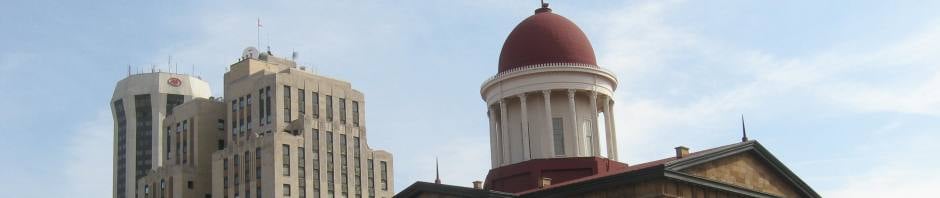
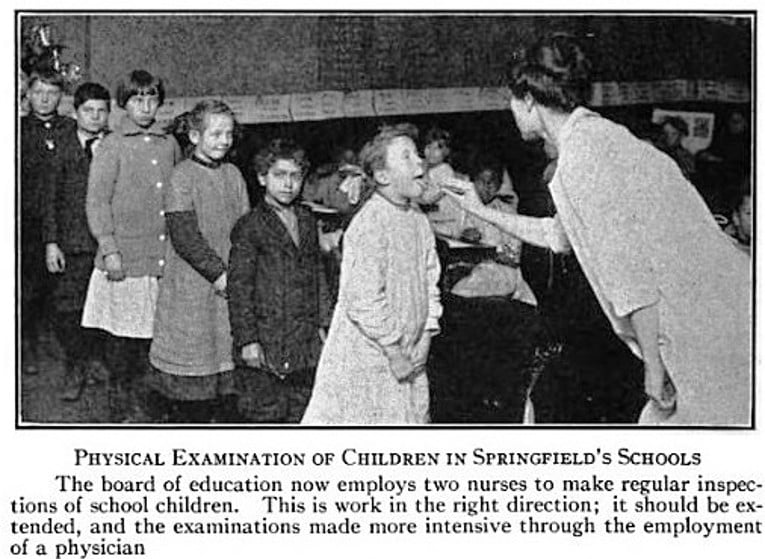
One of about 150 photos from the Springfield Survey, 1914. The photographer is unidentified, but see below.
The Springfield Survey of 1914 was a massive study of local schools, prisons, and other institutions, and it’s still well-known in the fields of sociology and social work. But, partly because it was so ambitious, nothing similar was ever attempted elsewhere.
Why was the Springfield Survey so groundbreaking? For one thing, the field of sociology was still new in the early 1900s, and its methods were still developing. A charitable foundation, the Russell Sage Foundation, became the leading advocate for a technique called “the social survey,” which tried to both investigate social problems and propose solutions to them.
The Springfield Survey was only partially successful in both those efforts. Today, however, its value is in the look it gives us at almost every facet of the community more than a century ago – especially the lives of people who don’t usually make it into the history books: common laborers, schoolchildren, petty criminals, and the poor, mentally ill and feeble.

Russell Sage (Wikipedia)

Olivia Sage (Wikipedia)
Russell Sage, the foundation’s namesake, was a financier and investor in New York. He also had a reputation – possibly undeserved – as a skinflint and miser. When he died in New York in 1906, however, he left $63 million to his second wife, Olivia, and she spent much of that inheritance on charities and good works. When she established the Russell Sage Foundation with a $10 million gift in 1907, it was, at the time, the largest single act of philanthropy in history.
Most of the Sage Foundation’s social surveys were small scale, looking at specific problems and specific populations in individual communities. The most notable exception before Springfield took place in Pittsburgh, where the Sage Foundation funded a study of industrial problems and working conditions in American steel country.
Pittsburgh was a bigger city than Springfield, of course. Otherwise, however, the Springfield Survey was far more ambitious in terms of the issues it tried to study.
The Springfield Survey was initiated by a group of citizens who were dissatisfied by social conditions in the city. As it had done elsewhere, the Sage Foundation provided expertise to underpin the work of local volunteers.
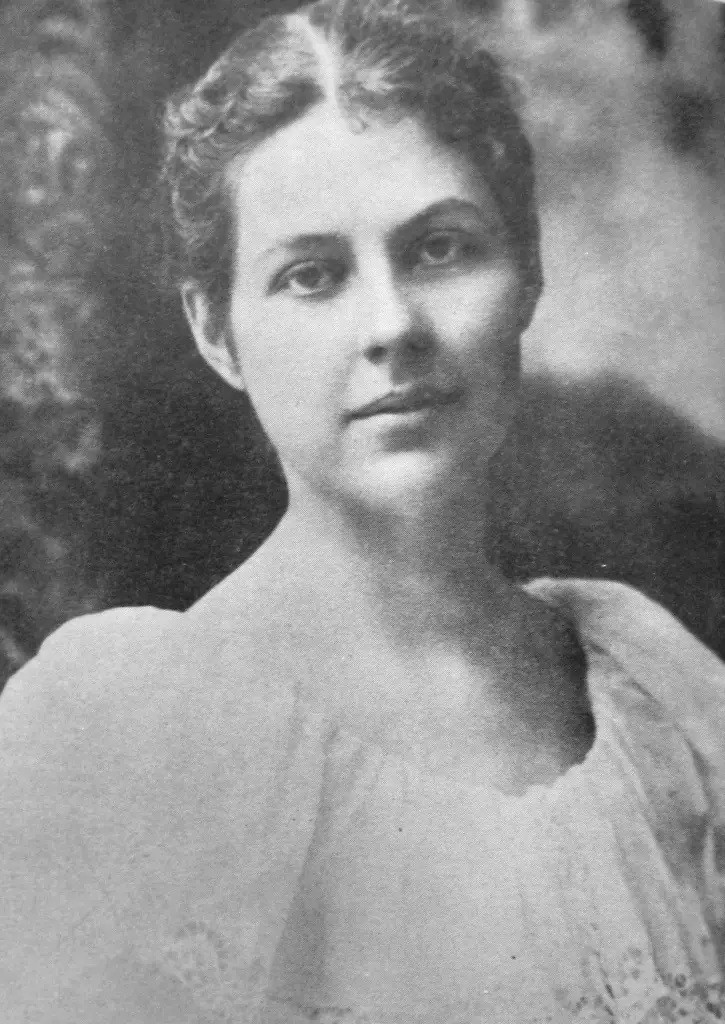
Elizabeth Brown Ide (undated)
About 120 of those volunteers — nearly all of them women, led by a society-matron-turned-social-worker named Elizabeth Brown Ide — collected data, a process that lasted from March through early July 1914. Another 600 people helped present the survey results in an exhibition held that fall at the Illinois State Arsenal.
Survey results were reported in nine pamphlets, one for each of the study topics: schools, care of “mental defectives, the insane and alcoholics,” recreation, housing, charities, industrial conditions, public health, the correctional system, and city and county administration.
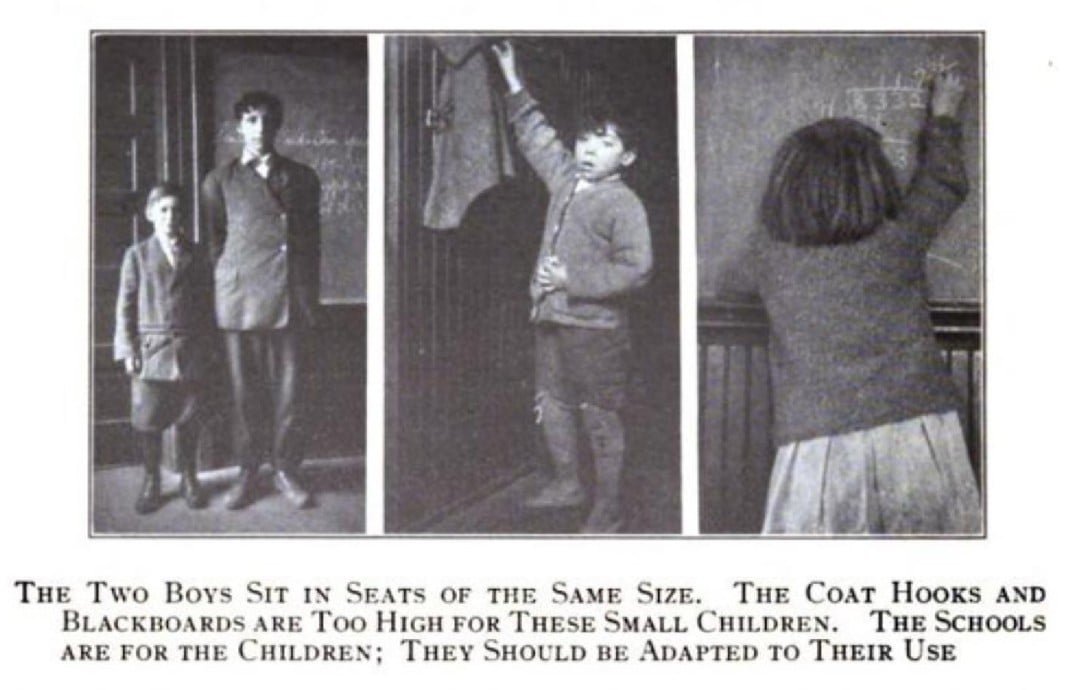
Not surprisingly, the survey found defects in many areas (the park system was a notable exception). Some problems were simple to deal with – for example, chalkboards in school classrooms were almost always placed too high on the walls, convenient for teachers but not for students. Others were more complicated. Some Survey recommendations went unaddressed. And Springfield’s racial divide was simply ignored.

Dr. George Palmer examines a man for tuberculosis (this and similar photos in this entry, including captions, come from Springfield Survey reports)
The Springfield Survey got its start from a smaller study. In 1910, the city health superintendent, Dr. George Palmer, did a survey of his own. In order to get a handle on a local epidemic of typhoid fever, Palmer mapped all 8,000 homes in Springfield, identifying every privy, well, water main and sewer. Typhoid spreads because of poor sanitation, and Palmer found that many of the wells where Springfieldians got their drinking water were contaminated by leakage from nearby outhouses.
The Sage Foundation had wanted to undertake one of its surveys in a middle-sized city anyway – Springfield had a population of about 58,000 at the time. So when Palmer brought his typhoid survey to the foundation’s attention, Springfield was suddenly on the leading edge of social research.
In 1920, Palmer summarized some of the conditions that prompted the Survey.
A few years ago … most of the citizens went calmly on with the assumption that the local conditions were quite as good as they need be … A cigarmaker held the job of health officer; saloons operated on Sunday in violation of the state law but with the sanction of the city officials; a red light district stretched along the streets traversed by the incoming passenger trains of four railway lines, the houses so boldly labeled that there could be no doubt as to their character. Shallow wells and privy vaults were unrestricted. … (T)yphoid fever prevailed to an inexcusable extent, and a shabby pest house opened its inhospitable doors to those sick with communicable diseases – a pest house perched on a hill with the open town branch sewer on one side and Oak Ridge cemetery on the other, with nearby slaughter houses and rendering works making their presence known to the afflicted.
Data collection started in March 1914 and was finished by early July, despite the fact that, In many areas, the volunteers had to start from scratch.
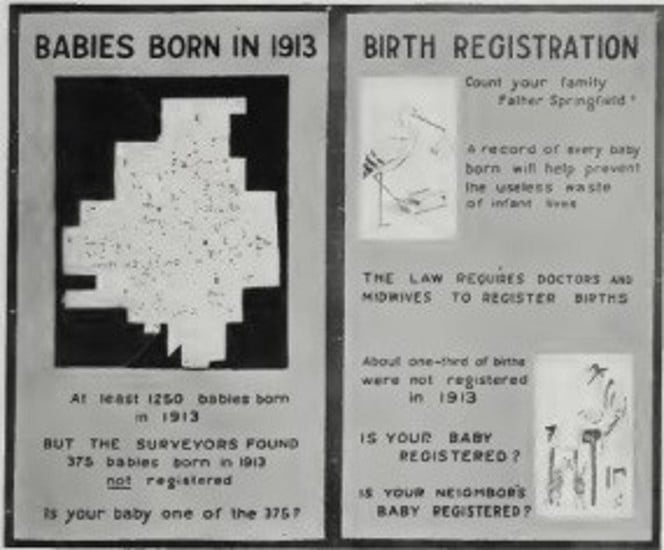 For instance, Elizabeth Brown Ide remembered years later that her assistants needed to improvise even to determine how many babies were being born in Springfield.
“Because there were no county statistics at that time, a volunteer went to one of the Catholic priests,” she said. “He let us take the (baptismal) certificates that were for the Catholic church. That was the only way we could get any figures on the birth rate.”
For the education portion of the Survey, volunteers visited every classroom in the Springfield Public Schools and tried to observe all 224 teachers at least once. Similarly, volunteers took firsthand looks at the city’s parks, jails, charitable facilities and other institutions — even vaudeville theaters and houses of prostitution.
To study working conditions, the volunteers interviewed a more-or-less-random group of 100 laboring families. They found that most families had two or three breadwinners — 70 percent of children aged 14 to 16 had jobs, if only as newspaper carriers — but nearly half of those employed were out of work for part of every year.
“One really needs to go into the homes of these workers to understand what this means,” the industrial survey report said. “In one family visited, the father, a miner, had not had a day of work for two months, and the mother had been forced to take in washing and go out cleaning to provide the necessities of life.”
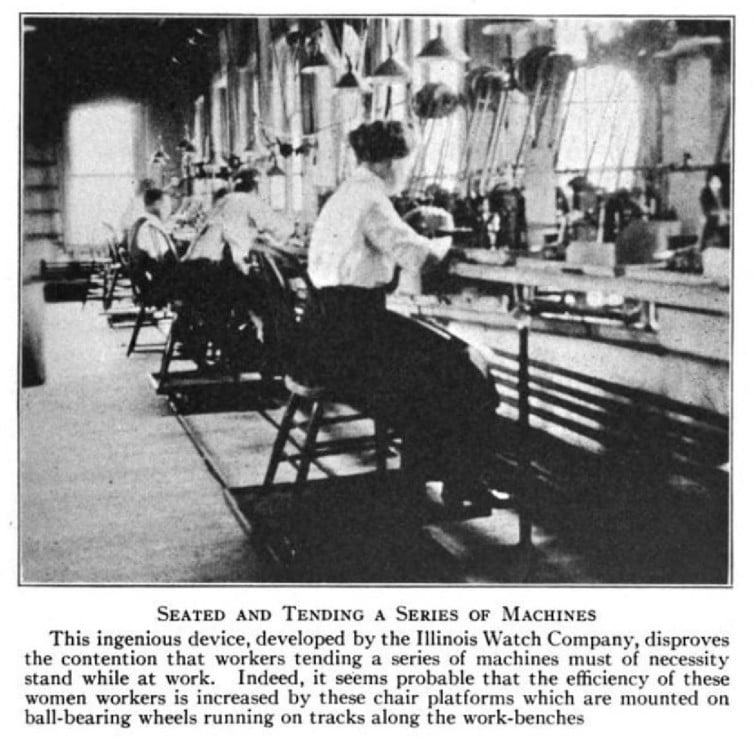 When someone did have a job, long hours were standard, especially in non-unionized occupations, a category that applied to nearly all women and young workers. The 400 women employed at the International Shoe Factory worked 10 hours a day, five days a week — and nine more on Saturday.
At one bootblack stand, the Survey reported, the employees, who were 17 to 20 years old, had a seven-day, 90-hour-a-week work schedule.
Even working long hours, though, only one-fifth of adult wage earners in the sample earned as much as $20 a week. Hard-pressed families got by through renting out rooms, even though overcrowding was nearly always the result.
“One family with seven members of its own, for instance, and living in three rooms, took in lodgers,” the Survey reported.
 With or without boarders, workers’ homes had few amenities. “Most of the houses … were four- or five-room frame structures without gas, electricity, city water or inside toilets,” the report said. “For water, the home was dependent upon wells or cisterns in the back yard, where privies were also located.”
The Survey was even less enamored of apartment houses.
The people who live in (an apartment house) certainly cannot have the feeling for it that those who live in the cottage have for their home. They are too far from the ground ever to strike roots down into the soil. … To them the dwelling becomes more and more a mere temporary shelter. Their real life is lived outside, and for them the word ‘home’ loses much of its significance. – Springfield Survey housing report, under the heading “Menace of the multiple dwelling”.
The Durvey’s criminal justice report suggests that volunteers had at least very closely observed Springfield’s semi-official red-light district, which ran primarily along Jefferson and Washington streets from Sixth to Ninth streets. According to the Survey’s tally, the area included 33 recognized houses of prostitution containing a total of 143 white women, plus “a considerable number of Negro houses with something like 60 inmates.”
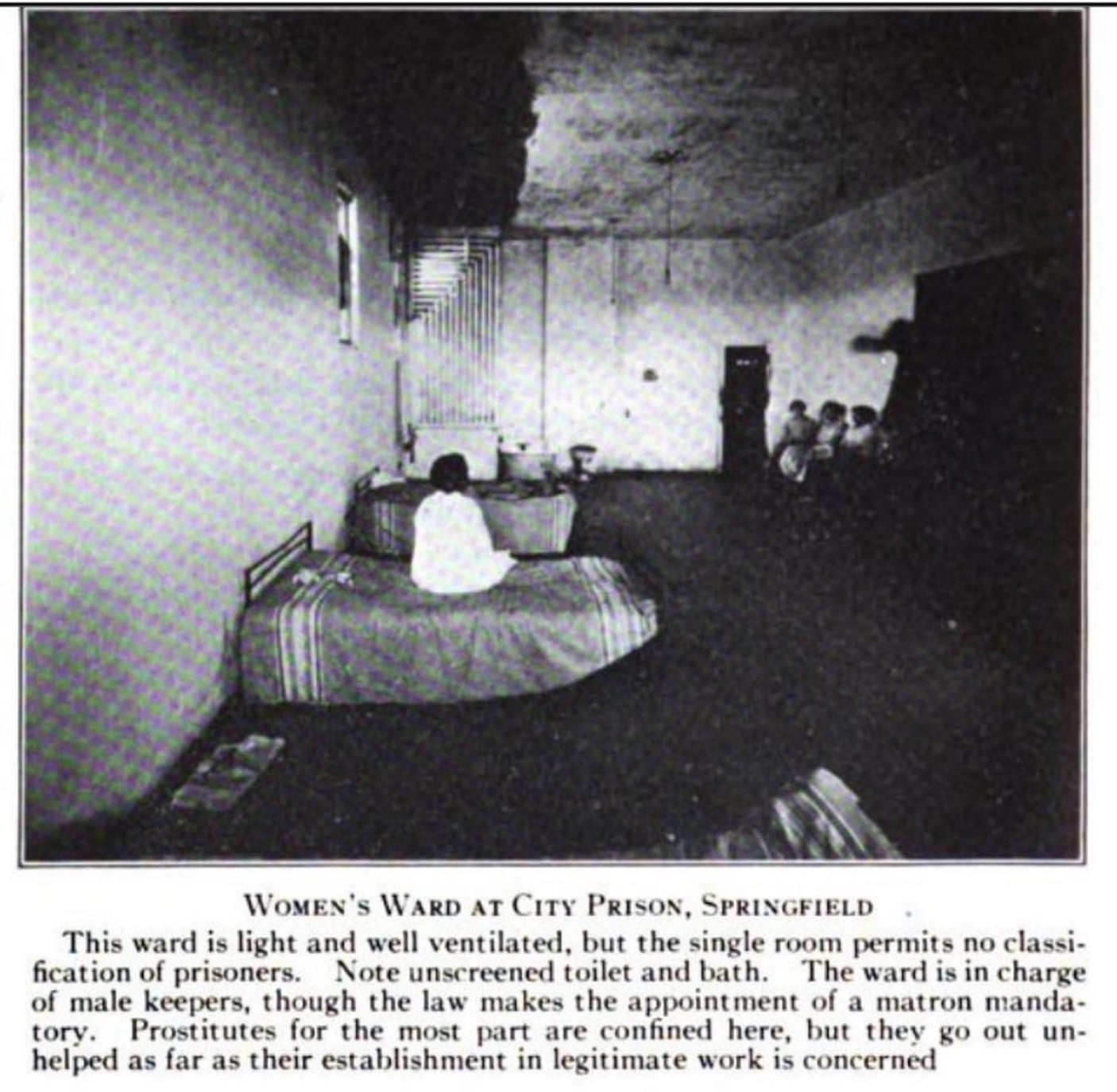 “At the time this investigation was begun, the district was indicated by red lights, house names painted on the doors and women soliciting from windows,” the survey reported.
Authorities tolerated the open vice, but there were limits. “There are some favorable features in the Springfield situation,” the report said. “Inmates of the houses may not leave the district or be on the street after 7 p.m., according to a police ruling that is quite strictly adhered to.”
The Survey even included a rate schedule. Most bordellos charged $1 to $2 per patron, although, quote, “there were three three-dollar to five-dollar houses.” Even at those prices, surveyors calculated that income from prostitution in the district amounted to as much as $185,000 a year.
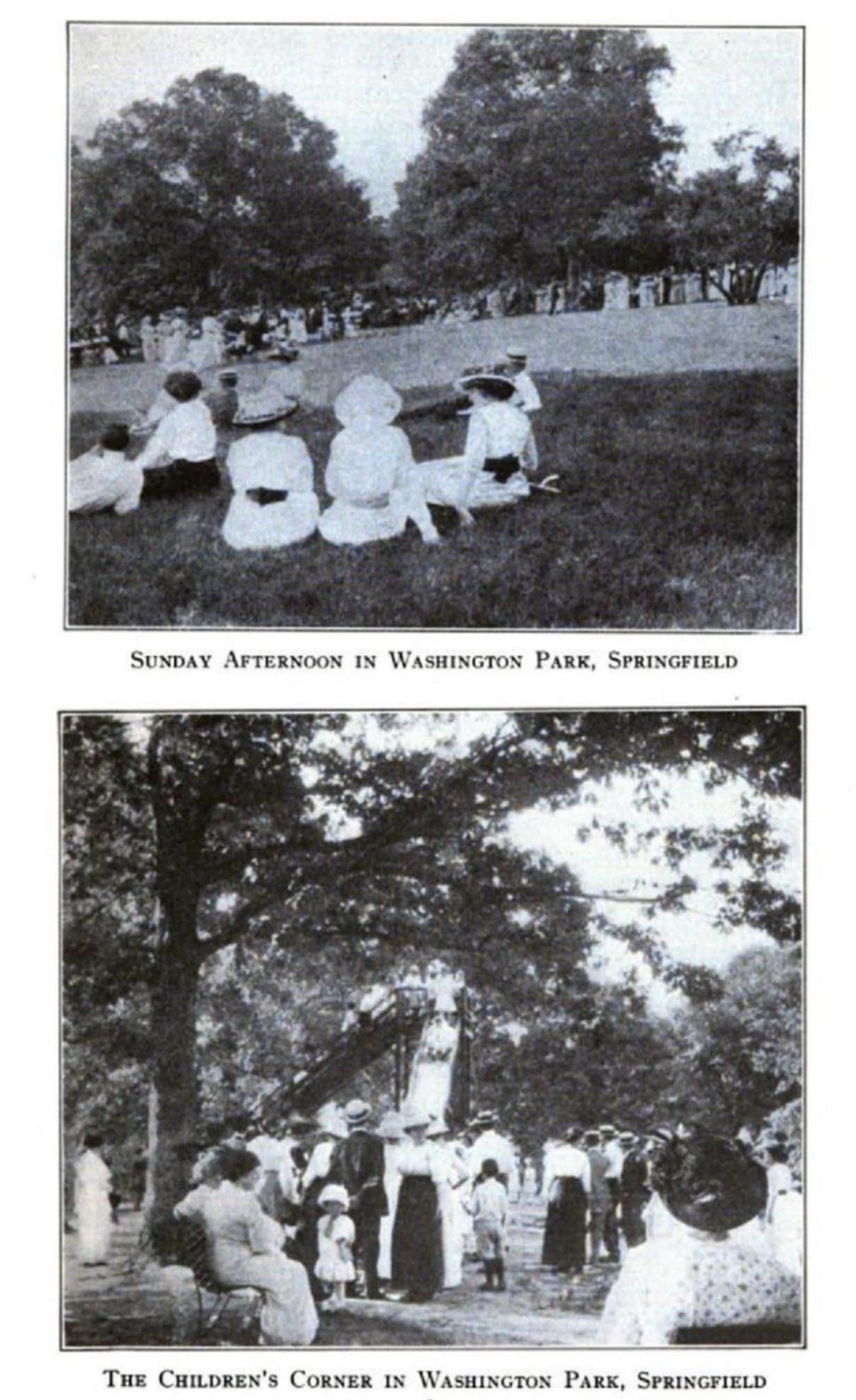 Parks like Washington Park were an exception to the Survey’s generally critical observations. “Few American cities had more beautiful parks or more acres of park space per inhabitant than Springfield,” the recreation report said. But the Survey was snippy about some other forms of entertainment.
In what the Survey called Springfield’s “least pretentious” vaudeville theater, a reviewer wrote:
On the stage a number of performers are giving a series of sketches, songs and dances which but for the headliner that is to come at the end, would not hold any intelligent person ten minutes if he had any other place where he could get in out of the cold. The last number on the program is usually an Oriental dance which often exceeds the utmost limits of propriety and decency.
Two of the Survey’s paid employees even went undercover to infiltrate another entertainment event – a so-called athletic show sponsored by what a local fraternal organization. Its main event was a “battle royal” in which five Black men pummeled each other until only one was left standing; that was followed by a similar fight between two brothers, one 7 years old and the other 9 (they were White).
“At the end of the contest, a shower of nickels, dimes and quarters rained upon the mat in token of the crowd’s appreciation,” the Survey reported. More about the Survey’s expose here.)
The Survey found that treatment of the mentally ill involved little more than confining them, usually in the annex to the Sangamon County Jail.
“Of course, no one can assert that the confinement of a person with mental disease in a jail is ‘treatment’ in any sense of the word,” the Survey said. “The jail annex … is cold, dirty, and a most unsuitable place for the care of any sick persons. It is only ignorance on the part of the public of the simplest facts about mental disease that makes such a practice possible.”
Even when they found a more or less permanent home at the Sangamon County Poor Farm near Buffalo, people with mental problems were locked in basement cells at night. The Survey did give the poor farm a certain amount of credit, though, quote: “Certain standards of cleanliness were required; among them that each inmate must bathe once a week and change his underwear.”
 Over the next several years, the Sage Foundation released individual reports on all nine Survey topics, a pamphlet on its methods, and a 440-page overall summary published in 1920.
The schools in particular took the Survey to heart, probably because School Superintendent Hugh Magill Jr. was a member of the oversight committee. Within a few years, the school board revised the curriculum top-to-bottom, opened four junior high schools, upgraded school lighting, ventilation and sanitation, and allowed buildings to be used as social centers outside class hours. Magill also turned to the Survey to help his push for a bond referendum to build a new Springfield High School, an effort that was successful in June 1915.
In a 1917 magazine article, Shelby Harrison, who headed the Springfield Survey for the Sage Foundation, cited more than 40 steps — in education, parks, corrections, health, charity organization and local government — he said had been taken in response to the Survey. But neither foundation reports nor newspaper accounts give any indication that similar improvements took place in labor conditions or housing.
 And the Survey had one glaring omission: It ignored racism. Survey reports do mention disparities between Blacks and Whites at several points – that proportionately far more African-Americans than Whites suffered from tuberculosis, for instance, and that, “Housing conditions are especially bad in the Negro district.”
But in general, the Survey took racism for granted as an unchangeable fact of life. This is a little surprising, because the Pittsburgh Survey seven years earlier explicitly did deal with Black/White issues in a section titled “100 Negro Steel Workers.”
One possibility is that the community leaders who commissioned the Springfield Survey remained gunshy in 1914 about the city’s reputation following the Springfield Race Riot of 1908 and that they warned the Sage Foundation against any deep exploration of racial discrimination in Springfield.
However, in one or two places, the Survey’s reports also suggest that the foundation’s experts held racist attitudes themselves. When discussing the racial incidence of TB, for instance, Survey leader Shelby Harrison wrote, “The Negro rate is generally explained by the personal habits and insanitary manner of living of the Negro. He presents an acute problem which is accentuated by the possibility of his spreading the disease to persons other than his own race.”
At least two of the local Survey volunteers were African-American women. But the Survey’s ultimate failure when it comes to racial attitudes can be summed up by a single fact: its reports don’t even mention the race riot, even though it had taken place just six years earlier.
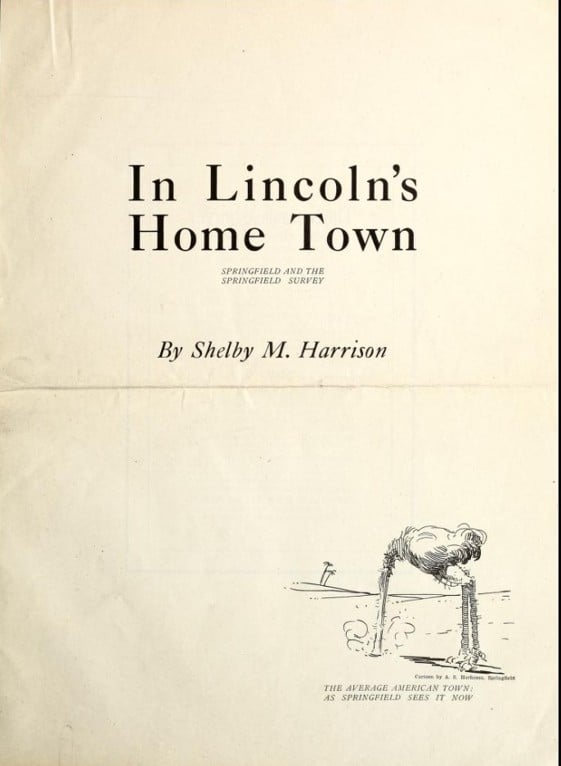
Cover of a Springfield Survey brochure
At the conclusion of the Survey, organizers put on a 10-day public exhibition of the results at the old Illinois State Arsenal. Features included questions-and-answers with “Father Springfield,” a model school playground (with actual students playing), theatrics, even a map showing the locations of billiards parlors (which the Survey called “youth traps in the heart of Springfield”).
The exhibition was publicized by essay contests and newspaper questionnaires, and transportation to the show was free. An estimated 15,000 people attended. (Vachel Lindsay, who apparently took an active role in the exhibition, wrote an account of the event for the December 1914 issue of The Survey magazine.)
The Springfield Survey did contribute to some important local changes. In addition to the school changes, ideas from the Survey resulted in mechanization of the fire department and creation of a free local health dispensary — not to mention new curbs on what the Survey called Springfield’s “large and flourishing red-light district.”
As a sociological technique, the Springfield Survey was a dead end. The Sage Foundation ran into financial reverses in some of its other initiatives, and sociology in general adopted other research approaches. “The Social Survey Movement, which flourished between 1912 and 1930, … (lost) its impetus in the latter 1920s and … virtually disappeared by the mid-1930s,” according to Private Funds, Public Purpose: Philanthropic Foundations in International Perspective,” published in 1999.
For Springfield, however, the Survey had more impact. Palmer, in a commentary published in the summary volume, outlined improvements prompted by the Survey, especially in education, charity involvement, and law enforcement/recreation. (“One of the most notorious of the old-style burlesque theaters, purveying wine, woman and song as it is seldom done in this generation, has modified its methods of operation until it is no longer an open scandal,” he wrote.) He concluded:
No one can measure the influence of the Springfield survey on the people of the community. That will be told in coming years. … But I cannot resist the feeling that the survey performs its greatest good in outlining the course of communities that have already had their first civic awakening; by directing the course into safe channels of those communities so thoroughly aroused that “they don’t know where they’re going, but they’re on their way.”
Who took the photos?
Springfield Survey reports include about 150 photographs, but never identifies the photographer(s). A SangamonLink investigation.
To read Springfield Survey reports: For the history buff, the Springfield Survey provides an extraordinarily revealing look at Springfield in 1914, a depth of information simply not available in most other communities. Here are links to survey materials:
Public health (back page includes lists of volunteers and financial supporters)
In Lincoln’s Home Town: How the Springfield Survey Went About Getting Results
The survey pamphlets also are available in three bound volumes at Lincoln Library’s Sangamon Valley Collection.
See also: March 2, 2014 State Journal-Register article about the 100th anniversary of the survey. The SJR’s coverage included a gallery containing 47 photos and other images from the survey.
Note: This entry, originally published in 2014, was greatly expanded in October 2025. This version is based on a presentation SangamonLink editor Mike Kienzler made to the 2025 Conference on Illinois History, held at the Abraham Lincoln Presidential Library on Oct. 2, 2025.
Original content copyright Sangamon County Historical Society. You are free to republish this content as long as credit is given to the Society. Learn how to support the Society.
Does anyone know if the gentleman who was cleaning up & listing inmates buried at the Poor Farm, has found any more names and where would I find them. Thank you.
Mick: I’m sorry, but I’ve never heard any more about the poor farm resident list. As a long shot, you might try contacting Chet Brandt at the Tri-City Public Library in Buffalo. The library web site is http://tricity.lib.il.us/.
Good luck.
I wonder if the overview of the Springfield Survey shouldn’t come before the ‘reports’
Nancy: As I view the list of documents, I consider the Summary the “overview.” It summarized the results of all the individual studies, so — even though it was the last document chronologically — I listed it on top. The “How” document was published kind of in the middle chronologically; if I’d listed it in chronological order, it would have broken up the flow of the substantive reports. Anyway, that’s my reasoning.