
Editor’s note: This bulk of this entry comes from a talk, titled “The Spirit of Springfield’s Early African-Americans,” delivered by local historian Richard E. Hart on May 20, 2002, to the Sangamon County Historical Society.
Hart (1942-2022), an indefatigable researcher, published more than 50 books and monographs on aspects of Springfield and Sangamon County history. Several focused on African-American life in early Springfield – an interest, Hart said in his 2002 talk, prompted by the “revelation” to him that the area’s first European settlers included some enslavers. Researching the topic, Hart said, he “reached the sad conclusion that there was no history of Springfield’s 19th century African-Americans. …
“So in my spare time, I began an undisciplined search of newspapers, court proceedings, and church and county records. At first it was a rather short but interesting collection of materials. Something I could get my arms around. But it soon grew, and today I have here with me a print-out of the 350 pages of collected materials on Springfield’s African-Americans before 1862. The search is not complete, and I am sure there is much more to be discovered.”
Samuel S. Ball’s expedition to Liberia was the most detailed of the four stories Hart covered in his talk, which the historical society later published as a pamphlet that included Hart’s footnotes. This lightly edited version omits all the footnotes except one – see below.
Samuel S. Ball
The second story is that of Springfield African-American barber and Baptist Church elder Samuel S. Ball. In 1848, at age 35, Ball traveled to the African Republic of Liberia and upon his return made a written report on its advantages as a place for Illinois African-Americans to relocate. The plan of relocation, known as “colonization,” was considered a possible solution to the racism and legal discrimination experienced by Illinois African-Americans.
Ball’s adventure began in August of 1847 when he attended the annual meeting of the Colored Baptist Association in Madison County, Illinois. The Association reviewed reports on the “condition of the Republic of Liberia favorable to us in America” and resolved to “… send Elder S. S. Ball to Liberia, as an Agent to inquire into the condition of the aforesaid country, and to report to this Association on his return, provided means can be raised and procured to defray his expenses.”
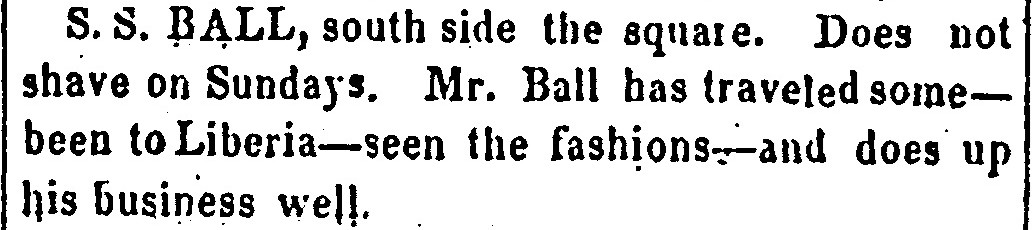
Samuel Ball’s Liberia trip was cited in his listing among “Business Men of Springfield” in 1849 (SJ-R)
Ball accepted the mission and in preparation for his visit to Liberia obtained a letter of introduction from Illinois Governor August C. French, a supporter of the colonization movement, as was (Abraham) Lincoln. Governor French’s letter stated that he had personally known Mr. Ball for some time and regarded him to be a man of strictest integrity and veracity and “worthy of the encouragement and confidence of all friends of colonization.”
On April 11, 1848, Ball departed for Liberia from the port of Baltimore. The Journal reported: “S. S. Ball, a very respectable colored man, late of this city, left Baltimore in a schr. on the 11th April for Liberia, for the purposes of examining that country as an asylum for free blacks.”
Ball arrived in Liberia on May 16, 1848. By August 24, he had returned to America and his homecoming appearance before the annual meeting of the Colored Baptist Association was reported as follows:
Friday morning August 25, intelligence being brought to the Association of the arrival … of Elder Samuel S. Ball, our missionary to Africa, whereupon the Association immediately adjourned to receive him … and conduct him to the … preaching stand. … Elder Ball responded with much feeling, after which in the shaking of hands, many tears were shed for joy, and praises were offered to God for his kind providence. Saturday at 3 p.m. was appointed for Eld. Ball to make his report to the Association. … and after hearing it it was ordered printed, and it came out in pamphlet form and was sold to defray expenses and to remunerate Elder Ball for his services in the trip. Elder Ball exhibited numerous African curiosities.
Money received for his voyage to Africa and back, ($)8,358.23: amount expended, ($)8,356.33: balance in hand $1.90.
Ball’s report was published in a 13-page pamphlet entitled “Liberia, The Condition and Prospects of that Republic; Made From Actual Observation.” The report is well organized and well written, describing the climate, geography, government, agriculture and religion of Liberia.
One cannot read Ball’s report without concluding that he was a literate and a sophisticated observer entitled to more than Professor Donald’s patronizing characterization of “servant” or “menial.” (The reference is to historian and Lincoln biographer David Herbert Donald, who Hart said underplayed the achievements and spirit of Springfield’s African-American population.)
At the age of 35, this African-American Virginia native left his young family and 3,912 fellow Springfield residents and ventured across the Atlantic to an unknown country for the purpose of determining if it would be suitable for settlement by African-Americans. He was obviously disturbed by the condition of African-American life and concluded that there might be a better life elsewhere. He took affirmative steps to investigate one alternative.
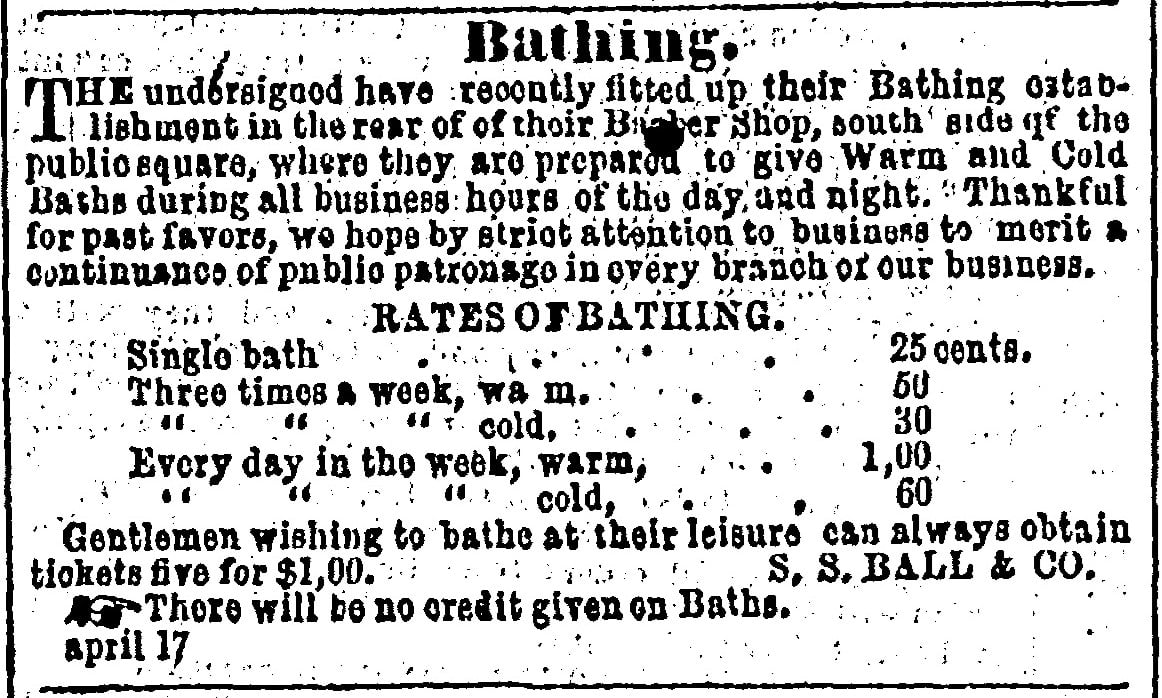
1852 advertisement for S.S. Ball & Co. bathhouse (Courtesy State Journal-Register)
Back in Springfield, Ball went about his regular daily life. He earned a living as a barber, cleaner and bathing room operator—a Springfield niche for African-American males discovered by Ball and his business competitor, William Fleurville. Ball’s business was located on the south side of the square and in close proximity to Lincoln’s law office at Sixth and Adams Streets. During the period 1849 through 1851, the Journal printed a number of advertisements for Ball’s barbershop. One such advertisement on March 28, 1849 stated that his shop would be open at all times from Monday morning until Saturday night and would have on hand “Ball’s celebrated Restorative, so famous for the restoration of hair, and preventative of baldness.”
Ball continued to advocate colonization and in 1851 he spoke at Springfield and St. Louis where he declared, “I am the warm friend and enthusiastic admirer of Liberia.” He described Liberia as “the brightest spot on this earth to the colored man. Liberia not only protects the colored man in the enjoyment of equal rights, but … its institutions fostered merit, developed the moral and intellectual faculties of its citizens, and produced great men.”
That same year, Ball drew up a bill for submission to the Illinois State Legislature proposing that state financial support be provided to free Illinois African-Americans wishing to migrate to Liberia. Springfield’s Journal newspaper supported Ball’s efforts.
On September 16, 1852, at age 42, Ball died after a short but deadly bout with typhoid fever. He left a widow and six children and real estate valued at $1,018.59. Samuel Ball is an example of the vigorous spirit of an individual African-American in early Springfield.
In a footnote to the printed version of his talk, Hart added this:
Samuel S. Ball’s obituary stated that “He was a man of good native talent, well cultivated for one in his circumstances. He was one of the most active, intelligent and useful colored Ministers in the State. He was extensively known by his visit to the Colony of Liberia, in 1848, as an exploring agent of the Colored Baptist Association of Illinois. He published an account of his travels, which was widely disseminated, and contains much useful information. He was affable in his deportment, respectable in scholarship, kind and affectionate in his social relations, esteemed by all.”
 Hart went on to comment that Ball was “probably in the minority in advocating the resettlement of free African-Americans to Liberia.” Indeed, a decade later, local Black residents adopted an eloquently stated resolution in opposition to Liberia emigration.
Original content copyright Sangamon County Historical Society. You are free to republish this content as long as credit is given to the Society. Learn how to support the Society.