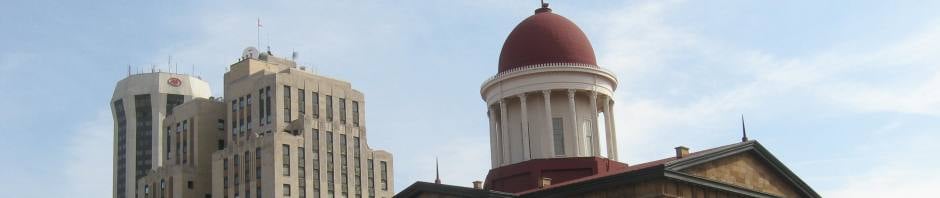
This is WSSR, Springfield, Illinois, with our inaugural broadcast. WSSR is operated by Sangamon State University and licensed to the Board of Regents of the state of Illinois. WSSR is heard at 91.9 megahertz on the FM dial and is authorized to operate at a maximum radiated power of 50,000 watts …
With those words, spoken at noon on Jan. 3, 1975, Dale Ouzts, SSU’s director of broadcast services, introduced Springfield’s National Public Radio station to the world.
The station went through a series of names as it evolved (and as SSU itself became the University of Illinois Springfield). Throughout, however, the station’s mission has been unchanged: To offer in-depth public affairs reporting in keeping with the focus of its college sponsor.
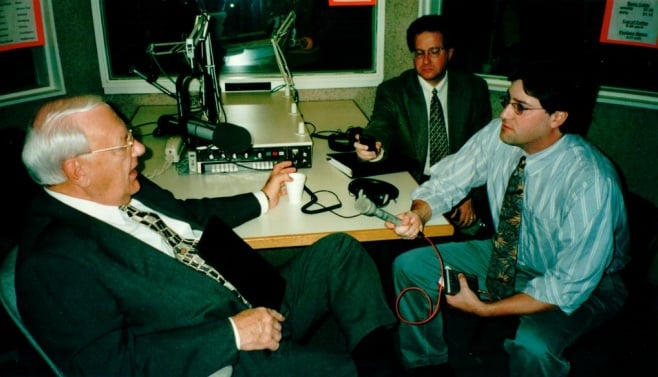
Sean Crawford interviews Gov. George Ryan, 2000 (Photos courtesy NPR Illinois and Sangamon Experience)
To celebrate its 50th anniversary in 2025, the station – by then known as NPR Illinois – worked with UIS’s Sangamon Experience to compile a historic record of the radio station. The results included both a physical display (viewable until May 2026 at Lincoln Library in Springfield) and an online presentation, “Radio That Listens to You”.
As a public radio station, NPR Illinois has financial support from the university, local businesses, and community members. It covers local issues and highlights local music, both part of its community-focused programming.
Funding for the station has ebbed and flowed throughout the 50 years. As of 2026, UIS no longer provided direct funding for NPR Illinois, though it continued to provide in-kind backup in the form of facility, administration, and fundraising support.
State funding established in 1985 allowed the station to transmit programs to other stations by satellite, a big improvement over the previously used telephone lines. National funding to public radio was rescinded in 2025, placing further stress on local stations. After 50 years, funding for the station and, more broadly, the future of public broadcasting in general depend more than ever on community donations.
Call letter history:
- 1975: Originated as WSSR
- 1989: Call letters changed to WSSU
- 1995: Call letters changed to WUIS to reflect the former SSU’s incorporation into the University of Illinois system
- 2015: Name changed to NPR Illinois
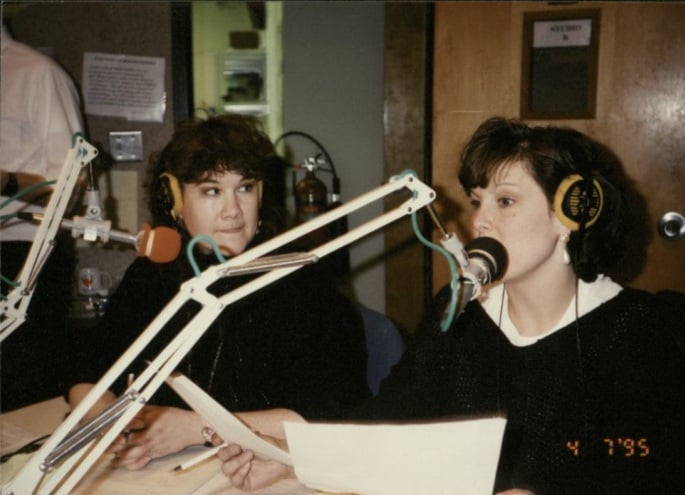
Tara McClellan and Mary Carlin during an on-air fundraiser, 1995
NPR Illinois has been housed in Building L at UIS since its beginning, with the transmitter tower in Mechanicsburg, 15 miles east of downtown Springfield. A second tower was built in 1992 in Griggsville, near the western edge of Illinois, to repeat WSSU’s signal in that area (under the call letters WIPA). Production became entirely digital in 1997. And in 2001 the station began streaming its programming on the Internet as well as broadcasting on traditional FM radio.
The station’s schedule features a blend of NPR and original programming. Locally developed programs include two that have been on the air the entire time the station has been in existence: “State Week,” in which panels of journalists discuss state government issues,” and “Bluegrass Breakdown,” which. as the name suggests, focuses on the best of bluegrass and related musical styles.
Other locally produced programs have included “Night Sounds,” “I’m Not Your Woman Anymore” and “Reading, Writing, and Radio.”
The Radio Information Service, under which people with visual impairments could hear a volunteer read newspaper stories aloud, ran from 1981 until 2021. The station’s annual “This I Believe” contest, which began in 2021 and continues in 2026, highlights the voices of local high schoolers. “Bedrock 66 Live!” for many years recorded live music performances and broadcast them on air. “Community Voices” interviews area residents about how they contribute to life in central Illinois.
Long-time listeners will recognize many of the people behind the scenes at the station, including two long-serving engineers – Jim Newbanks, who worked there for 19 years, and Jim Dunn, a 30-year veteran. Brad Swanson was general manager when he retired after 27 years with the station.
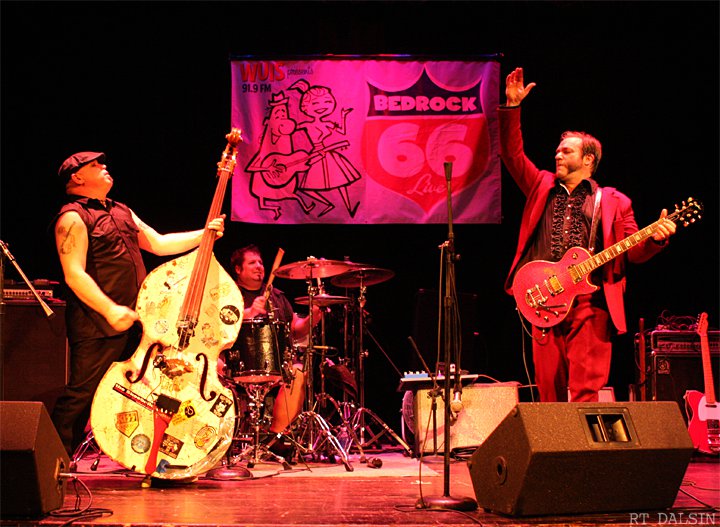
Krank Daddies at a Bedrock 66 Live! event, 2011
Many on-air personalities also have had long tenures. Rich Bradley, who founded “State Week,” was news director for 35 years. Jim Huston hosted “Lincoln Library Concert” as a volunteer for 41 years. Karl Scroggin shared his passion for classical music for 35 years. Bill Hickerson hosted and produced “Mulligan Stew,” a jazz program, for 24 years. Volunteer George Woulard was the host/producer of “Eastside Beat,” a show focused on African American issues and jazz, for 15 years. Bill Rintz hosted “Bluegrass Breakdown” for 22 years starting in 1975.
Dave Leonatti, a relative newcomer, first presented “Nightsounds” in 1988; that program, which blends modern, independent folk music with a sampling of other genres, continued in 2026.
In their 1973 presentation to SSU’s Board of Regents, the station’s organizers promised that:
FM radio will allow for communicating the activities of the Public Affairs segment of the University, for instructional entertainment, for news, and for cultural programs to fill the voids that now exist in the areas of live discussions, foreign music, classical music, plays, symphony orchestras, and event coverage of activities not now broadcast.
Fifty years later, that pledge remained at the heart of NPR Illinois.
 Contributors: Evie Rodenbaugh, Anne Moseley and Leslie Struble. Evie Rodenbaugh, as graduate assistant for Sangamon Experience in 2024-2025, researched, curated and produced Radio That Listens to You: 50 Years of NPR Illinois. Anne E. Moseley is director of engagement and curator of Sangamon Experience. Leslie Struble retired as a professor in the Department of Civil and Environmental Engineering at the University of Illinois in Champaign-Urbana.
Original content copyright Sangamon County Historical Society. You are free to republish this content as long as credit is given to the Society. Learn how to support the Society.