
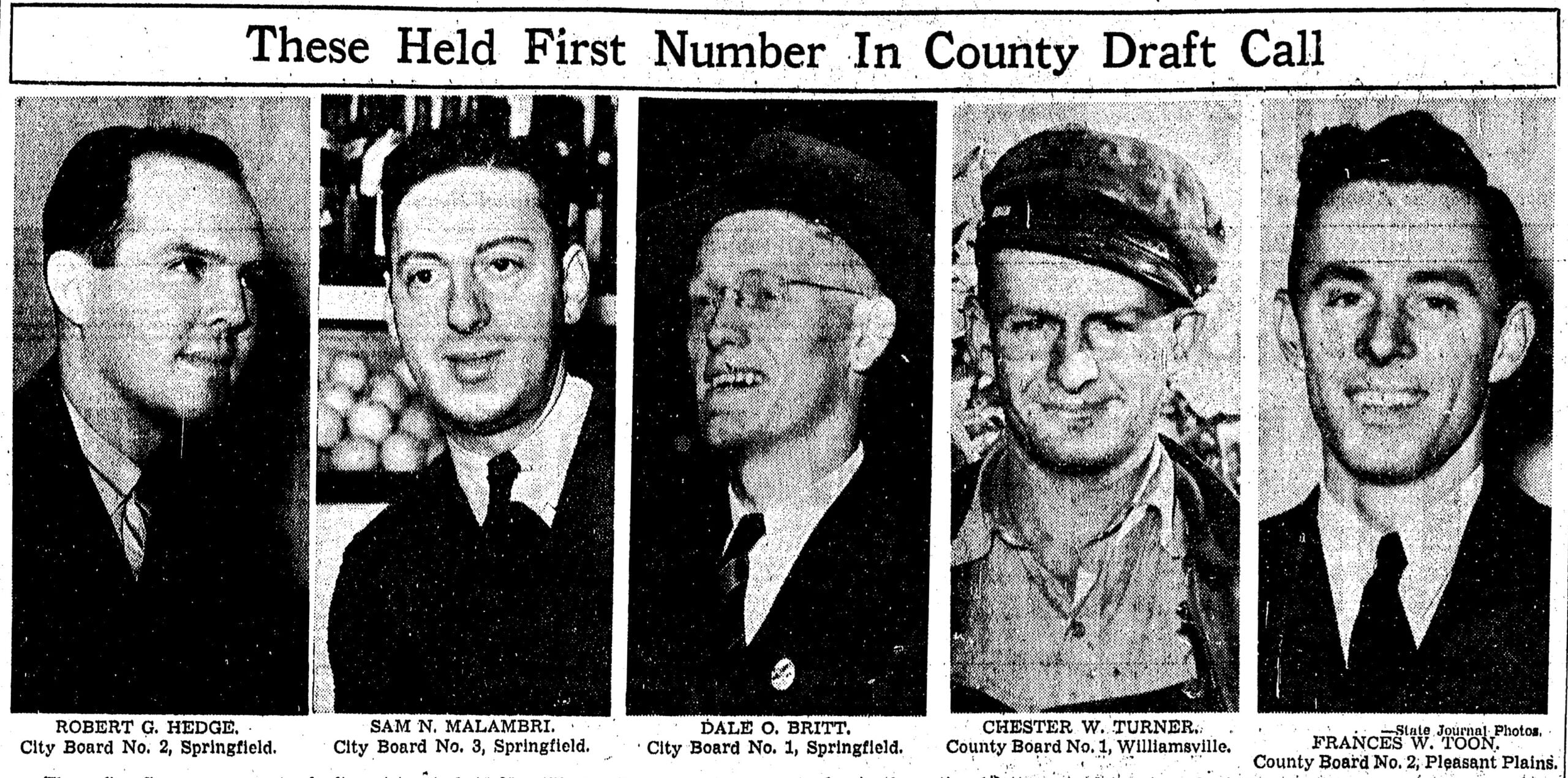
Both the Illinois State Journal and Illinois State Register published photos of Sangamon County’s first five draft-eligible men. (Courtesy State Journal-Register)
Dale Britt of Springfield turned 24 on Oct. 29, 1940. His birthday present? His number (158) was picked first in the national military draft lottery, held the same day.
Sangamon County was divided into five Selective Service districts, three in the city of Springfield and two in rural areas, for the U.S.’s first peacetime draft. The Illinois State Register published the names of all 14,000-some Sangamon County men whose numbers were chosen on Oct. 29; it took two days and nine newspaper pages.
The draft-number system was complicated. Nationwide, there were a total of 6,175 districts. Each number drawn applied to only one man in each district; as a result, number 158, for instance, was held by 6,175 men across the country.
The three with No. 158 in the city of Springfield were: District 1, Britt, an employee of the John W. Hobbs Corp. who lived on North Third Street; District 2, Robert Hedge, who lived South Pasfield Street, an accountant for Kraft Cheese; and District 3, Nicholas Sam Malambri of South Grand Avenue East, who operated a fruit and vegetable market.
Outside Springfield, No. 158 was held by Chester Turner, who farmed with his father near Williamsville (County District 1), and Francis Toon, a high school teacher in Pleasant Plains (District 2).
Every man in the U.S. between 21 and 35 years old had to register for that first draft, although relatively few were to be called up immediately. Those drafted were to undergo a year of training and then be put on reserve status. (Both the age range and term of service were later extended.)
The Register explained the workings of the October 1940 lottery.
The number of men in each draft board district ranges from 2,500 to 3,165. After the older numbers are all drawn, the quotas for training from each district will be announced
It is estimated that Sangamon County will furnish about 50 men in the first draft, to be called soon. This would mean that the men with the first ten order numbers in each district would be called immediately, although deferments may run the called lists up to 30 or 40 before the quota can be filled.
At least four of the five local men whose numbers were chosen first in that original lottery eventually served in World War II, although it isn’t clear if any were part of the initial training callup in November 1940.
- Dale Britt (1916-95) enlisted in the National Guard, served in the U.S. Army in Europe, and received a Bronze Star. He remained in the Guard after the war, reaching the rank of captain.
- After a temporary deferment because of injury, Nicholas Malambri (1908-71) enlisted in the Army Air Force in 1943. He served as a private.
- Francis Toon (1915-2003) enlisted in the Navy and commanded an LSD (landing ship, dock) in the Pacific Theater. He stayed in the Navy Reserve after the war, was promoted to lieutenant commander and served as president of the Mississippi State Reserve Officers Association.
- Chester Turner (1919-61) served as a Tec-5 in the Army Coastal Artillery Corps. A Tec-5 soldier had specialized non-combat technical skills, filling roles like mechanic, radio operator, medic or cook, etc. Though not officially a non-commissioned officer, a Tec-5 earned the same pay as a corporal and wore similar chevrons.
 Robert Hedge (1914-87) an Indianapolis native, apparently lived in Springfield for only a few months. Hedge was married and was initially deferred for dependency reasons. He moved back to Indianapolis shortly after the draft lottery, and online records give no indication that he ever served in the military.
Original content copyright Sangamon County Historical Society. You are free to republish this content as long as credit is given to the Society. Learn how to support the Society.