
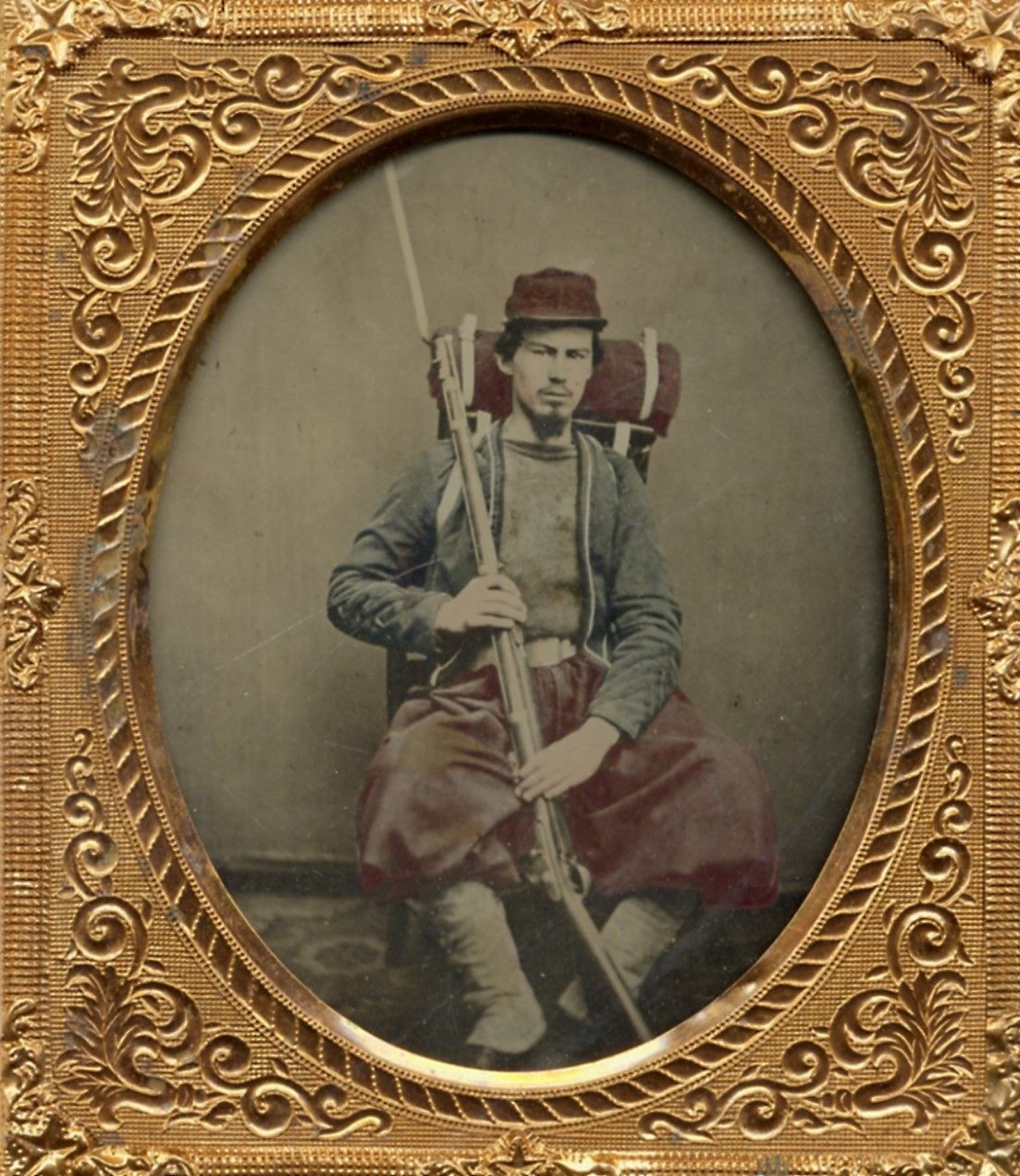
Pvt. (later Lt.) Marshall McIntire in his Zouave-style uniform at the start of the Civil War. (John A. Logan Collection, Abraham Lincoln Presidential Library, via Findagrave.com and Paul Golladay of the Sucker State Preservation Foundation)
“The city yesterday (wore) a camp like appearance,” the Illinois State Journal reported April 18, 1861, three days after President Lincoln called for volunteers to defend the Union from southern rebellion.
From many a housetop the grand old flag of the Union floated proudly to the breeze and the inspiriting music of the fife and drum aroused the patriot to the sad conclusion that the nation’s heart throbbings had become a painful reality.
From an early hour of the morning the headquarters of the Springfield Zouave Grays, corner of Sixth and Washington streets, were thronged with stalwart young men, anxious to enrol (sic) their names among the citizen soldiery of the land.
The company mustering, originally some thirty men, was increased towards evening by some seventy or seventy-five recruits, all “eager for the fray” and determined that the nation’s honor shall be vindicated whilst they possess the nerve to shoulder a musket.
The organization of the Grays is now complete and we may well say that a finer body of men cannot be found at the disposal of the government.
Patriotism notwithstanding, the Zouave Grays originally were a military-styled social club for young men, devoted mostly to banquets, galas and fancy-dress parades.
The Journal announced the formation of what was then called the Springfield Cadets, “a new military company lately organized in this city,” in June 1858.
“It is composed of young men from sixteen to twenty years of age,” the story said. “The uniform of the Company is a dark blue coat, made after the fashion of the United States uniform, trimmed with guilt (sic) lace, white pants and glazed cap.”
The Journal didn’t say how many men the Cadets enrolled, but it did identify the company’s 12 officers and non-coms; the last name on the list, with the rank of 4th corporal, was “R.T. Lincoln” – Robert Todd Lincoln, son of Abraham Lincoln.
The Cadets reorganized as the Zouave Grays in October 1859. Aside from the new name and mostly new officers, the unit adopted a fashionable Zouave-style uniform, featuring a short, open jacket and red, puffy pantaloons.
Camilla Quinn discussed the Grays in her 1991 monograph, Lincoln’s Springfield in the Civil War. The Grays “offered their services to the governor only a few hours after Lincoln issued the call for volunteers,” Quinn wrote, “earning the distinction of being the first company of Illinois men to be accepted for military services under President Lincoln’s call.”
For the last three years, the militia company had drilled in Springfield’s large halls and in a pasture on the south side of town. They had also been trained in the “Zouave” method of fighting, a method that employed flashy maneuvers and held audiences spellbound. As Zouaves, they were required to become proficient with the bayonet and had to “load and fire on the run, while lying down, or kneeling – in short in every possible position,” with every move “executed with incredible rapidity.”
Now mustering in at seventy-nine men, most of the Zouaves were under age thirty, single, and tradesmen or clerks who crossed paths daily on the streets and in the stores of Springfield.
The Zouaves entered Union service as Company I of the 7th Illinois Infantry Regiment, a three-month regiment. (Lincoln’s military proclamation of April 15, 1861, called for 75,000 volunteers to serve for 90 days. Preexisting militia units like the Grays helped provide an instant, though temporary, military structure while the Union Army organized itself for the longer term.)
The three-month 7th deployed to Alton, St. Louis, Cairo and Mound City, but saw no combat, unless you count a freelance escapade by a few of the erstwhile Grays. From the Aug. 3, 1861, edition of the Illinois State Register:
A SECESSION FLAG – The Springfield Grays, the first company accepted into service by the governor under the call for the first six months’ (sic) regiments, resolved to do something before the expiration of their term, besides holding Cairo and Mound City. A few nights before being mustered out of service, Corporals Roberts, Caulfield, Bishop and Pearson, and Privates McIntire (Marshall McIntire, pictured above – ed.), Johns and Gourley, under the command of Sergeant J.C. Reynolds, proceeded seven miles up the Ohio river, in a skiff, and thence to a small place three miles back in Kentucky, captured a secession flag, and were in before reveille in the morning. Sergeant Reynolds has deposited the flag in the office of Gen. Mather (Illinois Adjutant General Thomas Mather – ed.), where it may be seen.
Gray? No, blue
Gaudily uniformed Zouave units fought on both sides early in the Civil War, until supply problems led to general distribution of standard-issue uniforms.
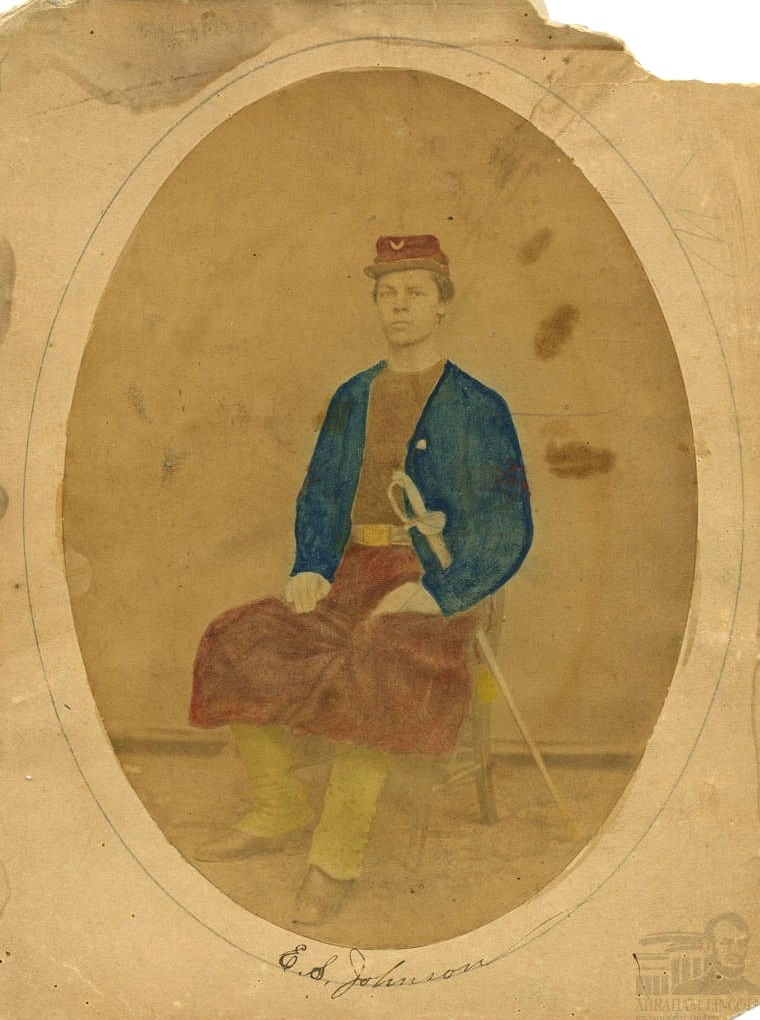
1st Sgt. Edward S. Johnson, 7th Illinois Infantry (Boys in Blue Collection)
While the name “Springfield Zouave Grays” obviously suggests the unit wore gray jackets, that was not the case when the Grays went into federal service.
Pvt. Marshall McIntire’s photo above was tinted by a relatively sophisticated process that brings out the red in his cap, pantaloons and blanket roll, but the color of his jacket is not as obvious. A colorized photo of another former Springfield Gray, however, indicates the three-month version of the 7th Illinois Infantry wore blue jackets.
That photo, part of the Boys in Blue Logan Collection at the Abraham Lincoln Presidential Library, is of 1st Sgt. Edward S. Johnson, like McIntire a member of both the Grays and the three-month 7th Infantry. Though Johnson’s photo isn’t as subtly tinted as McIntire’s, it definitely shows Johnson in a blue Zouave jacket.
After the 7th was mustered out following its first three-month callup, Johnson (1843-1921) reenlisted with the longer-term version of the 7th Regiment. He stayed with the unit during the entire Civil War, rising to the rank of major/brevet lieutenant colonel. Johnson later became the second custodian of the Lincoln Tomb.
Lt. Marshall M. McIntire
While some former Grays, like Johnson, joined the reorganized 7th after the three-month version went out of existence, others switched to new units. Among those was Marshall McIntire (1839-62), the soldier pictured in Zouave uniform at the top of this entry.
McIntire signed up with the brand-new 29th Illinois Infantry. In the process, he jumped from the rank of private, which he had held with both the Grays and the 7th, to that of 1st lieutenant. Rosters indicate he was second in command of Company I of the 29th under Capt. A.O. Millington (1828-1902).
The 29th regiment was ordered to Cairo in September and then participated in expeditions in Missouri and Kentucky. In early February 1862, when Union soldiers under Gen. U.S. Grant drove Confederates out of Fort Henry, Tenn., the 29th regiment was part of the first Union brigade to enter the fort.
A week later, according to the Illinois Adjutant General’s regimental history:
In the battle of Fort Donelson, the Brigade formed the extreme right of the line of investment, meeting the enemy first and fighting them longer than any other portion of the army. Regiment lost 100 men, killed and wounded, of which 30 were killed on the field.
The dead included Lt. Marshall McIntire on Feb. 15.
“Enemy left entrenchments during the night and opened fire on our right wing at daybreak,” according to the Official Records of the Union and Confederate Armies (as reported on McIntire’s Findagrave.com site). “The Seventeenth and the Twenty-fifth Kentucky came up on our rear and fired upon us, which caused (us) to retreat. Lieutenant McIntire fell, mortally wounded, from this fire.”
Company I organized a resolution of tribute to McIntire two weeks later, which Millington had published in the Illinois State Journal March 7. “Resolved,” it said, “That in losing him we have met with the loss of a brave and efficient officer, and a true and firm friend of his country.”
The McIntire family
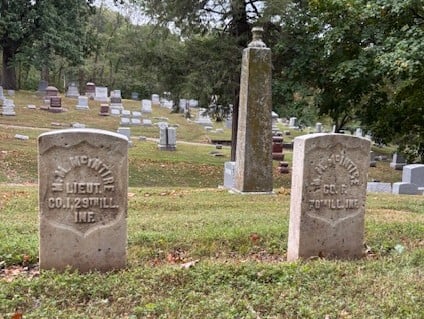
McIntire family plot, Oak Ridge Cemetery (Sangamon County Historical Society)
Lt. Marshall McIntire’s military tombstone sits next to that of his brother Marcus (1845-1869) at Oak Ridge Cemetery. Their parents, a sister and the sister’s husband also are buried in the McIntire plot, which is in the cemetery’s Block 13.
Marcus McIntire was a private with the short-lived 70th Illinois Infantry. The unit, organized in July 1862, guarded Confederate prisoners at Camp Butler until October 1862, when it was mustered out.
Roxanna Stearns McIntire (1817-93), the brothers’ mother, also deserves credit for her Civil War work.
“During the war, Mrs. McIntire was a great worker for the soldiers,” her obituary said, “and early in (1863) she and Mrs. Zimmerman, now deceased, were sent to Vicksburg, Miss., by Governor Yates with supplies for the Illinois soldiers.”
Actually, Roxanna McIntire, along with other members of Springfield’s Ladies Aid Society, did more than take supplies to Vicksburg. The group, apparently led by Mary C. Zimmerman (1821-89), traveled to Vicksburg shortly before it fell to the Union Army in July 1863. They cared for sick and wounded soldiers there and then accompanied some of the worst afflicted back to Illinois on the hospital steamer City of Alton, according to Zimmerman’s obituary.
Zimmerman’s efforts, and presumably also those of the rest of the group, “were untiring and evoked the highest praise from the surgeons and nurses in charge of the boat,” the obituary said.
Benjamin McIntire (1810-66), Roxanna’s husband and the father of Marshall and Marcus, worked building railroad bridges – and died on one. He was walking on a trestle while on a job in Pittsburgh, Pa., when he was caught unawares between two trains going opposite directions on adjoining tracks. One of the locomotives knocked McIntire to the ground beneath the trestle. He died of his injuries.
Marcus McIntire also died in a gruesome train accident. He tried to jump from the caboose of a moving train at Springfield’s Chicago & Alton Station (the Third Street Amtrak station in 2025) on Feb. 23, 1869. The caboose’s steps were snowy, and McIntire slipped and fell under the train while still holding onto the rail of the caboose. Both his legs were “shockingly injured,” the Journal said. McIntire didn’t survive an operation to amputate his right leg.
 Hat tip: To Paul Golladay (corrected spelling) of the Sucker State Preservation Foundation, whose September 2025 presentation to the Sangamon County Historical Society prompted this entry. The foundation, which cleans, maintains and repairs military headstones and monuments, refreshed Lt. Marshall McIntire’s gravestone in 2023. For more information, see the foundation’s Facebook page.
Original content copyright Sangamon County Historical Society. You are free to republish this content as long as credit is given to the Society. Learn how to support the Society.
I love this!! Thanks so much im and ancestor of Abraham Lincoln and this is new info for me , thanks again!
I didn’t know about all the tragedies in the McIntire family. Thank you for sharing the history of this family. I will look for their grave plots the next time I’m at Oak Ridge.
An article in the Springfield Register explains more about Lieutenant McIntire’s plight. He was apparently shot by accident by friendly fire from Union Kentucky troops that got confused. It says that the “Kentucky troops became very excited and commenced firing on us, which caused our regiment to run in every direction. Lieutenant McIntyre was shot by them and died this morning.” Daily Illinois State Journal, Feb. 24, 1862, p. 3, column 4.