
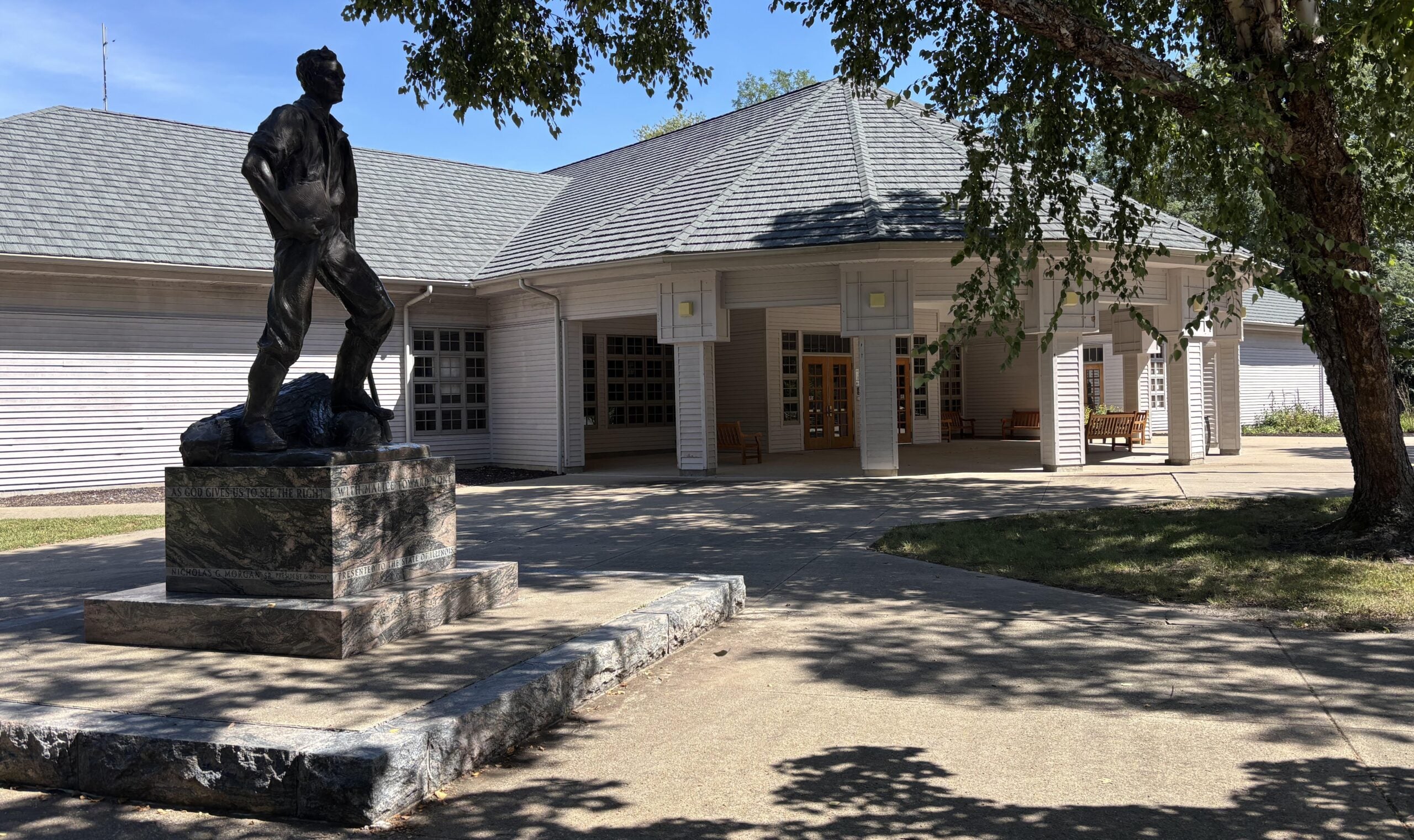
Avard Fairbanks’ statue of a young Lincoln stands outside the Visitor Center at Lincoln’s New Salem State Historic Site (SCHS)
The site of New Salem, the village where Abraham Lincoln lived as a young man, is in Menard County today. When Lincoln lived there, however, New Salem was part of Sangamon County. See below.
In researching his foundational biography, Herndon’s Lincoln: The True Story of a Great Life (1889), William “Billy” Herndon, Lincoln’s last law partner, interviewed many former New Salem residents. According to the 1881 History of Sangamon County, Together With Its Cities, Villages and Townships, Herndon described New Salem’s villagers – the men, at any rate – in a lecture he gave shortly after the Civil War)” He repeated that talk to the 1881 meeting of the Old Settlers of Sangamon County, which was held at Sweetwater in Menard County.
Herndon classified the inhabitants of early central Illinois in “four distinct and separate waves”. To oversimplify, he identified them as first, Native Americans; second, nomadic “bee and beaver hunters”; third, “the wild, hardy, honest, genial and social man”; and fourth, entrepreneurs and developers.
New Salem, Herndon said, was populated largely by the third group.
The third class which I am about to describe – the brave, rollicking royster – is still among us, though tamed by age into a moral man. He is large, bony, muscular, strong almost as an ox. … He is naturally strong-minded, naturally gifted, brave, daring to a fault. He has strong, quick sagacity, fine intuitions, with great good common sense. He is hard to cheat, hard to whip, and still harder to fool. These people are extremely sociable and good-natured – too much so for their own good, as a general rule. They are efficient, ready, practical men, and are always ready for any revolution. …
These men, especially about New Salem, could shave a horse’s mane and tail, paint, disfigure, and offer for sale to the owner, in the very act of inquiring for his own horse, that knew his master, but his master recognizing him not. They could hoop up in a hogshead a drunken man, they being themselves drunk, put in and nail down the head, and roll the man down New Salem hill a hundred feet or more. They could run down a lean, hungry wild pig, catch it, heat a ten-plate stove furnace-hot, and putting in the pig, could cook it, they dancing the while a merry jig.
They could, they did, these very things occasionally; yet they could clear and clean a forest of … wolves in a short time; they could shave off a forest as clean and clear as a man’s beard close cut to his fact; they could trench a pond, ditch a bog or lake, erect a log house, pray and fight, make a village or create a State.
They would do all for sport or fun, or from necessity – do it for a neighbor – and they could do the reverse of all this for pure and perfectly unalloyed deviltry’s sake.
They attended church, heard the sermon, wept and prayed, shouted, got up and fought an hour, and then went back to prayer, just as the spirit moved them.
These men – I am speaking generally – were always true to women, their fast and tried friends, protectors and defenders. There are scarcely any such on the globe for this virtue. They were one thing or the other – praying or fighting, creating or destroying, shooting (Native Americans) or getting shot by whisky, just as they willed.
Though these men were rude and rough, though life’s forces ran over the edge of its bowl, foaming and sparkling in pure and perfect deviltry for deviltry’s sake, yet place before them a poor weak man who needed their aid, a sick man, a man of misfortune, a lame man, a woman, a widow, a child, an orphaned little one – then these men melted up into sympathy and charity at once, quick as a flash, and gave all they had, and willingly and honestly toiled or played cards for more.
New Salem village
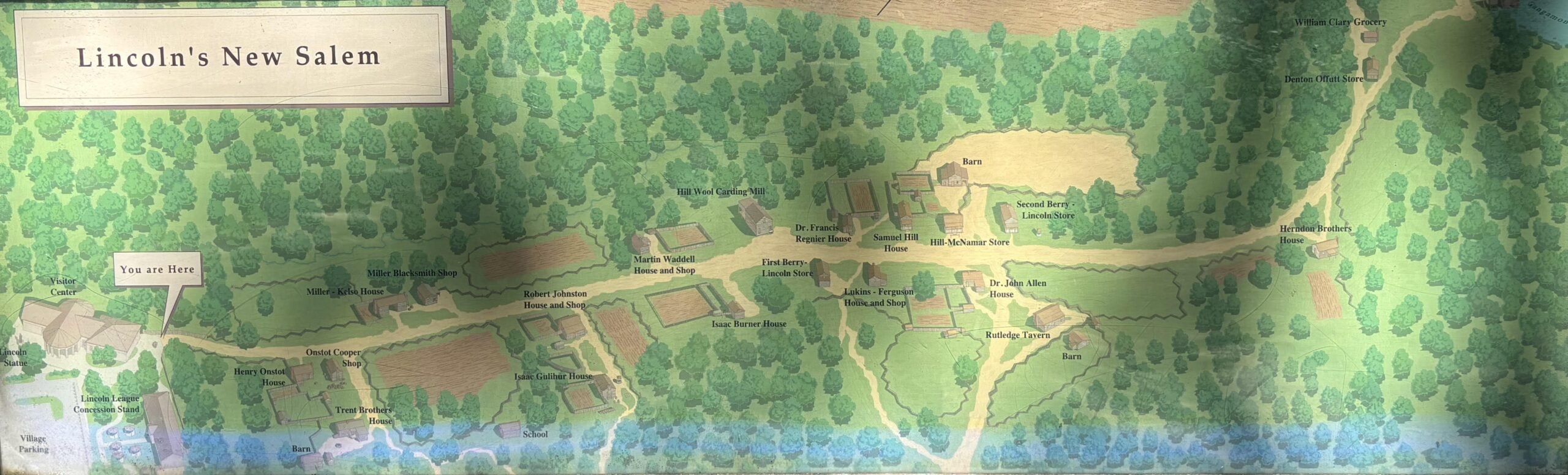
A map at the entrance to the restored village identifies the major reconstructed buildings at New Salem (SCHS)
When founded in 1821, Sangamon County took in all or parts of 13 central Illinois counties. As European settlers moved into the area, the county was subdivided three times. Sangamon got its last boundary change in 1839, when the legislature created Menard, Logan and Dane (now Christian) counties.
The Illinois Department of Natural Resources’ interpreter’s handbook for Lincoln’s New Salem State Historic Site summarizes the town’s historic significance.
Abraham Lincoln, future 16th president, lived here from 1831 to 1837, was a captain in the Black Hawk War, storekeeper, postmaster, surveyor, railsplitter, legislator, and eventually lawyer. Abraham Lincoln would leave New Salem on April 15, 1837, for Springfield, Illinois.
New Salem, the handbook notes, “was not primarily residential but was a place of business, a cluster of stores and tradesmen’s shops. … Its merchants (who included Lincoln – ed.) had connections to far-flung sources of goods that included the eastern United States and even Europe.”
New Salem was founded by James Rutledge and John Camron, who built a saw and grist mill on the Sangamon River in 1829. The town was platted on Oct. 23, 1829, and probably reached its peak population in the mid-1830s. It was already losing residents by 1839, when the legislature created Menard County and named Petersburg the county seat. New Salem was essentially gone by 1840.
The area reverted to farmland until newspaper magnate William Randolph Hearst purchased the site on behalf of the Old Salem Chautauqua Association. The property was transferred to the state of Illinois in 1919.
Today’s New Salem is a reconstruction based largely on former residents’ memories. Only one of the 23 major structures in the log-cabin village, the Onstott Cooper Shop, is original; the rest, as the handbook says, are “educated guesses based on fragments of evidence … (and) what is known generally about log house architecture of the period.”
The 700-acre site also includes parking, a campground, picnic areas and walking trails.
Onstott Cooper Shop
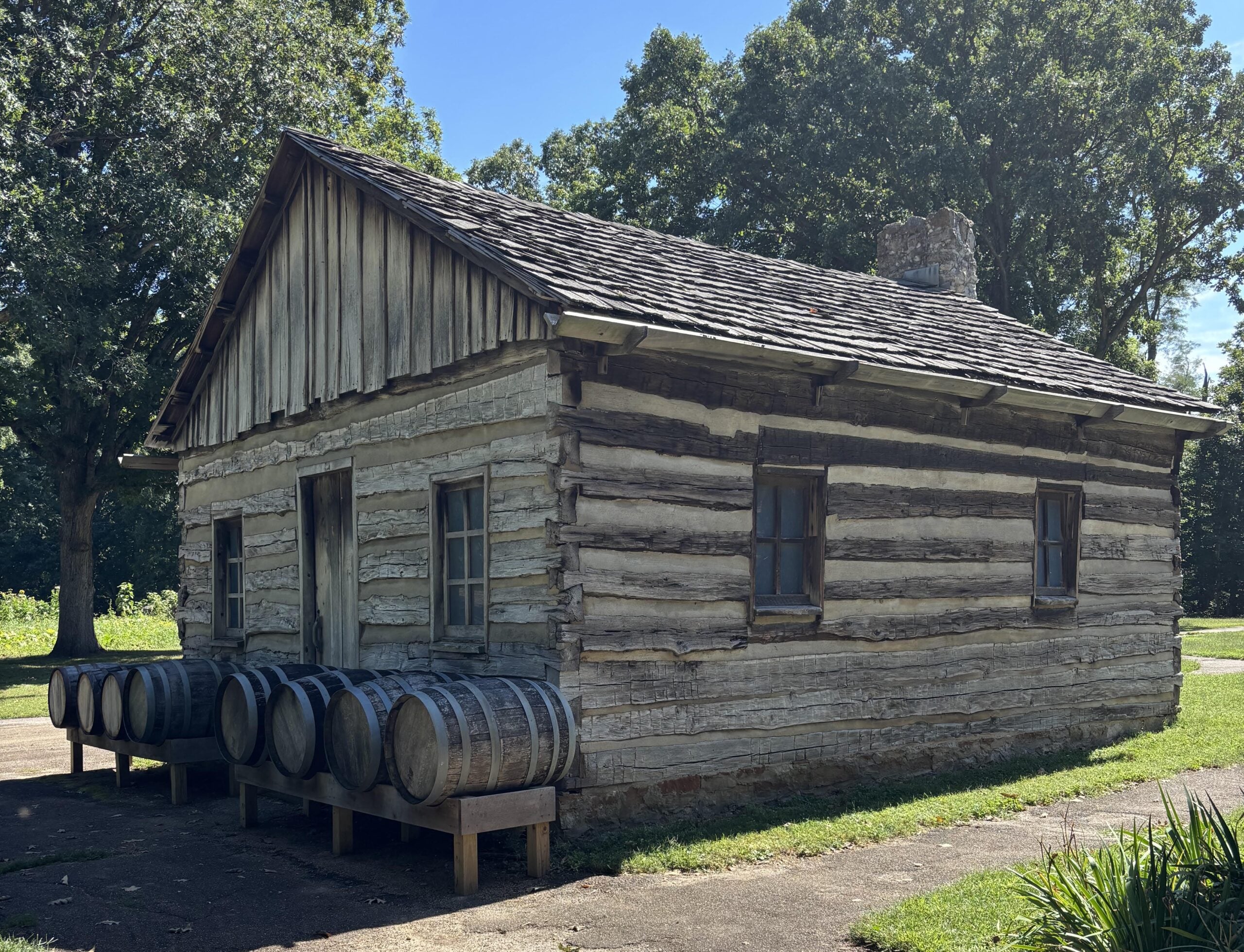
The Onstott Cooper Shop. The 1830s logs are narrower than the replacements. (SCHS)
About 60 percent of the logs in the Onstott Cooper Shop, which sits at the west end of the restored village, date from the 1830s. Henry Onstott (1804-76) made and repaired wooden containers, such as barrels, buckets and butter churns, in the shop, which he built about 1834.
Tradition says Lincoln read books by firelight in the shop, feeding the fire with wood shavings left over from Onstott’s projects.
Onstott moved to Petersburg sometime before 1840. In the process, he relocated this shop, along with an earlier one, from New Salem. Disguised by siding on the outside and plaster on the inside, the cooper’s shop was discovered in Petersburg in 1922. The Old Salem Lincoln League bought the building and returned it to New Salem, and the Depression-era Civilian Conservation Corps restored the remaining original logs in 1937.
Source: Interpreter’s handbook, Lincoln’s New Salem State Historic Site.
 More information: There are many sources of information about the historic village and its reconstruction; the standard reference is Lincoln’s New Salem by Benjamin Thomas (1934 and later editions).
Original content copyright Sangamon County Historical Society. You are free to republish this content as long as credit is given to the Society. Learn how to support the Society.