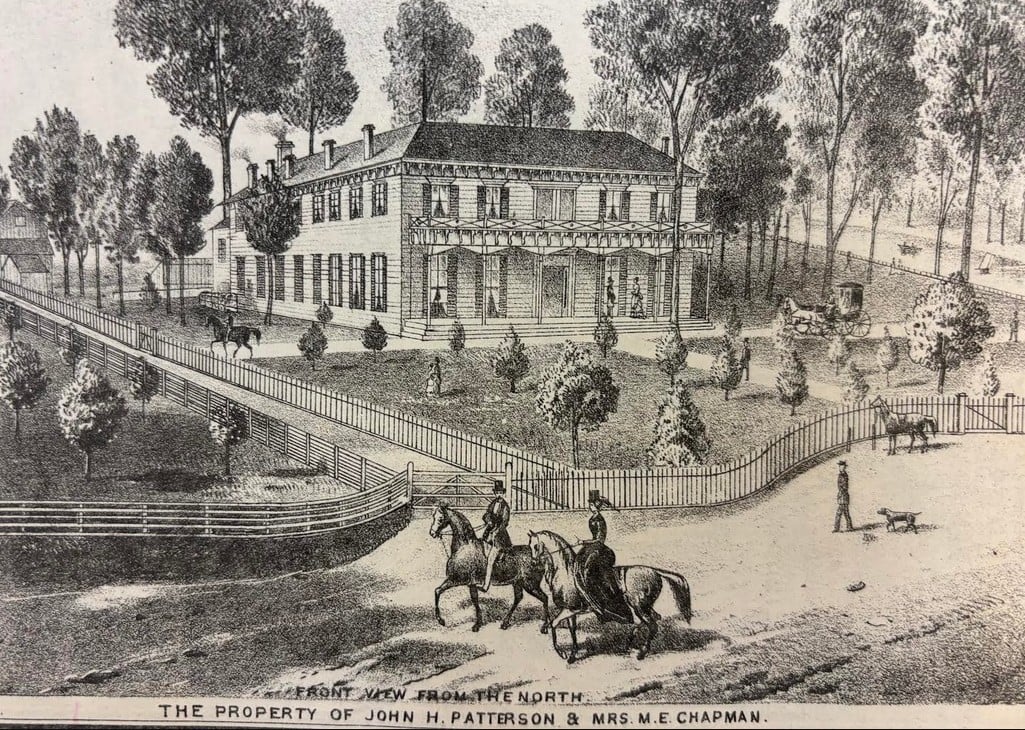
Clear Lake House (1874 Atlas of Sangamon County)
Before the Civil War, Springfield residents seeking an escape from the summer heat could visit the Clear Lake House, a resort hotel located on Clear Lake, five miles east of Springfield. The establishment offered boating, fishing, picnics, dancing and refreshments. Contemporary newspaper accounts trace the hotel’s fortunes from the 1850s into the 1880s.
Resort hotels before the Civil War
The Clear Lake House was part of an emerging tradition of resort travel in Illinois in the 1850s. The Lake View House, which opened in 1854 along Lake Michigan north of Chicago’s developed area, attracted visitors with its lakeside scenery and cooling breezes. Other establishments promoted mineral springs and their supposed health benefits. These included the Sulphur Springs Hotel near present-day Utica, dating to about 1851; a hotel at mineral springs in Greene County, erected in 1852; and a hotel at Perry Springs in Pike County, built in 1856.
Instead of a mineral-water cure, Clear Lake House emphasized its accessible rural setting and opportunities for boating, fishing, picnics and entertainment. Its proximity to Springfield made a day’s excursion practical for city residents.
Origins of the resort
John H. Patterson (?-1878), a carpenter from Harrodsburg, Ky., came to Sangamon County in 1856 and subsequently acquired land near the lake. He developed the Clear Lake House on its northeastern shore, with his daughter Mary E. Chapman and her husband, Springfield dry-goods merchant Joseph Chapman. Whether the Chapmans helped finance construction is unknown.
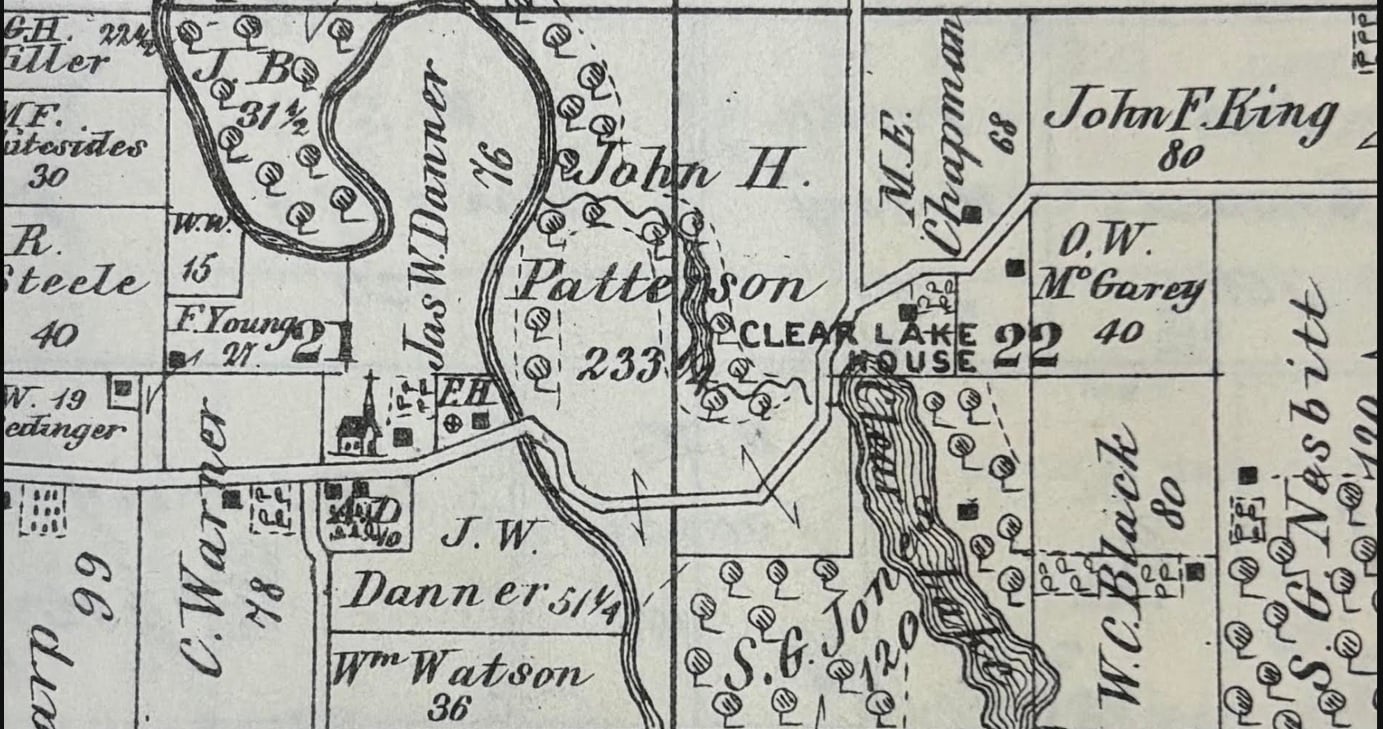
Map showing location of Clear Lake and the Clear Lake House, (1874 Atlas of Sangamon County)
Clear Lake was offering recreational opportunities and refreshments by 1857, and in June 1858, Patterson advertised that the lake had been fitted up to receive visitors seeking health or pleasure, offering ice cream, lemonade, cakes and oranges, along with a sailboat for pleasure parties. That advertisement did not explicitly name the hotel, leaving its precise opening date uncertain. However, a later account suggests the establishment was in existence by the summer of 1858. Patterson was listed as a hotelkeeper in the 1860 census.
An illustration in the 1874 Atlas of Sangamon County depicts a large, L-shaped frame hotel with a central entrance, broad veranda, steep hipped roof, bracketed overhanging eaves and a balustrade at the roofline. Its Italianate-influenced details and surrounding shade trees gave the building the appearance of a fashionable country retreat. The hotel was also marked on the 1876 Atlas of Illinois.
A destination for excursions
In June 1859, Patterson and Chapman hosted an elaborate outing for Springfield fire and military companies and visiting firemen from St. Louis. A torchlight procession welcomed the guests in Springfield, and a special train was arranged to take the party to Jamestown, or Jimtown (present-day Riverton), before they continued to Clear Lake.
The festivities included entertainment and a ball at the hotel. Clear Lake House thus served not only individual pleasure seekers but also organized excursions and public celebrations.
Camp Butler and the Civil War
The establishment of Camp Butler near Clear Lake in 1861 transformed the neighborhood. Infantry regiments occupied the east bank of the lake; the possibility that the hotel served as officers’ quarters has not been confirmed. In September 1861 a correspondent described the Clear Lake Hotel as one of the institutions associated with the camp, praising its comforts and mentioning its barroom, managed by a Mr. Johnston.
The original camp site proved unsuitable, and the installation was relocated to the area of today’s Camp Butler National Cemetery.
Military activity did not end civilian recreation. In July 1862, more than 100 visitors enjoyed dinner beneath the trees on the east bank, music from a cotillion band, fishing, walks in the woods and dancing at the hotel.
“There is no more beautiful or romantic spot any where near Springfield than Clear Lake,” the Illinois State Journal said in its report on the outing. +
Yet the resort also acquired a less flattering reputation. A June 1865 Journal report described a violent fight at Clear Lake House, calling it “a whiskey shop.” The paper criticized disorder around the military camp and called for harsh action.
We are much astonished that the military authorities at Camp Butler, instead of frequently placing guards around this place, to protect its proprietors in their illegal traffice (sic) – so much to the disgrace and annoyance to the neighborhood, and so detrimental to the best interests of the soldiers, and to good order in the camp and its vicinity – have not long since closed up this disreputable concern. We hope that both civil and military authority will be brought to bear to extinguish this intolerable nuisance.
A later oral-history account characterized the hotel as a “maison du joi,” or brothel.
Renewal and community gatherings
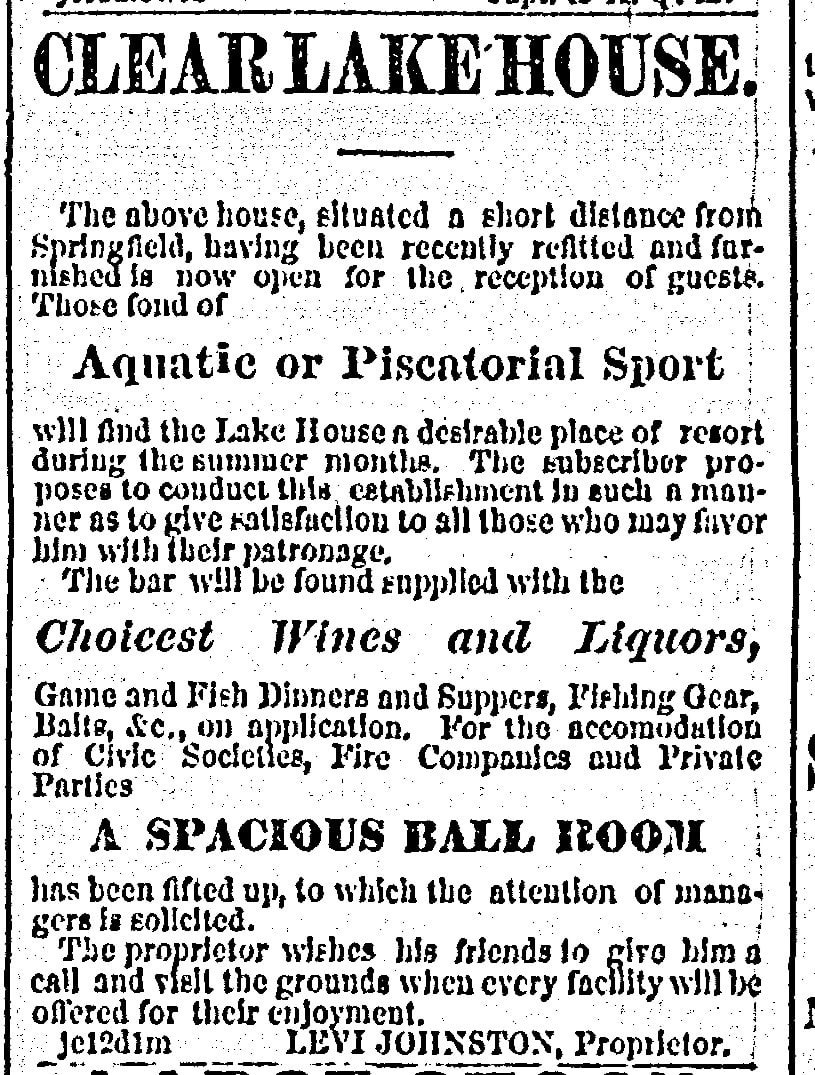
Clear Lake House ad, 1866 (Courtesy State Journal-Register)
In May 1866 Levi Johnston (1822-1902) renovated and refurnished Clear Lake House. Advertisements again promoted picnics, fishing, boating and dancing, with boats, fishing equipment, fish and game dinners, refreshments and a spacious ballroom. The resort was also a venue for political and community gatherings. Republicans scheduled a meeting there in 1868, and the Sangamon County Old Settlers’ Society held gatherings at Clear Lake in the late 1860s and again in 1870.
Patterson’s attempt to obtain a license to sell alcohol in 1870 was unsuccessful: the county board referred the petition to its Committee on Swamp Lands, which recommended denial. The unusual committee assignment was noted in the presentation, though the reason for it is unknown.
The lake nevertheless remained a destination for church and family outings. A church festival in 1873 raised money for a Sunday-school library. That October a young man and woman survived when their sailboat capsized; the young man held onto his companion until help arrived. In August 1875, flooding forced the removal of furniture and carpets to the hotel’s second floor.
During the nation’s centennial celebrations in 1876, the resort advertised music, dancing and basket picnics, inviting guests to bring their own food.
Ownership, ice harvesting and winter outings
After Patterson died in August 1878, his widow, Isabella (?-1880), sold the resort property, excluding approximately eight acres of farmland, to Lloyd Hamilton in February 1880; she died the following month.
The partnership of Bradish and McCulloch, which harvested and sold ice, bought the property later that same year. An 1881 advertisement sought 100 men to cut ice, offering wages and board and lodging at the hotel.
The hotel also hosted winter social gatherings, including a sleighing party whose guests came for supper and entertainment. In January 1884, promoters proposed buying the lake, hotel and grounds and constructing a small steam-powered railway from Springfield, but the plan apparently did not materialize.
In March 1884, the Springfield Fishing Club was reported to have taken control of Clear Lake. A June newspaper account described improvements for boating parties and suggested that the Clear Lake House might again be leased and operated as a summer resort. This is among the last few documented references to the hotel; its precise closing date and ultimate fate remain uncertain.
 Although the hotel eventually disappeared, newspaper reports preserve the story of a country establishment that welcomed pleasure seekers, social organizations, soldiers and winter guests over several decades. The Clear Lake House occupied a distinctive place in Sangamon County’s nineteenth-century social life.
Contributor: Curtis Mann. Mann is the retired Springfield city historian and manager of the Sangamon Valley Collection at Lincoln Library. He currently works as a research affiliate with the Foundation for Illinois Colonial and American Studies, located in Springfield.
Original content copyright Sangamon County Historical Society. You are free to republish this content as long as credit is given to the Society. Learn how to support the Society.