
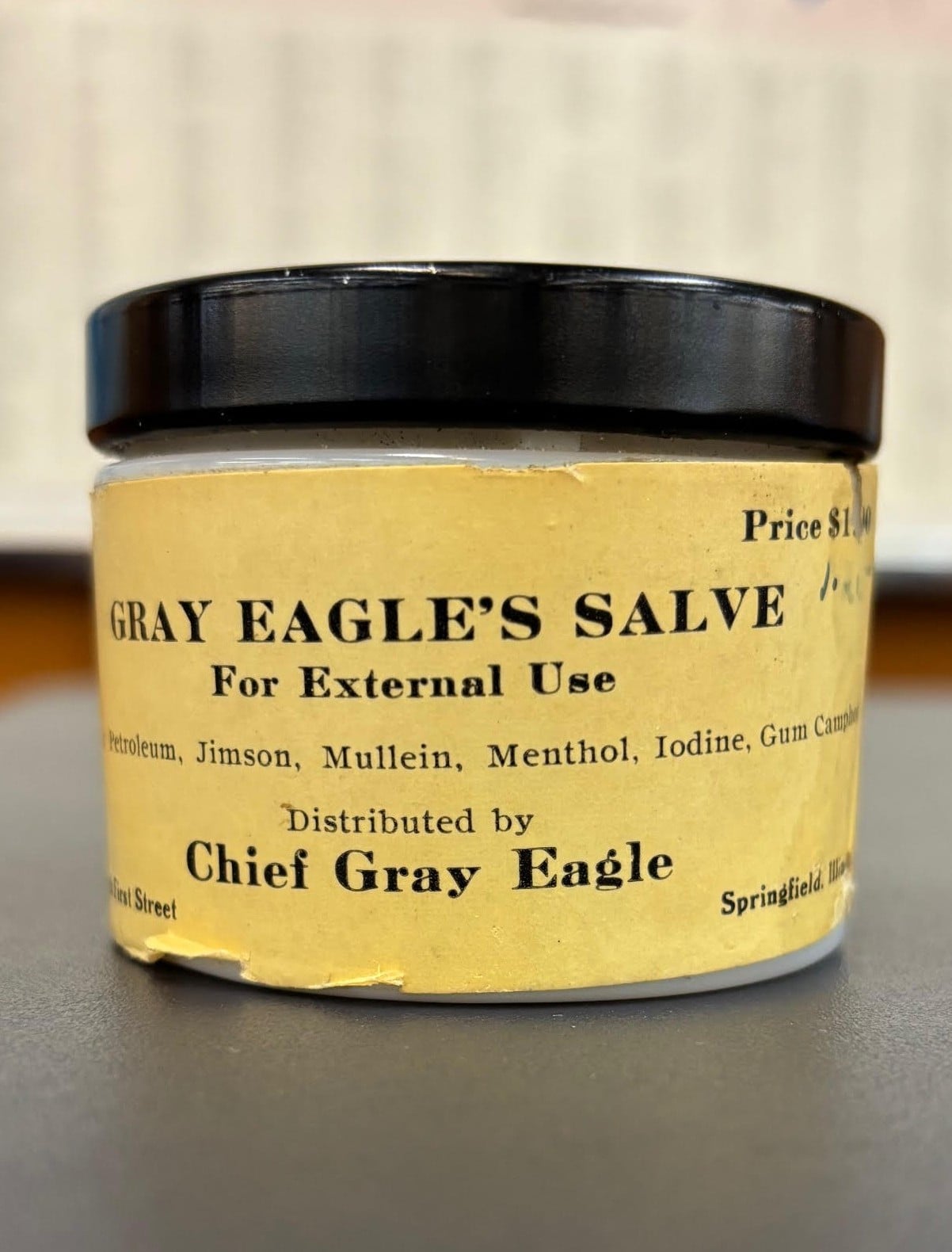
Unopened jar of Gray Eagle’s Salve, Sangamon Valley Collection (Sangamon County Historical Society photo)
Chief Gray Eagle, a Native American born in Oregon, sold what the label claimed was a miracle-working ointment for two decades in Springfield.
According to the label on each 2-ounce, $1.25 jar, Gray Eagle’s Salve could treat symptoms of head colds, poison ivy, hemorrhoids and aching feet. “For nasal irritation, apply generously to each nostril,” the label said. “(S)niff well up in head, then blow nose several times in handkerchief. Use as often as necessary.”
The cream might have had some useful effects. Several of its listed ingredients – petroleum, menthol and gum camphor (with the additions of jimson, mullein and iodine) – were similar to ingredients in Vicks Vapo-Rub, used by many people to deal with a cold and stuffy nose. Similarly, Vaseline and other brands of petroleum jelly act as skin moisturizers and protectants.
It’s possible that Chief Gray Eagle (1871-1946), who lived in Springfield from the late 1920s until his death in 1946, adapted his formula from both of those products.
Eagle’s early background is vague, partly because he was an itinerant showman for much of his life and partly because official records are sparse anyway – it was 1890 before the U.S. Census Bureau first tried to count all Native Americans.

Chief Gray Eagle’s portrait (undated pamphlet, Sangamon Valley Collection)
According to his Illinois State Journal obituary, however, Eagle was born on the Umatilla reservation near Pendleton, Ore. As a boy, the obituary said, he attended the Haskell Institute, a school for Native American children in Lawrence, Kan. (The institution first opened in 1884 under the name United States Indian Industrial Training School. It was renamed the Haskell Institute in 1887 and today is Haskell Indian Nations University.)
At any rate, Eagle apparently wasn’t a Haskell student for very long. “Before completing his education, he left the school and joined a medicine show in St. Louis,” the obituary said. “After several years on tour with the show, he started his own medicine show in 1894.”
Eagle reportedly spent the next several decades performing across the U.S. and Europe in medicine shows and “an Indian opera company.”
He was designated a chief, according to the obituary, at a meeting of the “head council of American Indians” held in Cleveland in 1918. This part of Eagle’s resume seems impossible to verify. SangamonLink couldn’t locate any online mentions of such a group in 1918, and there are no references to such a meeting in the archives of the Cleveland Plain Dealer. A number of Native American nations formed the National Council of American Indians in 1926, but Gray Eagle isn’t mentioned in what little information is available about that organization.
Eagle, however, said the designation entitled him to wear a bonnet containing 32 eagle feathers (or maybe 42; the number is different in various newspaper stories, possibly due to reporters’ errors).
Eagle apparently had stopped touring with medicine shows by 1925, when the business section of the Peoria city directory listed “Gray-Eagle Chief” under the “Medicines” category.
Eagle married his second wife, Mary “Mamie” Colvin (1886-1972) of Springfield, in St. Louis in 1929. The couple lived at 936 N. First St. until Chief Gray Eagle died two decades later.
Aside from producing his ointment, Eagle was a frequent speaker locally on Native American history, his conversion to Christianity and similar topics. “Dressed in his tribal costume, Chief Gray Eagle was an imposing figure as he mounted the platform to speak at chautauqua meetings,” the obituary said.
Eagle printed a pamphlet about his religious awakening. It’s undated, but the Sangamon Valley Collection, the regional history section of Springfield’s Lincoln Library, has a copy of the pamphlet, as well as an unopened jar of Gray Eagle’s Salve.
A church group, he wrote in the pamphlet, once petitioned the federal government to ban Native American traditional dress and force indigenous people to “quit dancing those heathenish and savage dances.”
I wrote them I would never wear Indian clothes again when the white girls commence wearing some clothes and that I would never dance another Indian dance when the white people quit dancing the “shimy (sic).”
I went to a dance one evening out of curiosity and saw a number of girls with hardly anything on but a bead necklace and they were trying to “shimy” that off.
Eagle also spoke up when indigenous people were disparaged. In 1933, Eagle responded when an Illinois State Journal story about Macoupin County history called a group of Native Americans “red devils.” “White devils,” Eagle wrote Journal editor J. Emil Smith, had done worse to Native Americans. Then he added:
When an Indian wishes to become a leader, he must do deeds of honor to win his feathers. … If at any time the Chief does anything unfair or crooked, he is stripped of his feathers, kicked off the reservation and no Indian will speak to him or have anything to do with him.
It would be well if the white man would adopt some of the Indians’ way of putting men in responsible positions.”
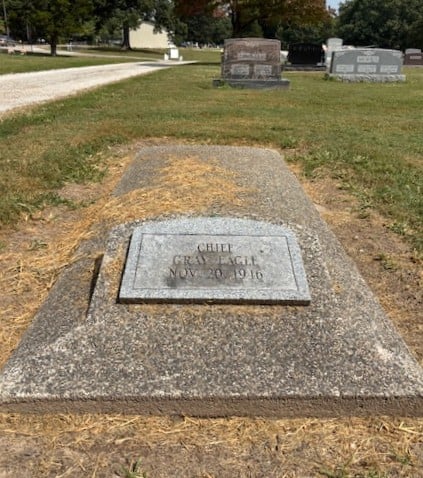
Chief Gray Eagle grave, Oak Hill Cemetery (SCHS)
The obituary called Eagle’s home “a mecca for ailing persons who came from throughout Illinois as well as from other midwestern states to purchase medicine which the chief made from herbs.
“The residence, on the marked route to Lincoln’s tomb, is viewed by thousands of visitors to Springfield. Many stop to admire the large, colorful statue of an American Indian and another statue of an American eagle which grace the front yard of the home.”
The Eagles sold much of Gray Eagle’s collection of memorabilia a couple of years before he died. The statue of the Native American went to an antique store in Mason City, where it was displayed outside.
However, the sculpture was stolen and severely damaged by vandals in March 1963. The Sunday State Journal-Register reported on the theft in a stunningly insensitive article, headlined “Redskin Relic Removed: Stolen by Palefaces?”.
If Chief Gray Eagle had still been alive, the newspaper’s editor probably would have received another letter.
 Chief Gray Eagle is buried at Oak Hill Cemetery near Clear Lake. Mamie Eagle’s grave is at Oak Ridge Cemetery.
Original content copyright Sangamon County Historical Society. You are free to republish this content as long as credit is given to the Society. Learn how to support the Society.
March 3, 1963, edition of The State Journal-Register, page 28, headline reads, “Redskin Relic Removed; Pilfered by Palefaces?”
The use of alliteration for newspaper headlines was big ‘back in the day’ regardless of insensitivity.