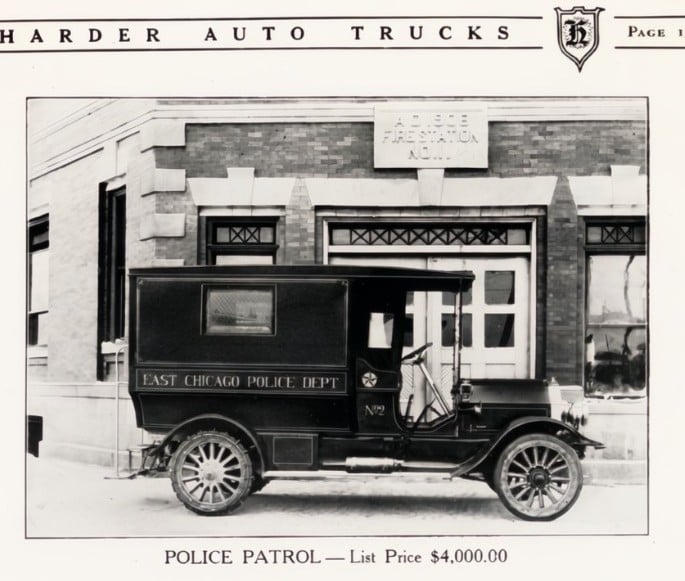
A Harder Auto Truck Co. motorized police wagon, 1913 (Facebook group “Car Brochures & Adverts”/Heikki Siponen)
Springfield city government entered the automobile age on July 30, 1913, when the police department’s first gasoline-powered vehicle went into service.
The wagon collected its first prisoner and its nickname a few hours later. The arrestee was Arthur Luckey, a carpenter who got drunk and fought with his wife. The truck, naturally, was immediately dubbed “Lucky.”
Speed was Lucky’s key advantage over the horsedrawn wagon the city used previously. “Four minutes after the call (involving Arthur Luckey) arrived at the station,” the Illinois State Journal reported July 31, “the police arrived at the scene of the disturbance two miles away.”
Lucky had been manufactured by the Harder Auto Truck Co. of Chicago. The wagon cost $2,250 and could carry 10 passengers. Besides hauling officers and arrestees, it sometimes served as an ambulance.
Buying the police patrol was a yearlong process. Officials spent months discussing the idea, visiting other cities to examine their gasoline vehicles and putting the project out for bids. Even after the city council chose the Harder wagon, police tested the truck by driving it from Chicago to Springfield. From the Journal’s July 30 story:
Averaging twenty miles per hour, five members of the Springfield police force arrived in this city at 6:30 o’clock last evening in the new auto police patrol from Chicago. William Sanders, George Pehlman, Daniel R. Buck, Sergeants (Dennis) Gannan and (Charles) Phillips, the officers who composed the party, left Chicago at 8:30 o’clock Monday morning. Stops were made at nearly all of the cities of importance between Chicago and this city.
The machine is a Harder, weighs 4500 pounds and can make sixty-five miles per hour. Patrolmen Kunz, Pehlman, Buck and Sanders, the men who are to drive the car, will spend to-day in studying the mechanism. The car will probably be pressed into service to-day. It is similar in appearance to the (horsedrawn) patrol wagon now in use.
The vehicle suffered its first accident after only three weeks in action. The Illinois State Register had that story.
“Lucky” had a tough day yesterday. The front end was badly bent when the new car crashed into a fence just west of police headquarters after it tried to run away from a police officer who cranked the machine with half speed on. A mechanic was hurried to the station to fix Lucky up and the wagon was back on the job within a short time.
When the driver used the crank and the machine started off at a jump, it was necessary for him to jump aside to save himself from being run over. Luther Davis, a farmer of Pawnee, who was riding on the seat, jumped before the crash came and was not hurt.
As it turned out, Lucky didn’t work out – the wagon was deemed too heavy for police work only two years after it was purchased. (The truck did last longer than its maker, however. The Harder Auto Truck Co. apparently existed only from about 1911 to 1913.)
Police replaced Lucky with a series of Ford automobiles.
“The city police department yesterday received a new five-passenger Ford touring car, which was immediately put into service,” the Register reported in February 1916. “The old Ford, which had been used for two years, was traded in as part payment. The engine was in fairly good shape, but the body was worn out after traveling over 25,000 miles in the two years.”
Lucky languished in the police garage until January 1917, when the Register reported officials had finally found a use for it.
“Lucky,” which is named after the first prisoner that rode in it, will be supplanted in the police department by a Ford automobile which has been fitted up as a patrol and ambulance by Gietl Brothers of Springfield. “Lucky” is to be sold to the water department and will be dismantled and used as a truck for hauling heavy iron pipe and other material.
The old truck has proved to be too heavy a machine, and its upkeep has been too great for service in the police department, according to present city officials, and for this reason is to be abandoned by the police.
The smaller car which is to take its place will be able to cover the ground in less time and will be more convenient from every point of view, the police say.
First fire engine
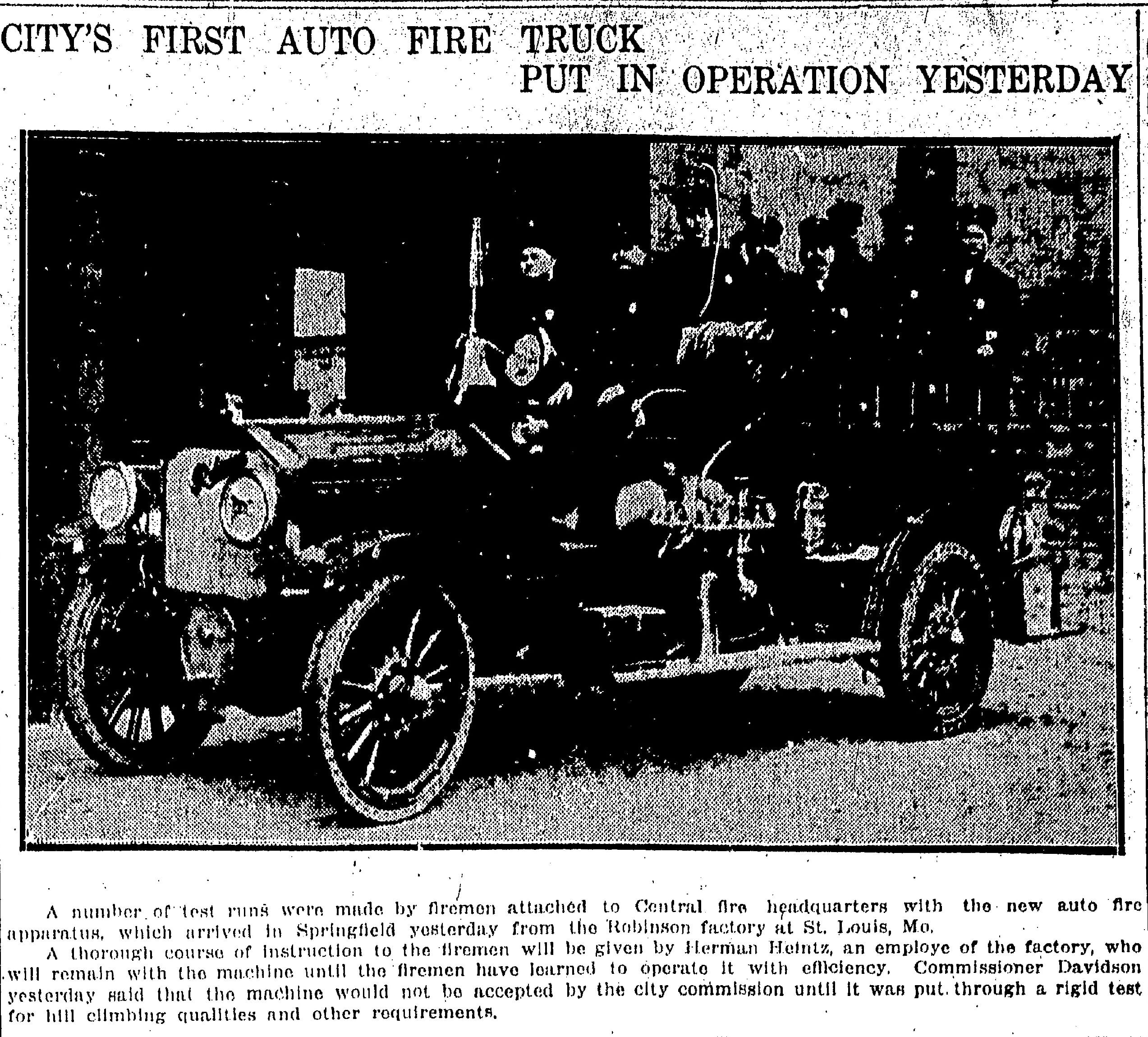
Springfield firefighters show off the city’s first motorized fire truck, Jan. 31, 1914 (Courtesy State Journal-Register)
The Springfield Fire Department’s first motorized fire truck turned out to be a better deal.
The truck, built by the Robinson Fire Apparatus Mfg. Co. of St. Louis, arrived in the city Jan. 30, 1914. The Register’s description:
The truck is equipped to do very efficient work. It carries 1,100 feet of regular fire hose, 250 feet of chemical hose, two 35-gallon tanks of chemical, a 24-foot extension ladder, two smaller ladders, an extra fire-extinguisher, picks, crowbars, etc.
The chief of the fire department, Henry Bolte (1862-1929 – ed.), the city commissioners, and all of the firemen of the local department are confident tat the new apparatus will prove to be a valuable addition to the fire-fighting strength of the department.
Like Lucky, the fire truck got its nickname from its first run, to a fire at the home of Leonard “Hickey” Freelove on South 15th Street.
Fire Chief Peter Jacobs, who succeeded Bolte in 1915, reported in 1916 that the Hickey truck had saved money for the city, according to a Journal article.
The total cost of maintaining the Robinson fire engine, outside of repairs, for the year ending August 15, 1916, is $131.47. The purchase of the engine eliminated the use of four horses. The total cost of maintaining them would be $860.
The report of the fire chief shows that the new engine traveled a distance of 459.8 miles and was pumped for a total of twenty-four hours. One hundred and one and one-half gallons of water was used, which cost $50.75, and 512 gallons of gasoline was consumed, the cost of which was $80.72.
Results like that probably helped persuade voters in 1917 to approve borrowing $50,000 to convert all of the city’s fire equipment from horsepower to gasoline power. The bond issue allowed the department to discard 15 pieces of horsedrawn equipment and replace them with nine motor-driven vehicles.
“The idea of the commissioners is to place the fire department on an A-1 efficiency basis at one stroke,” the Register said.
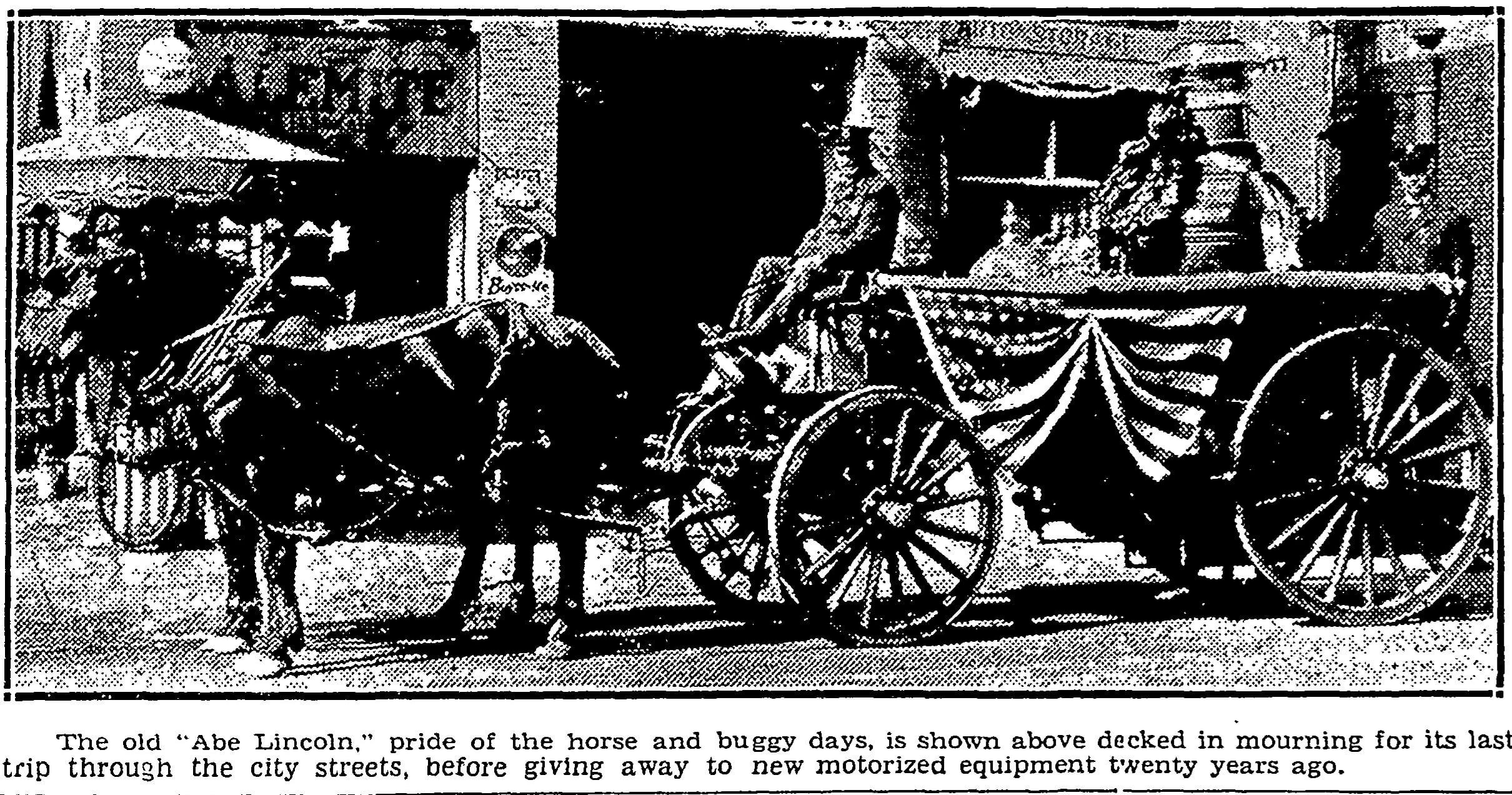
The last run for ‘Old Abe,’ one of the Springfield Fire Department’s horsedrawn pumper trucks, as remembered in a 1938 Illinois State Register story (SJ-R)
The last three fire horses in Springfield – the team of Charley and Dan, operating out of Engine House No. 2, Fourth and Jefferson streets, and Old Bob, the chief’s horse – were sold off in March 1918.
The most expensive vehicle on the city’s motorized shopping list was a $10,000 aerial truck that featured a 75-foot extension ladder. When tested in May 1918, the ladder reached the seventh floor of the Leland Hotel, according to another Register story. “The ladder is raised and lowered by means of powerful springs, and it is the latest thing in the way of firefighting apparatus,” the paper said.
The truck also was equipped with an eight-foot net “for catching persons who jump from buildings,” the story said. The net apparently was never employed in Springfield.
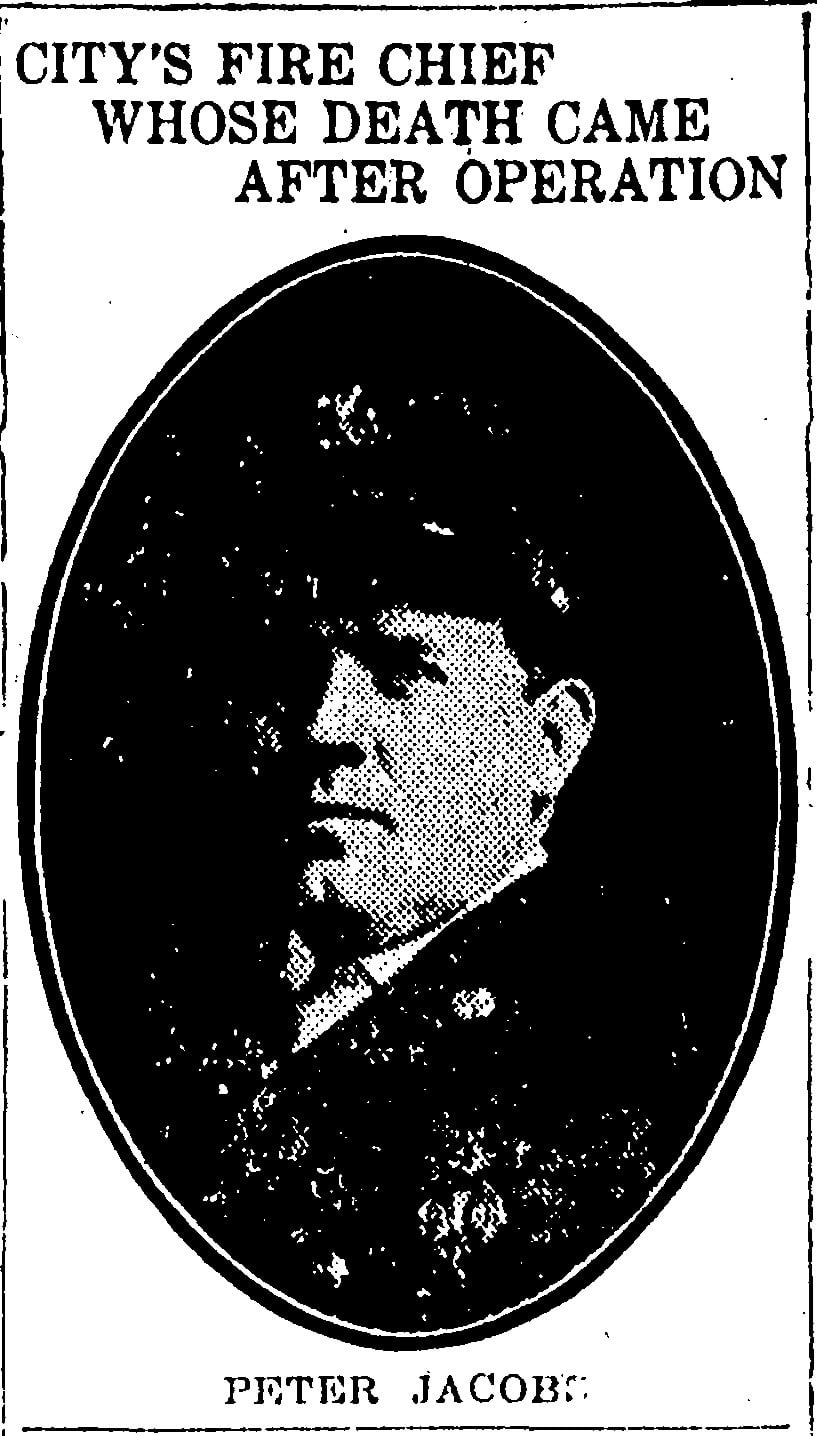
Peter Jacobs’ obituary photo (SJ-R)
Peter Jacobs was still fire chief when he died Oct. 16, 1920, of complications from stomach surgery. He was 55 years old. Jacobs had served a total of nine years as chief under four different mayors. (Jacobs was a close friend of one of those mayors, David Griffiths, and was with Griffiths on the fishing trip in 1907 when Griffiths drowned.)
“The dream of his life was to motorize the department,” Jacobs’ obituary said. “He lived to see it realized.”
 Jacobs is buried at Calvary Cemetery.
Original content copyright Sangamon County Historical Society. You are free to republish this content as long as credit is given to the Society. Learn how to support the Society.