Sundown Corner near Divernon was a landmark in the early days of Route 66.

Sundown Corner, undated. This “Picturing the Past” photo, contributed by Todd Becker of Divernon, was reproduced in the State Journal-Register in 2012. (Courtesy SJ-R)
The “corner”, at the intersection of Divernon Road and U.S. 66, got its name because the bar/restaurant/service station was a convenient stop for people traveling the Mother Road. A “Picturing the Past” feature in the Dec. 9, 2012, State Journal-Register described the spot’s attractions.
Sundown Corner was a combination filling station, tavern, dancehall and towing service and thrived with a steady stream of customers brought to its door by Route 66. … (C)ustomers could fill their cars with Marathon gasoline and fill themselves with Coca-Cola, Budweiser or Fox DeLuxe beers. They then could use the “modern restrooms,” which probably meant they were indoors instead of in an outhouse.
The Sundown Tavern opened on the corner in August 1936, but Virgil “Cork” Boblitt (1903-84) and Earl Ford (1895-1974) took over the business in early 1938. It isn’t clear how long Ford was associated with the corner; he retired in 1954 as operator of Ford’s Garage in Divernon itself. However, Boblitt operated Sundown Corner until 1970, when the site was bought to make way for Interstate 55.
Sundown Corner was one of only five Sangamon County highway services opportunities highlighted in A Guidebook to Highway 66, compiled by Jack D. Rittenhouse in 1946; the pamphlet was reprinted by the University of New Mexico Press in 1989. (The other four locations were the communities of Williamsville, Sherman, Springfield and Glenarm.)

Newspaper ad, August 1936 (SJ-R)
“As far as can be determined, this is the first complete Guide Book ever published covering a transcontinental highway – combining historical data, road information, and accommodations all in one volume,” the UNM version says. “… Use this complete facsimile to retrace the famous old road.”
After noting that Sundown Corner was 173 miles from the start of Route 66 in Chicago and 73 miles from St. Louis, the next large city, the guidebook gives the following description (capitalization and boldface in the original):
SUNDOWN CORNER, at a junction with a road to DIVERNON, a half-mile west. Gas station at intersection. Divernon (Pop. 1,033, alt. 614’) is a small, quiet town. Garage here.
Sundown Corner’s isolation made it a target for burglars. That led to tragedy in 1953, when Cork Boblitt shot and killed a 14-year-old thief, John Cenatiempo of St. Louis. Cenatiempo, two other teenage boys and a 13-year-old girl had stolen a car in St. Louis and made their way north on Route 66.
Cenatiempo and one of the other boys broke into the tavern’s cash register. Boblitt, who lived in quarters adjoining the tavern, “was awakened by the ringing of a cash register bell, went to investigate and fired three shots upon seeing the burglars,” the Illinois State Register reported. “Cenatiempo was hit in the neck by one of the bullets.”
The quartet escaped in the stolen car toward Springfield. They stopped at the Southern View Motel to get medical help for Cenatiempo, but fled again when the motel owner called state police. Cenatiempo’s body was found the next day in a ditch south of the motel, and the other three teenagers were arrested in Edwardsville.
A coroner’s jury later ruled that Boblitt “should be exonerated of all blame” in the shooting.
Boblitt fired at another Sundown Corner burglar under similar circumstances in 1961. That time, the unhurt thief was captured a few hours later. His loot amounted only to a package of frozen corn.
A Guide Book to Highway 66
Author Jack D. Rittenhouse (1912-91) self-published his original A Guide Book to Highway 66 in 1946. According to his findagrave.com obituary, Rittenhouse went on to create the Stagecoach Press, which published 50 titles dealing with the American Southwest between 1949 and 1967. He retired as editor of the University of New Mexico Press.
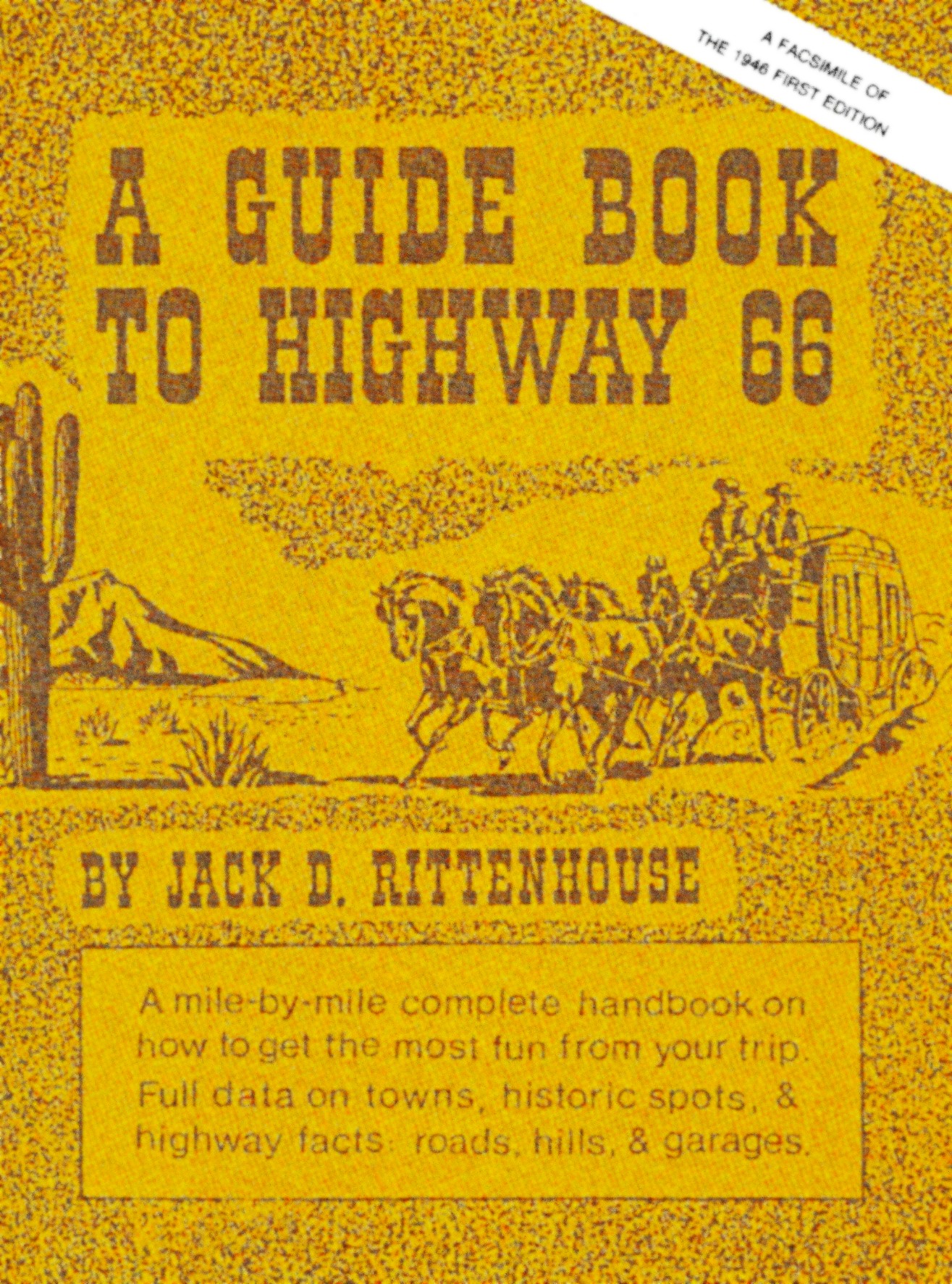
Facsimile edition of Jack Rittenhouse’s guide to Route 66 (University of New Mexico Press)
In his explanation of how to use the Route 66 pamphlet, Rittenhouse was careful to note its limitations and to remind drivers of the difficulties of post-World War II travel. For instance, he wrote:
It would be ideal if each tourist court and hotel could be listed in detail, with its size, rates, type of accommodations, and rating of quality. However, in view of the unsettled condition in this immediate post-war period, any such detailed listing might change quickly. … Perhaps in the next edition, such complete data can be included (there was no next edition – ed.) …
In spite of the housing shortage, there are still accommodations for tourists – if you do not wait until too late in the day to secure lodgings. The best idea is to plan to stop before 6:00 p.m., earlier if possible, and locate lodgings promptly. Don’t wait until after the evening meal – get your cabin or hotel room first, then eat.
Rittenhouse counted Springfield among the 10 major cities he identified on Route 66, but added that his book was primarily a guide to areas between those cities. “Any major gas station can supply you” with a map of the cities, he wrote.
Nonetheless, he devoted several paragraphs to Springfield, “famous as the home of Abraham Lincoln.” His capsule description included lists of selected repair garages and overnight accommodations:
 Springfield garages: Uptown, Thomas, Motor Inn, Midtown “and others.”
- “Main hotels”: Abraham Lincoln, Leland, Nicholas, Illinois.
- Travel courts: Highway Hotel Court, Bedini’s Lakeview Cabins, Johnny & Janey Camp, Ahrenkiel Service Station Camp, Capitol Tourist Camp, Moderne Court, Poland’s Modern Cottages and Sabattini’s Cabins.
“A good café is Maldaner’s,” Rittenhouse wrote.
Original content copyright Sangamon County Historical Society. You are free to republish this content as long as credit is given to the Society. Learn how to support the Society.