
A tiny sign above a self-service stamp machine is the only public indication that Springfield’s Cook Street post office is named after a World War II hero.
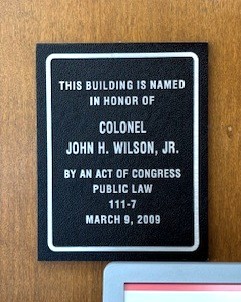
A sign in the post office notes Wilson’s distinction (SCHS)
John H. Wilson Jr. (1918-2008) earned a Silver Star, the nation’s third highest military combat decoration, while a first lieutenant in the 599th Ordnance Ammunition Company, part of Gen. George S. Patton’s Third Army, in France in summer 1944. According to his citation, Wilson was honored for “gallantry in action … while personally directing the safety of all of his men while being bombed and strafed by enemy aircraft.”
Wilson, the son of John H. Wilson Sr. and Hazel Bates Wilson and a graduate of Springfield High School, enlisted in the Army in 1942.
Wilson was African-American, meaning, although the limited information available online doesn’t say so, the 599th Ordnance Ammunition Company was an all-Black unit. The U.S. military observed strict racial segregation until the mid-1950s. Most Black units in WWII had non-combat roles, although Wilson’s experience shows that didn’t always keep them out of danger.
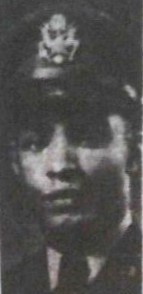
Lt. John H. Wilson Jr., 1944 (Courtesy State Journal-Register)
He had little to say about his Silver Star in a 1997 newspaper interview. “I was in the wrong place at the right time,” Wilson told State Journal-Register reporter Frank Fuhrig.
Wilson joined the U.S. Army Reserves before leaving Europe after the war. When he returned to Springfield in 1948, he was assigned to the locally based 303rd Ordnance Group (Ammo). Wilson remained with the 303rd until he retired in 1973, including six years (1967-73) as group commander. (The 303rd was disbanded during a reorganization in 2008.)
His promotion to colonel in 1965 made Wilson the first African-American to attain that rank in the Illinois Reserves; he apparently was only the seventh Black Reserves colonel anywhere in the U.S. Wilson later received the Army’s Legion of Merit award for his Reserves leadership.
When he signed up with the Army Reserves, Wilson also joined the Reserve Officers Association and similarly stayed with that organization for more than 50 years. He was president of ROA’s Springfield chapter in 1960-61 and the ROA Illinois department president from 1971 to 1972. Wilson also was a member of the Military Officers of America.
U.S. Sen. Dick Durbin sponsored the 2009 legislation naming the Cook Street Post Office after Wilson. The idea was instigated by Dave Loebach, who served under Wilson with the 303rd and alongside him in the Reserve Officers Association.
In civilian life, Wilson worked for the U.S. Postal Service for 57 years. He also was a commercial photographer and a life member of Holy Trinity Lutheran Church.
Wilson is buried at Camp Butler National Cemetery.
The Wilson family
John H. Wilson Jr.’s parents also made their marks in Springfield.
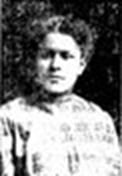
Hazel Bates (Wilson), 1907 (SJ-R)
Hazel Bates Wilson (1889-1977) probably should have been the salutatorian of the winter 1907 graduating class at Springfield High School. She apparently was kept from that honor by grade finagling that prevented two Black students from winning the class’s top academic honors.
Another African-American, Josephine Snowden, was the top-ranked student going into the class’s final academic period. Hazel Bates ranked second. However, both their grade-point averages suspiciously slipped in that final term. As a result, a white student became valedictorian instead of Snowden, who was named salutatorian, and Bates’ class standing slipped all the way to fifth. Read more about that controversy here.
J.H. Wilson Sr., 1970s (SJ-R)
John H. Wilson Sr. (1889-1973) was one of the earliest members of the Springfield branch of the NAACP, formed about 1915. He served as the group’s vice president from 1938 through 1941 and as president in 1942-43. Wilson also led a troop of African-American Boy Scouts for almost 40 years, receiving the organization’s Silver Beaver Award, the highest the organization gives to adult leaders, in 1939.
Wilson’s leadership in both civil rights and Scouting coincided in 1939, when he filed suit against the Frisina theater chain. Local Scouts and Scout leaders had been invited to a screening of the film “Boy Scouts to the Rescue” at the State Theatre, 613 E. Washington St., but the State’s ticket seller refused to admit Wilson because he was Black. Circuit Judge L.E. Stone dismissed the case, but Wilson filed it again, seeking $500 damages.
 When the second case went to trial, the Illinois State Journal reported, “Several scouts of Wilson’s troop appeared in court in uniform.” The jury nonetheless ruled in favor of the Frisina company.
Original content copyright Sangamon County Historical Society. You are free to republish this content as long as credit is given to the Society. Learn how to support the Society.
The baseball diamond over at Griffin High School used to be known as Vitale Field. It had been named for Bill Vitale, a Griffin boy who gave his life in the Republic of South Vietnam in the service of our country. He was posthumously awarded the Silver Star for gallantry in action. RIP Vitale. The school changed ownership, a new stadium was built, and it was named for a new donor. It will always be Vitale field to me. RIP Wilson.
I knew John from the early 1960s when I worked the night shift at the Springfield Post Office (11:30 pm to 8:00 am). He was one of several World War II veterans who worked that shift their entire postal career. Me, I couldn’t wait to switch to days! John, being a really good photographer, came out to Farmingdale in 1970 to take a picture of my boys’ Khoury League 9-10 years old team. I still have that photo. He was a great gentleman and fine co-worker.