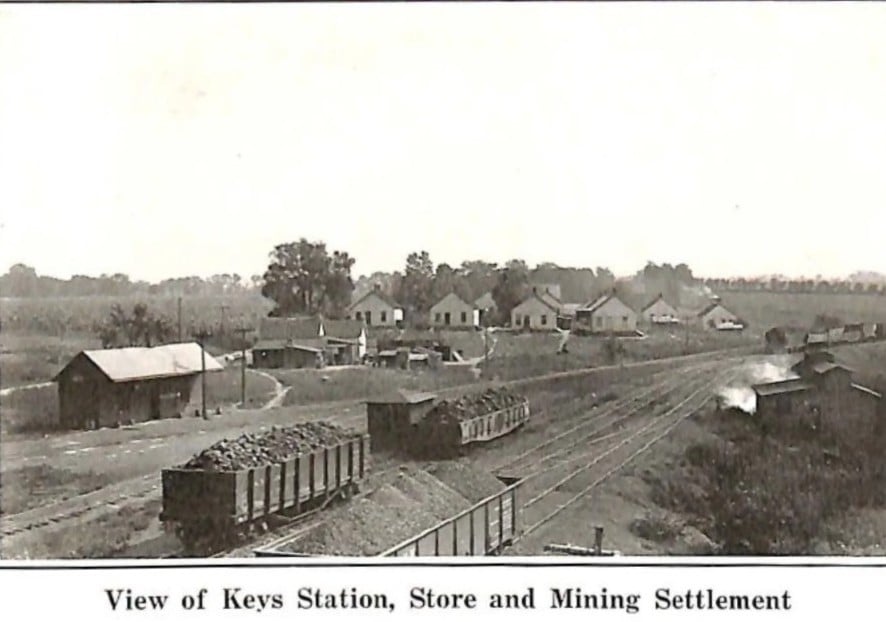
Partial view of Tuxhorn Mine structures in 1918. Miners’ cottages are in the background. (Orange Judd Farmer Pictorial Community Album of Rochester Township and Village)
The Tuxhorn Coal Mine, which opened in 1903 in the Round Prairie/Rochester area, produced more than 3 million tons of coal before it closed two decades later. As many as 250 miners worked at the mine during its most productive years.
The mine got its name because it was built on land that previously belonged to William (1857-1929) and Louise (1854-1936) Tuxhorn (one of their eight children, John Tuxhorn Sr., founded the Tuxhorn Garage, famous for its “Tuxhorn pink” tow trucks). William Tuxhorn, who formerly farmed in Woodside Township, purchased 120 acres in Round Prairie from O.L. James in 1896. The land included a home, known as Elmhurst, and the later mine site.
William Tuxhorn sold the property’s mineral rights in 1902; a year later, he sold 20 acres of land to Edward D. Keys (1852-1935), a Springfield banker and financier. In 1910, Tuxhorn sold his remaining property, including Elmhurst, to neighbor Conrad Heissinger (1851-1936) and moved back to Woodside Township.
The mine operated from 1903 to 1919 as the Tuxhorn Mine and from 1919 to 1924 as Union Fuel Co. Mine No. 2. The mine site, located on what now is Tuxhorn Road, and the community that surrounded it were commonly known as Keys or Keys Station.
The mine was incorporated in March 1903. The original board of directors included Edward Keys; his son George (1880-1967), also a banker; Springfield coal mine entrepreneur Robert C. Solomon (1849-1911); and Frank Roby of Decatur, a lawyer and former president of the Cincinnati, Hamilton and Dayton Railroad, whose tracks ran through the middle of the mine site. The largest bloc of stock was held by M.D. Woodford of Ohio, president of the CH&D at the time.
According to the Illinois State Geological Survey, the Tuxhorn’s coal vein was about six feet thick under four feet of stone (which suggests there might have been outcrops on the southern edge of the property). The mine was 220 feet deep at the shaft. Underground, it extended several miles in each direction, taking in some 764 acres. It employed the common “room and pillar” technique, in which coal was dug out to form rooms and pillars left to support the roof.

Tuxhorn mine surface layout (Illinois State Geological Survey)
Above ground, the Tuxhorn Mine also was typical of central Illinois coal mines. An ISGS map shows the main mine structures: a wash house, the hoist and shaft, the tipple (the large structure used to load coal onto rail cars) and an air shaft. A 1918 photo of the mine adds some other features: a store, railroad station, and miners’ houses in the distance. Some miners lived on site, though many came from Springfield by train
The Tuxhorn Mine was both a shipping mine and a local mine. Convenient access to the CH&D meant much of its output shipped out on trains for industrial purposes. But the Tuxhorn also sold coal to nearby residents, who used it for household heating and cooking.
“… (H)eat was mostly from stoves using coal,” lifelong Rochester resident Esther Taft said in a 1974 oral history interview for the former Sangamon State University. “Some people had furnaces, but most people had coal stoves. They cooked on coal ranges and heated with coal.
“Now, coal was hauled from Tuxhorn, which had a mining town a few miles northwest of Rochester, and there were several people in the village who hauled coal. … Later they had trucks, but I recall the horses and wagons hauling coal from Tuxhorn. I myself went with my father when I was a little girl when he would haul coal from Tuxhorn, and we bought our cold soda pop from … the little store in Tuxhorn.”
The mine brought electricity from Springfield in 1914, allowing the company to use electrical equipment instead of man- and mule-power to mine and haul coal. In 1915, as noted by local historians Ray and Pam Bruzan, Rochester extended power lines from the mine to the village.
The Tuxhorn Mine went through a variety of management changes during its existence. William Outten, another Decatur lawyer associated with the CH&D railroad, was named president in 1904. “Colonel” James Jefferson (1847-1924), an insurance and printing financier, took over the presidency in 1905.
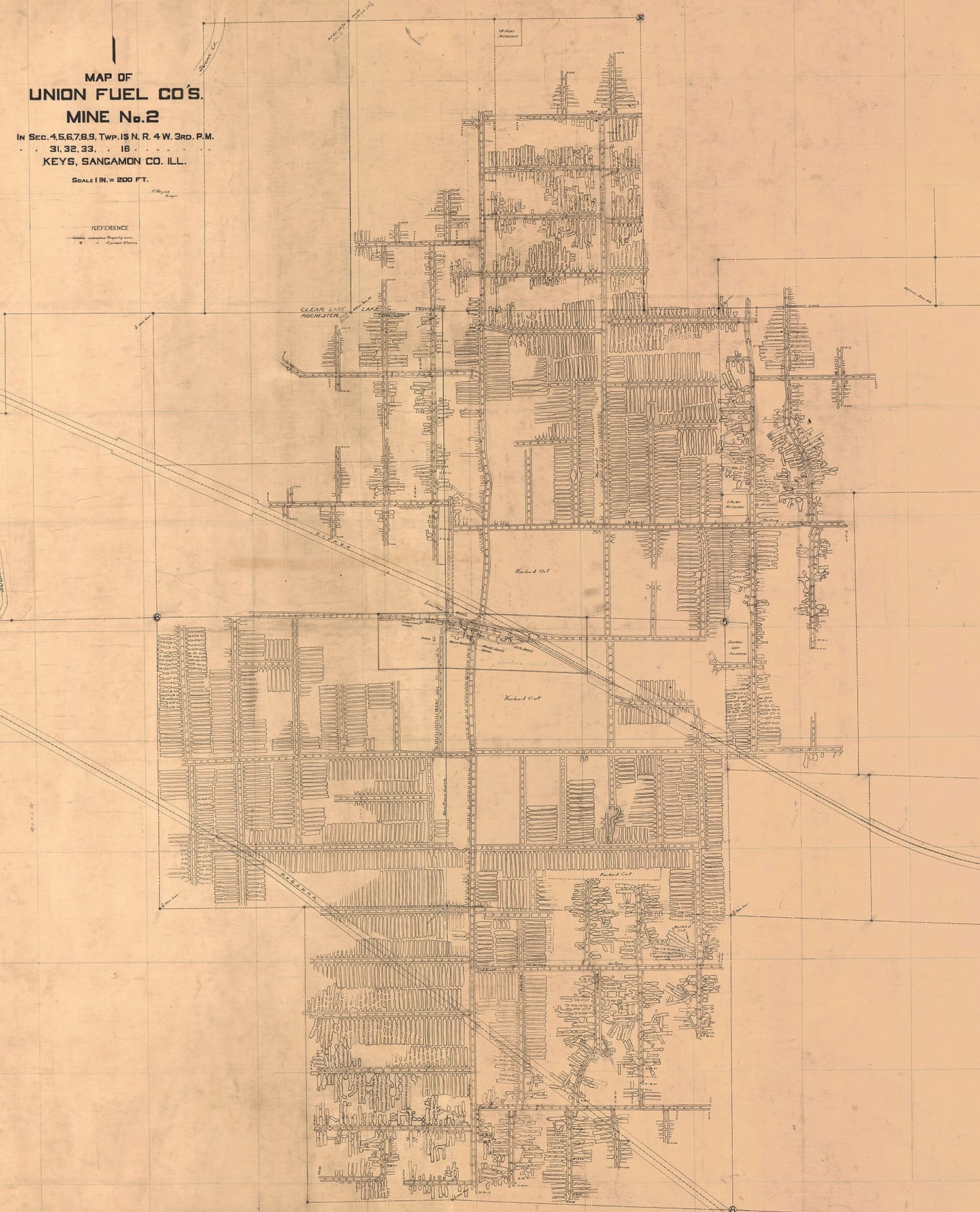
Larger-scale map shows underground coal excavations at the Tuxhorn mine (ISGS)
Jefferson still ran the Tuxhorn in 1919, when the newly formed Union Fuel Co. bought it and three other area coal mines and consolidated them as the Union Fuel Co. The new company was headed by Leslie Pulliam (1881-1935), a Springfield banker and real estate developer.
Pulliam moved Union Fuel’s headquarters to Chicago for a time, but the venture apparently wasn’t successful. Pulliam returned to Springfield and handed off management of the Union Fuel mines to the Leland Coal Co. in 1923.
By then, however, the Tuxhorn was operating only intermittently. It apparently shut down for good in late 1923 or early 1924.
The mine must have brought complex cultural challenges to Round Prairie. The miners were mainly Italian and Lithuanian and often did not speak English. Presumably miners living on site sent their children to the nearby South Round Prairie school, which was probably not well equipped to teach immigrant children. Altercations were reported at the mine, some involving miners and some involving their families.
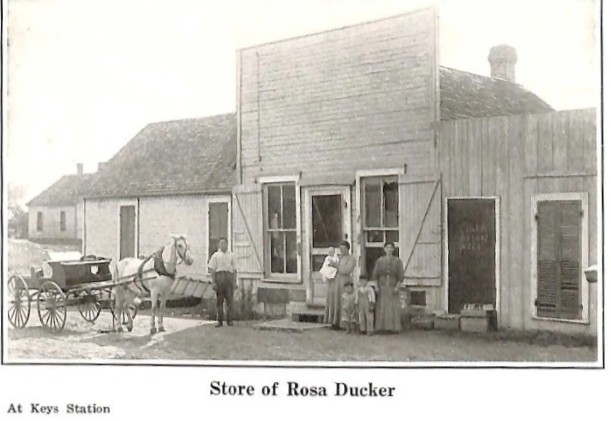
The Ducker Store, which served miners and their families, 1918; in her interview, Esther Taft said the family’s name was DeCroix, not Ducker, but Ducker seems to be correct. (Orange Judd Pictorial Album)
Mining coal was a dangerous occupation, and there were many injuries at the Tuxhorn. For example, a fire in the engine room in 1904 caused an oil tank to explode, badly burning night engineer Michael Finnegan. And in 1905 miner James Ford suffered a crushed leg when he was caught between a car and a wall.
In 1918 there was an interesting intersection of war funding, labor, immigration, and race relations at the Tuxhorn Mine. The dispute played out in articles and letters in the Springfield newspapers as well as in confrontations at the mine site.
It apparently started with a pledge by Robert Jackson, president of the Tuxhorn Mine local of the United Mine Workers of America, that every Tuxhorn union worker would buy at least one World War I Liberty Bond and that the local would contribute to the Red Cross. However, labor radical George Voyzey allegedly stirred up the mine’s foreign-born miners against Jackson’s supposed “high-handed methods.”
Complicating the split was the fact that Jackson was African-American, leaving the miners split on both racial and ethnic lines. Anti-Jackson miners refused to work for at least a few days, although the effect was limited by the fact that the strike took place during the summer, when central Illinois miners often had no work anyway. The dispute ended in mid-August, when Jackson resigned as local president.
It was also tough to have a coal mine as a neighbor. Conrad Heissinger, who lived in the house directly across the road, sued the company over dust and fumes in 1921. However, Heissinger previously had sold his mineral rights and leased a pond to the mine. The contracts caused him to lose the lawsuit.
Tuxhorn Mine today
As of 2025, Elmhurst, the Tuxhorn home, was still standing on the present-day Tuxhorn Road, perhaps 200 yards west of the mine shaft. The former mine property itself held a house, machine shed, chicken coop (sometimes with eggs for sale), barn, several fenced pastures, and the bed of the old railroad line. None of the structures shown in the ISGS map remained.
The house and barn previously were owned by Bill and Alison Seiz. Bill did a lot of work there – he built the house and barn, leveled the railroad bed, and raised the area around the barn and chicken coop to the level of the road — by as much as 6 feet in places. The Seizes found evidence of the old mine when they bought the property: remnants of equipment and debris, such as bricks, glass bottles, and clinker from burned coal. Bill was told that tools and machinery were dumped down the shaft when the mine was abandoned. A large concrete block (probably the anchor for the hoist, since this is roughly the location the ISGS map shows for the hoist) sits in the garden immediately east of the house. There was a large concrete wall, way too deep and large to remove, south of the chicken coop, so Bill dug a hole below it and pushed the wall over into the hole. This was probably part of the exhaust shaft.
The rail bed extends diagonally from northwest to southeast, crossing Tuxhorn Road and continuing easterly towards the South Fork of the Sangamon River.
The miner’s houses fared better than the other structures. Of the eight houses seen in the 1918 photo, three were still standing in 2025, one in its original location on the east end of the mine site. According to Mike Melton, who lived in one of them in 2025, the miners’ houses originally were 24 feet by 24 feet, with a brick foundation and two brick chimneys; each house contained four rooms with a center dividing wall and two coal stoves, with no basement and no bathroom.
Contributor: Leslie Struble has lived in Round Prairie since 1989. She retired as a professor in the Department of Civil and Environmental Engineering at the University of Illinois in Champaign-Urbana. For the last 15 years she has migrated between Illinois and Wyoming, where she has a cabin in the Shoshone National Forest.
Connections (Leslie Struble)
The Tuxhorn Mine was about two miles from my house, so the people living there would have heard noise from the mine every day that it was in operation.
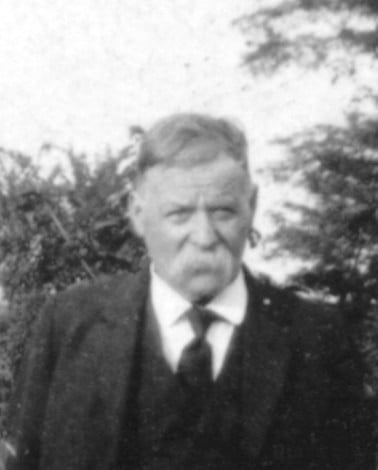
William Tuxhorn, undated (Tuxhorn family)

Louise Tuxhorn, undated (Tuxhorn family)
My house also has several connections to the Tuxhorn family. George Kalb built the house about 1879. George was the nephew of Daniel Kalb, a teacher and farmer in Round Prairie. Daniel’s granddaughter, Laura, married William Tuxhorn’s son Alfred in 1907. Alfred was a cattle farmer and a long-time member of the Rochester School Board.
In addition, William Tuxhorn’s daughter Lena married Lloyd Hart; the Harts rented the house I now live in for some years after George Kalb retired and moved into Springfield.
William Tuxhorn’s son Ben was the grandfather of the present-day Ben Tuxhorn, a member of the Rochester Historic Preservation Society. The younger man spoke with me when I was researching the mine; among other things, he said the Tuxhorn boys (the sons of William and Louise) worked in the mine as young men.
Hat tips:
I appreciate very much the support and interest of the people who helped me with information and photographs: Ray and Pam Bruzan, Linda Heissinger, staff at the ISGS, David and Fay Jostes, Mike Melton, Bill, Alison, and Ryan Seiz, Tim Scannell, Marlene Spurgeon, Ben and Mary Tuxhorn, and Mary Weshinsky.
More information:
Ray and Pam Bruzan, Cotton, Violins, & Shots in the Night, Sangamon Valley Writing Associates, 2017.
Floyd Mansberger and Christopher Stratton, Pick, Shovel, Wedge, and Sledge: A Historical Context for Evaluating Coal Mining Resources, in Illinois, 2005, available in digitized form, http://www.illinoisarchaeology.com/IDNR/Coal Mines/Coal Context 2.pdf.
 Orange Judd Farmer Pictorial Community Album of Rochester Township and Village, Orange Judd Company, Chicago IL, 1918; updated and reprinted in 1995 by the Rochester Historic Preservation Society and available in digitized form from the Rochester Public Library, https://www.rochesterlibrary.org/orange-judd/.
Original content copyright Sangamon County Historical Society. You are free to republish this content as long as credit is given to the Society. Learn how to support the Society.
Very interesting article about the Tuxhorn Mine and family. Referring to the mention of the CH&D Railroad: now I know why three streets in Springfield south of North Grand and east of 19th are named Cincinnati, Hamilton and Dayton, in that order. The railroad reached Springfield and they also named two north-south streets Indiana and Ohio.
Highly interested in ANY other photos of the Keys miner village, Tuxhorn\Union Fuel mine structures, adjoining railroad, and the miners themselves. I’ve been looking for photos for the past 30 years since moving out here, and have only found the same photos in this story. Yes it was 100 years ago, but surely someone has old forgotten handed down family photos?