A photo caption below has been corrected.
Unlikely though it seems, Rochester, Illinois, elevation 570 feet, has a legitimate claim to a mountain in Alaska. But you have to drive 3,800 miles to see it.
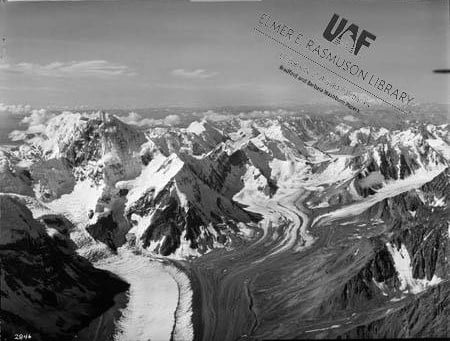
Mount Deborah from the northeast, with Denali in the background (Bradford Washburn Collection, UAF-Washburn-2846, Archives, University of Alaska Fairbanks)
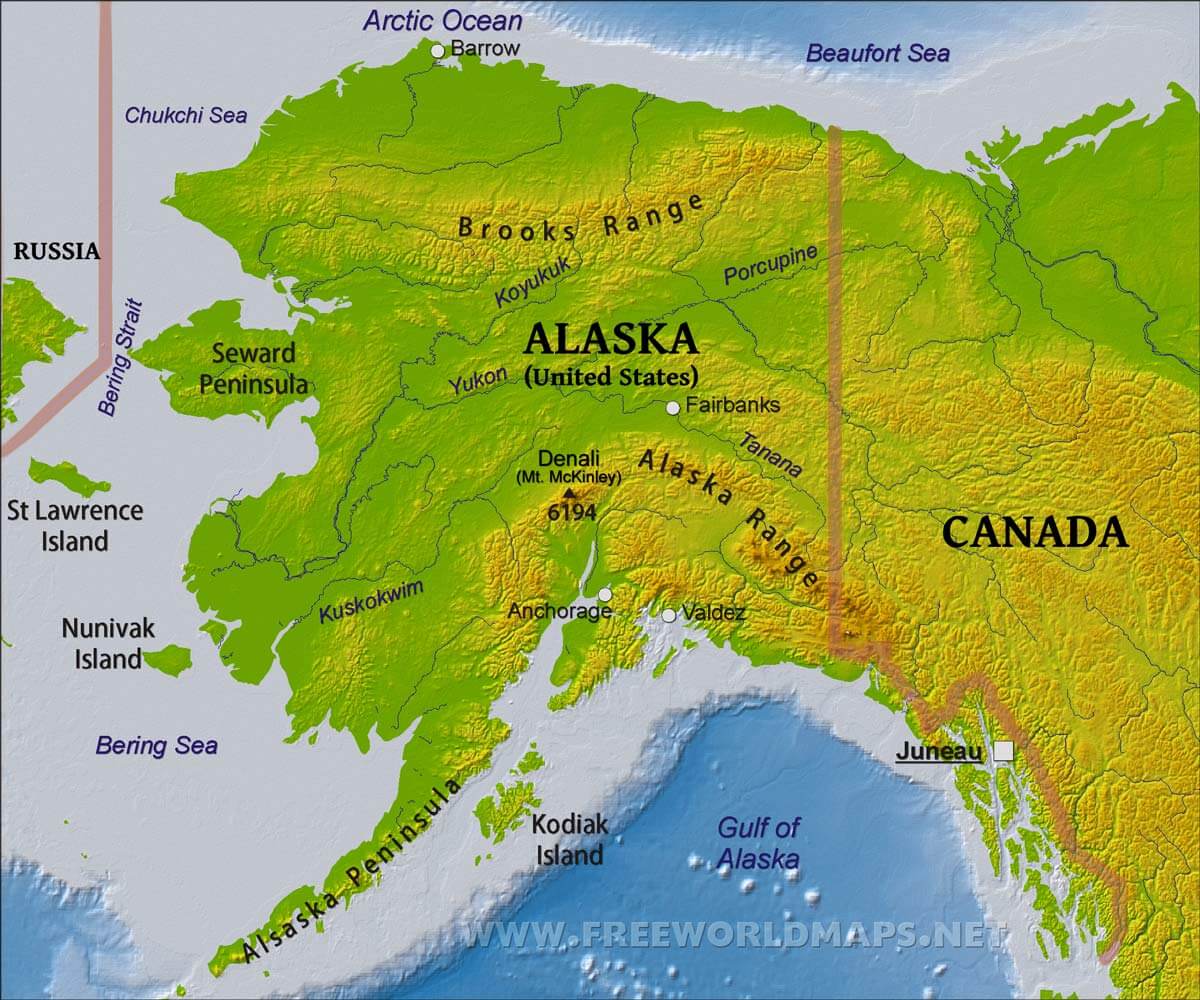
Mount Deborah, 12,339 feet above sea level, is in the Eastern Alaska Range about 50 miles east of Denali. Its namesake is Deborah Bell Wickersham (1861-1926), born in Rochester Township and married in 1880 to James L. Wickersham (1857-1939), then a fledgling lawyer in Springfield and later one of the most important figures in pre-statehood Alaska.
James Wickersham left his hometown of Patoka in southern Illinois in 1877 to move to Sangamon County. His first occupation in Springfield was as a janitor and office boy in the law office of former governor John Palmer. That job gave him a chance to study law at Palmer’s law library.
Wickersham was fascinated with America’s early inhabitants. That took him to Rochester Township, where he excavated more than two dozen Native American mounds along the South Fork of the Sangamon River. He wrote an article in a Smithsonian Institution publication that described finding human remains and stone implements in some of the mounds.
Wickersham also took a teaching position at a one-room country school in Berry, southeast of Rochester. To live near the school, he rented a room at the nearby Isaac Bell farm. There, Wickersham soon became aware that the Bell family included a lovely daughter.
Deborah was the youngest of Isaac and Susan Bell’s six daughters. After completing eighth grade in the nearby one-room country school, Deborah moved into Springfield to attend Springfield High School. After her mother died in 1877, Deborah returned home on weekends to help look after her father and the farm. It was on these weekend visits that she became aware of the handsome Berry school teacher who rented a room on the farm. A romance developed.
In the pivotal year of 1880, James Wickersham passed the Illinois bar exam, and Deborah received her high school diploma. But, as Deborah later described it, her graduation was bittersweet, because she was called on graduation day to the bedside of her ailing father, Isaac. He had died by the time she arrived at the farm.
James was 23 and Deborah 18 on Oct. 27, 1880, when they were married in Rochester’s Methodist Episcopal Church. The newlyweds made their home on the north side of Springfield, and James found employment as a law clerk with the U.S. Census Bureau. He and Deborah welcomed the birth of a son, Darrell, in 1882. (Two later sons died as children.)
The couple moved from Springfield to Tacoma in what was then Washington Territory in the spring of 1883. James built a home, formed a law firm, and helped establish the Tacoma Bar Association. He was elected county probate judge in 1893 and then to the Washington State House of Representatives after Washington gained statehood in 1889. The key step in Wickersham’s career, however, took place in 1900, when President William McKinley named him to one of three federal judgeships in Alaska.
The Wickersham family went by train into Canada, then on the Yukon River to Dawson and finally to their new home in Eagle, Ala. James built a log home for his family and a courthouse for holding trials.
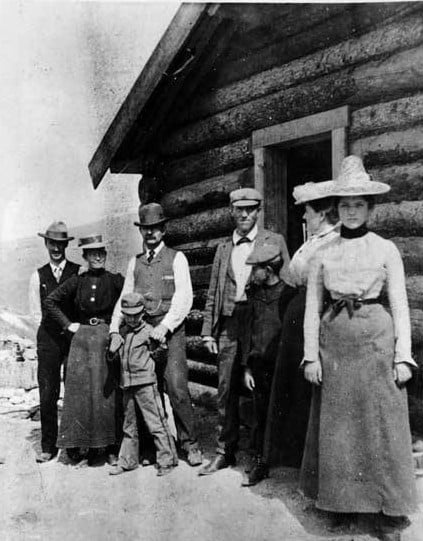
The Wickershams and others inspecting mines in the Klondike, July 1900. Deborah Wickersham is the woman second from left. James Wickersham is next to her in bowler hat. The boy in front is their son Darrell Howard (P277-004-043, Alaska State Library Wickersham State Historic Sites Photo Collection)
As judge, Wickersham helped reduce lawlessness in the districts of Eagle, Fairbanks, and Nome. He then became a territorial delegate to Congress, where he successfully lobbied for funding of the Alaskan Railway and for an agricultural college that later became the University of Alaska. He also advocated for Alaskan statehood, although that would not come to pass until 1959.
Over the years, Wickersham wrote 47 personal diaries and authored a book, Old Yukon Tales, Trails, Trials (1938).
In 1903, Wickersham led the first attempt by white men to climb Denali. His climb took place during a five-month-long “Expedition to Mt. McKinley” (as Denali was known then). He later won legislation to create Mt. Mckinley National Park.
It was during his expedition to Denali that Wickersham named Mount Deborah after his wife, Deborah Susan Bell, born in Rochester. The name is recognized by the U.S. Geological Survey.
In 1923, Wickersham visited Ketchikan and the nearby island of Tongass, the former home of the Tlingit Native Tribe. There he located a totem pole with an attached life-sized statue that looked like Abraham Lincoln. Wickersham, who wanted to save numerous totems that were being lost to decay, was especially interested in saving what became known as the Lincoln totem pole.
As described in 2025 by Brooke M. Morgan, curator of anthropology at the Illinois State Museum, the original totem, carved around 1883, was never meant to honor Lincoln but to recognize the first appearance of a white man in the Tongass territory. The pole’s actual name is the Proud Raven totem.
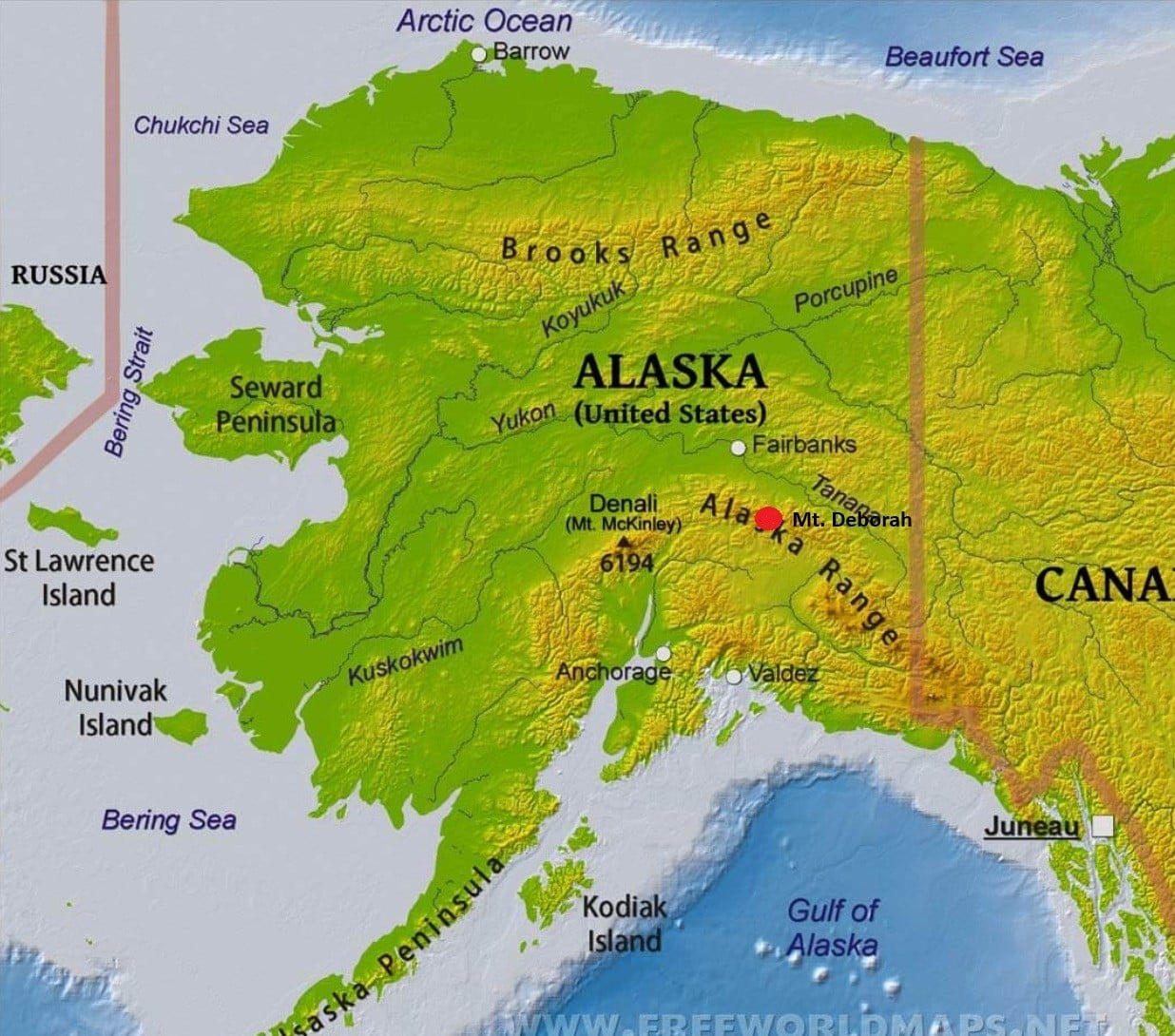
Approximate location of Mt. Deborah (Freeworldmaps.net/Sangamon County Historical Society)
James and Deborah are buried in Tacoma along with two of their sons, Arthur and Howard, both of whom died young. Their oldest son, Darrell (1882-1954), is buried in California.
A fiberglass replica of the Lincoln totem now stands outside the Illinois State Museum. It can be thought of as a tribute to the successes of James Wickersham, which were built upon his young adult years in Rochester and Sangamon County. His wife’s monument is no less than an Alaskan mountain – Mount Deborah.
Climbing Mount Deborah
Although only the 35th-tallest Alaskan peak, Mount Deborah nonetheless can be a challenge to climb. It was first summited in 1954 by the team of Fred Beckey, Henry Meybohm, and Heinrich Harrer.
Deborah: A Wilderness Narrative, David Roberts’ 1970 account of an unsuccessful attempt to climb Mount Deborah with friend Don Jensen, is well-known in the mountaineering community, although mostly for the climb’s effects on the two men’s relationship, not the ascent itself.
 This entry is an edited version of “Rochester’s Mountain,” an article that originally appeared in the December 2025 edition of The Prairie Land Buzz Magazine. Copyright Raymond Bruzan. Published with permission.
SangamonLink is a free service of the Sangamon County Historical Society. Learn how to support the Society.
A great historical article!
Thank you Pam. I’m delighted you enjoyed “Rochester’s Mountain.”
Ray Bruzan
Awesome.