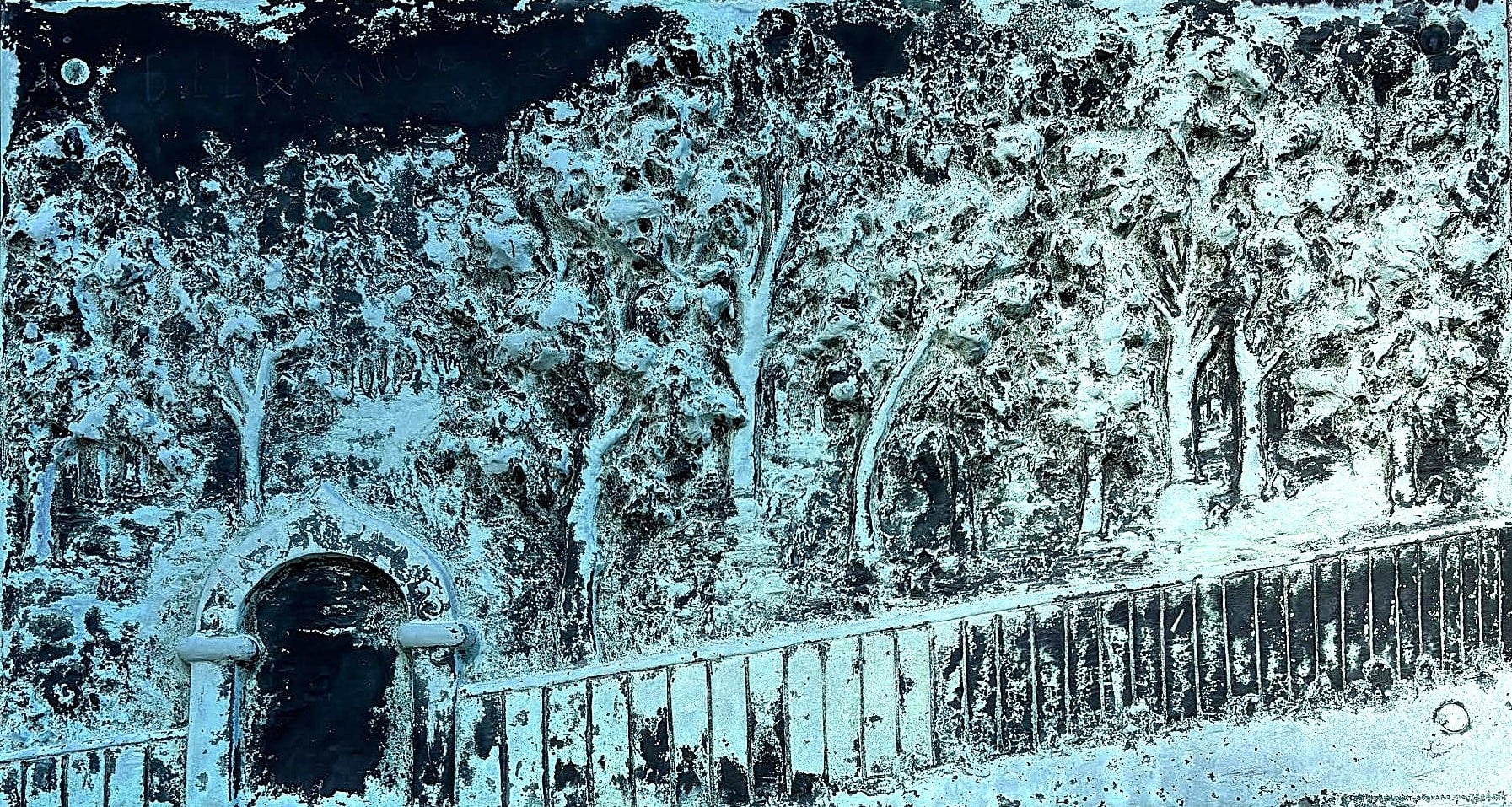
John Krous’s tombstone in Oak Ridge Cemetery includes a copper rendering of the entrance to Krous Park. It apparently is the only existing image of the park. (Sangamon County Historical Society)
Beer was the lifeblood of Krous Park, which operated west of Amos Avenue in Springfield from about 1878 until the early 1910s.
John G. Krous (1847-94), who owned a saloon on the northwest corner of Edwards and Baker streets (today’s Amos Avenue), founded the park as a beer garden. An Illinois State Journal story described the park in 1930.
Located between Amos and Feldkamp avenues and Edwards and Governor streets, the site comprises four square blocks.
In the days still remembered by Springfield’s older men, Kraus (sic) Park was a beer garden second to none in the middle west and drew its patronage from the elite of the city.
The Illinois State Register’s Ed Hamann added more details in a 1951 remembrance. “(I)n the summer and early autumn months, Krous’ park was the location for many Fourth of July celebrations, lodge picnics and gala gatherings of various kinds, … and the fact that plenty of iced beer was available on the hot summer days served to make the park all the more popular with Springfield residents.”
Krous Park also benefited from the fact that one of Springfield’s first streetcar lines, the Capital Railway Co., ran its cars to the park.
Aside from picnics and similar celebrations, the park sponsored a variety of special events, including dances, concerts and, in its early years, speed-walking competitions. In August 1879, John Hofferkamp beat another local walker named Henderson in a 25-mile race. Hofferkamp took five hours and ten minutes to complete the distance; Henderson made it only to 21½ miles.
The walk races, however, may not always have been on the up-and-up. In reporting on the arrests of a gang of confidence men 40 years later, the Illinois State Journal said their schemes “recalled the days of the fake footracers in Springfield.”
After bets had been placed, a fight was staged in some secluded spot. One of the fighters would fall, blood flowed from his mouth and there would be a scramble to get away to evade arrest.
A promised settlement, when the excitement died away, never materialized.
The “bloody bladder” game, as it was known, was also used a sideline to the local fake foot races, which were staged in old Kraus (sic) park in this city.
The rest of the Journal article is partly illegible, but the upshot was that, if betting was light on a footrace, the promoters would stage a sham fight between the racers. One combatant would supposedly hit the other in the mouth, “and when the bladder containing red liquid broke, the racers and promoters took to the tall pines.”
Shortly after John Krous died in 1894, his wife Emma sold Krous Park for $9,000 to the Reisch brewing family. The park’s name was unchanged.
The area around Krous Park was part of what was then a suburban village, West Springfield. Village officials tolerated Krous’s saloon/beer garden, along with two other taverns, because the fees they paid supplied virtually all of West Springfield’s revenues. The saloons’ existence, however, irritated temperance advocates.
German social groups held many events at Krous Park. This 1911 picnic may have been the last major event at the park. “Krous” was frequently misspelled “Kraus” in newspaper stories and ads. (Courtesy State Journal-Register)
As a result, when West Springfield got the chance to annex to the city of Springfield in the 1890s, West Springfield took the first step by voting to ban liquor sales. West Springfield then attached itself to the city in December 1897 as a dry section of town.
Based on events mentioned in newspaper stories, patronage at Krous Park seems to have dropped off following the annexation. The last gasp at keeping the park open took place in March 1904, when a group of “saloon men” brought a surprise petition to the Springfield City Council; it sought a referendum on whether to allow taverns again in the former West Springfield neighborhood. As the Illinois State Journal characterized the proposal:
Under the proposed call for the election, the people who are most vitally interested in the West End saloon proposition will have no opportunity to vote upon it. These are the people who live east of West Grand avenue, whose neighborhoods formerly were made hideous at night by the drunken revellers of both sexes who frequented the resorts in the old village.
Ald. Tom Brewer – a saloon owner and reputed gambling kingpin himself – moved to approve the petition on the spot. His motion was blocked on a 7-7 vote, which gave liquor opponents time to examine the petition. Oops. People at a hastily organized community meeting found at least half the signatures were clumsy forgeries. According to the Journal:
Men who had examined the petitions declared that on their face they showed that most of the names had been written by one man. …
(Robert Patton, the attorney for the objectors) read one string of almost unpronounceable names of persons who were located at a number on Lincoln avenue. “I do not know of any such people as these in my neighborhood,” he said as he puzzled over the names. “I can’t figure out where this house is either.”
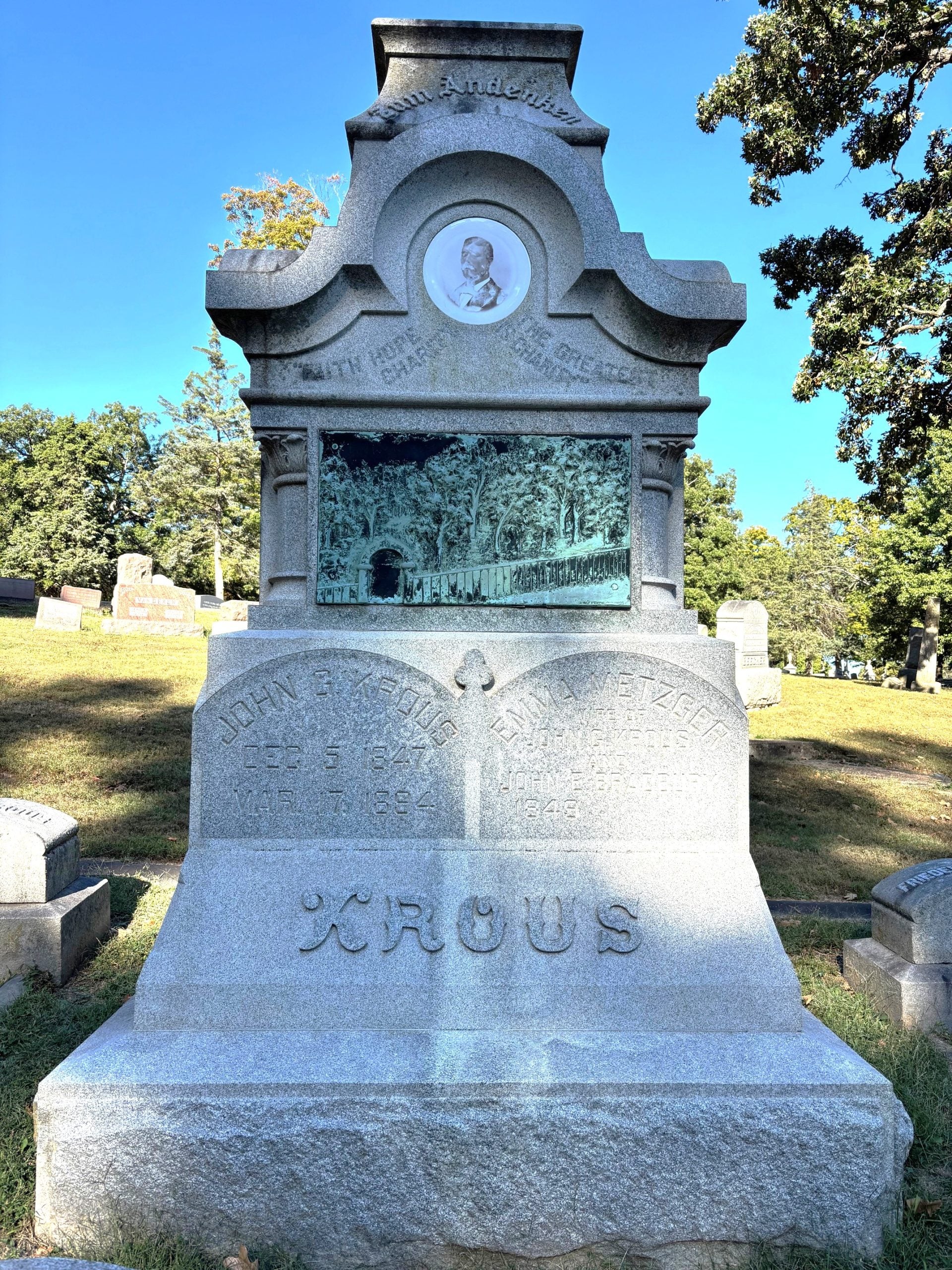
John Krous’s tomb (SCHS)
“Why, that number is in your cow pasture, Bob,” said one of the members of the audience. This was found to be true.
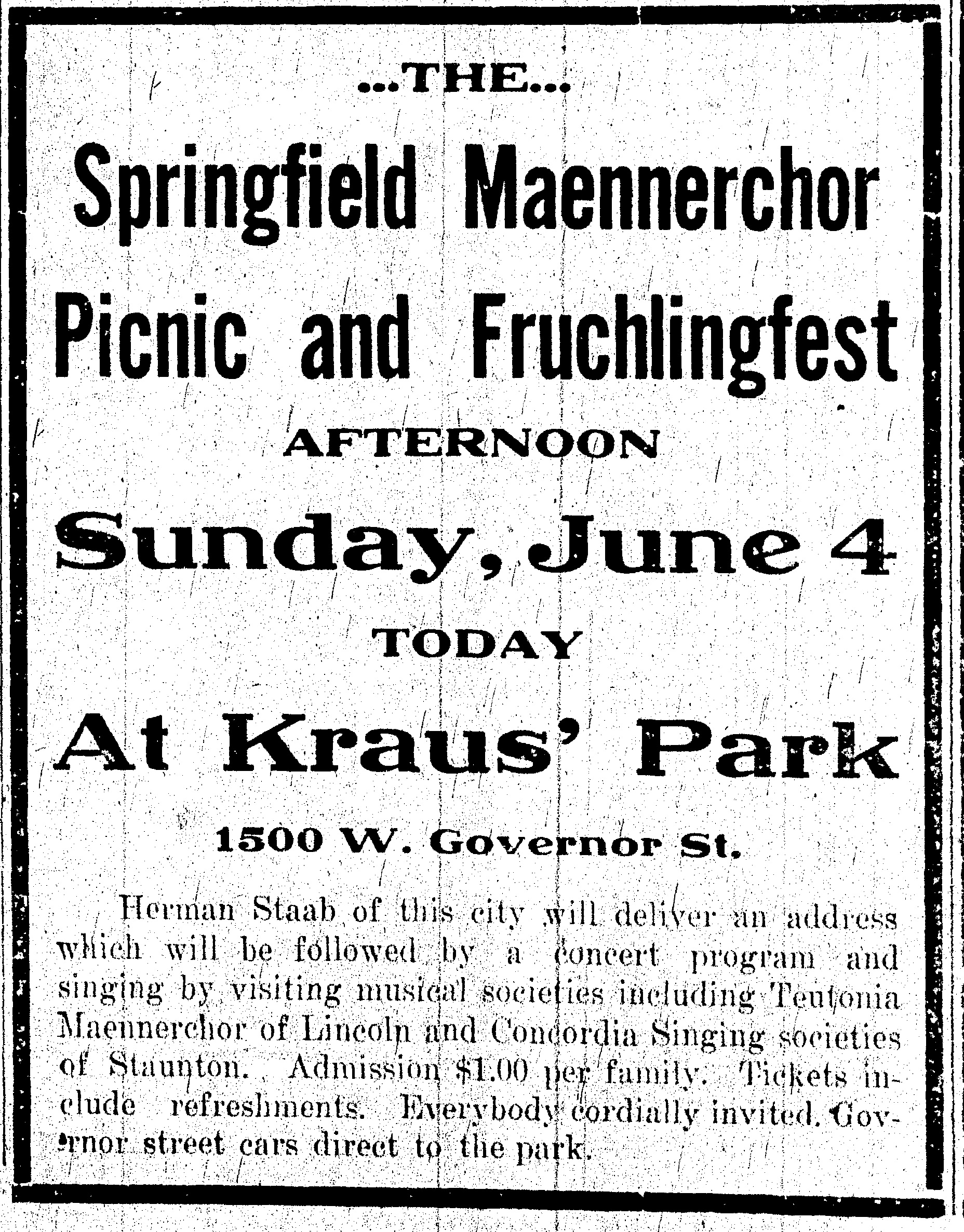
The petition was ignored, and Krous Park gradually faded into oblivion. What appears to have been the last major event there, a picnic and Fruchlingfest (spring festival) featuring several German choral societies, took place in June 1911.
The former park “was allowed to go to ruin” over the next two decades, according to the Journal in 1930, when the Annie Reisch Investment Co. sold the property to the real estate firm of Wanless & Wanless. The Wanless brothers subdivided the area, and in 2025 tthe neighborhood was residential and tree-lined – perhaps including some trees that shaded beer garden patrons more than a century ago.
 John Krous is buried at Oak Ridge Cemetery. His imposing gravestone features his photo along with a copper rendering of the entrance to Krous Park. It is the only existing image of the park.
Hat tip: Thanks to Roy Mayfield of Reisch Charities and the Sucker State Preservation Foundation for suggesting this topic.
Original content copyright Sangamon County Historical Society. You are free to republish this content as long as credit is given to the Society. Learn how to support the Society.