James L. Wickersham spent only six years, from about 1877 to 1883, in Sangamon County. He came to Springfield as assistant, office boy and general dogsbody to former Gov. John M. Palmer. He left the city as a fledgling lawyer, on his way to becoming a legendary figure in Alaskan history.
The fact is, he would have preferred Japan.
Pugnacious, indefatigable and flawed, James Wickersham (1857-1939) served as Alaskan district judge and then territorial delegate to Congress from 1900 until (with interruptions) 1933.

James Wickersham (Erik Skytte/findagrave.com)
As Congressional delegate, Wickersham was instrumental in passing laws that made Alaska a self-governing territory, organized the state’s railroad system and established what today is the University of Alaska. He introduced legislation that created Mt. McKinley National Park (now Denali National Park and Preserve) and, in 1916, sponsored the first Alaska Statehood Bill (it was unsuccessful; Alaska was finally granted statehood in 1958).
Alaska historian Terrence Cole wrote a warts-and-all profile of Wickersham as an introduction to the 2009 edition of Wickersham’s 1938 memoir, Old Yukon: Tales, Trails, Trials.
“Between the Klondike Gold Rush and the Second World War,” Cole wrote, “no name came to be more synonymous with the Territory of Alaska than that of Judge James Wickersham, and no individual would be more loved, hated, respected or despised than the man who would always be ‘The Judge.’”
Comparatively, Wickersham’s brief sojourn in Sangamon County was undistinguished. Wickersham was born in Patoka in southern Illinois and moved to Sangamon County when about 20 years old, mainly, Cole wrote, to read law in Palmer’s office. (“Reading law” – studying with an established lawyer instead of attending law school – was an accepted way to qualify for the bar exam at the time.) From Cole’s profile:
Wickersham taught school in a small town outside of Springfield on the side, but his real ambition was the law. As Governor Palmer’s assistant for some two years, Wickersham earned about five dollars a month; in addition to poring through the law books, he “swept the floors, kindled the fires and washed the windows,” sleeping occasionally at night in the back room in a homemade bed. (The quoted phrase apparently originated with JoAnne Wold’s 1981 booklet Wickersham: The Man at Home; link below – ed.)
While teaching in Berry, Wickersham boarded with the Isaac Bell family of Rochester Township, according to Rochester historian Raymond Bruzan, and also courted Bell’s daughter Deborah. The couple was married in 1880, shortly after Wickersham passed the Illinois bar exam.
It isn’t clear that Wickersham did much locally with his law degree. City directories and newspapers show he worked closely with the Rev. Fred H. Wines (1838-1912), in both the Springfield U.S. Census office and with the Illinois Board of Public Charities.
The 1880-81 Springfield City Directory lists Wickersham as a clerk in the Branch U.S. Census office, which Wines headed. The next directory, for 1881-82, reports that the law firm of Wines & Wickersham operated out of an office at 523 E. Monroe St. The partners probably still spent some time on census work, since the census office that year was nextdoor at 521 E. Monroe.
Wickersham also dabbled in Republican politics while living in Springfield, newspaper stories report, but to no great distinction. That changed after the Wickershams headed for greener West Coast pastures in 1883.
“James Wickersham, formerly of the office of the board of public charities, accompanied by his wife, will leave this morning for Washington Territory, where they will take up their future abode,” the Illinois State Register reported on May 24, 1883.
In Tacoma, Wash., Wickersham’s career took off. He served as city attorney and won election as probate judge and, once Washington gained statehood, to the state legislature. As a lawmaker, he helped Addison Foster win election to the U.S. Senate from Washington, and in return, Foster offered Wickersham a federal appointment: either a consulship in Yokohama, Japan, or a federal judgeship in Alaska.
Wickersham claimed in Old Yukon that he turned down the Japanese post. That isn’t true, Cole wrote: “In fact, Wickersham’s private diary reveals that if he had had his way, he would have never set foot in Alaska, and that age forty-two it was the Rising Sun he yearned to see, not the Midnight Sun.”
President William McKinley nonetheless named Wickersham to the Alaska judgeship in 1900; willing or not, Wickersham turned his full – and considerable – energies to it. As Cole wrote:
… “Wick” crammed nine lives’ worth of adventure into his four decades in Alaska. The federal judge, frontier lawyer, congressional delegate, political power broker, legal scholar, mountain climber, self-taught ethnologist, linguist, historian and book collector shaped the literature, law, history, education, commerce and politics of Alaska.”
The enormous range of his interests was matched only by his phenomenal discipline and relentless work ethic. …
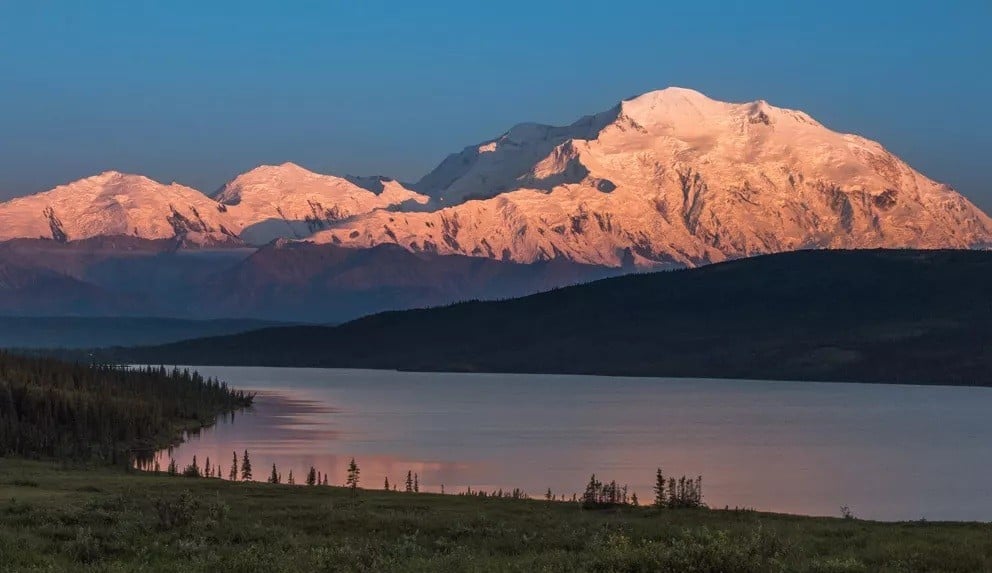
Denali/Mt. McKinley from the north (National Park Service)
Wickersham’s achievements in molding Alaska went well beyond his public roles. He gave Fairbanks, Ala., its name, he led the first recorded attempt (in 1903) to climb Denali/Mt. McKinley, and he compiled the state’s largest private library. He collected and edited Wickersham’s Alaska Reports, a systematic examination of Alaska case law dating back to 1868 (the Reports eventually came to eight volumes and 7,000 pages). He somehow also found time to write a personal diary logging his experiences almost every day between Jan. 1, 1900, and Oct. 19, 1939, five days before he died.
Memorials to James Wickersham in Alaska include the geological features Mt. Wickersham, Wickersham Creek, Wickersham Dome, and Wickersham Wall, the cliff on the north face of Denali/Mt. McKinley that stymied Wickersham’s 1903 climb. The centerpiece of the Wickersham State Historic Site is the home in Juneau shared by Wickersham and his second wife, Grace.
Marriages
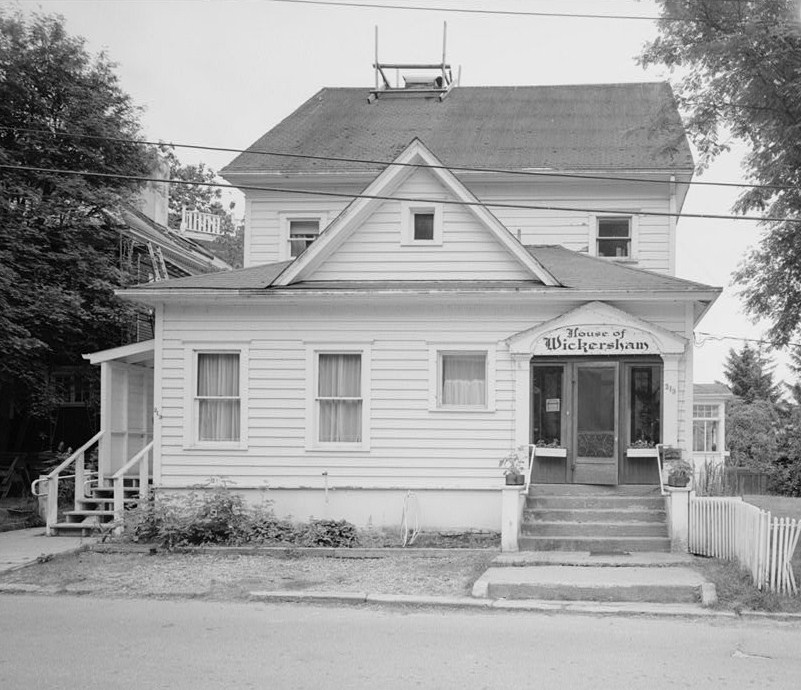
‘House of Wickersham’/Wickersham State Historic Site, Juneau, Ala. (Library of Congress, Prints & Photographs Division, AK,8-JUNE,2-1)
James Wickersham named Alaska’s 35th-tallest mountain “Mt. Deborah” after his wife Deborah Bell Wickersham. Debbie Wickersham (1861-1926), however, suffered from chronic illness – she died of tuberculosis – and as a result spent much of her time back in Tacoma while her husband worked in Alaska, according to “Wickersham: The Man At Home,” by JoAnne Wold (Tanana-Yukon Historical Society, 1981).
Wickersham apparently was devoted to his wife, and letters quoted by Wold show his frustration at her absence.
However, Wickersham also seems to have strayed from his marriage from time to time –Wickersham’s diaries, Cole says, include an oblique reference to an affair the judge apparently had with a Fairbanks woman. And even before his Alaskan appointment, Wickersham was convicted in 1889 of seducing a 19-year-old Tacoma woman. (The woman also claimed Wickersham had helped her obtain an abortion, although that wasn’t part of the criminal charge.) The woman later recanted her statements, and the conviction was dismissed, but, politically, Cole writes, the case remained “the great skeleton in Wickersham’s closet.”
James Wickersham married a second time two years after Debbie’s death. His second wife, Grace Vrooman Wickersham (1872-1963), was a former schoolteacher and member of the Board of Regents of the University of Alaska.
James, Deborah and Grace Wickersham are all buried in Tacoma (Wa.) Cemetery.
The ‘Tacoma 27’
James Wickersham paid no political penalty whatsoever as the result of a different criminal charge: that he helped lead a mob that drove Tacoma’s Chinese residents out of the city. The incident was part of a wave of anti-Chinese actions on the West Coast in the 1880s.
In Tacoma, the mob went from home to home on Nov. 3, 1885, warning Chinese residents to leave town. From the digital history site The Tacoma Method:
They stopped at every Chinese residence and business and instructed the occupants to get on wagons or march down to a train headed to Portland, Oregon, that day. The mob also visited homes and businesses of white citizens to intimidate the supporters of the Chinese community. Several days later, what remained of the once prominent Chinese community was burned to the ground. …
(T)his event in Tacoma was heralded as a way to take action against Chinese communities and became known as the “Tacoma Method.”
Wickersham, who in speeches proudly proclaimed himself anti-Chinese, was one of the “committee of 15” who led the expulsions. He also was among 27 participants who were indicted for conspiracy. In the end, however, none of the 27 ever went to trial or faced punishment.
 Hat tip: To Raymond Bruzan for drawing SangamonLink’s attention to James and Deborah Wickersham.
Original content copyright Sangamon County Historical Society. You are free to republish this content as long as credit is given to the Society. Learn how to support the Society.
This is wonderful! A true Guilded Age rascal who epitomized the era. So was james related to Dudley Wickersham, a Springfield merchant who served in the 10th Illinois Cavalry with Francis Springer?