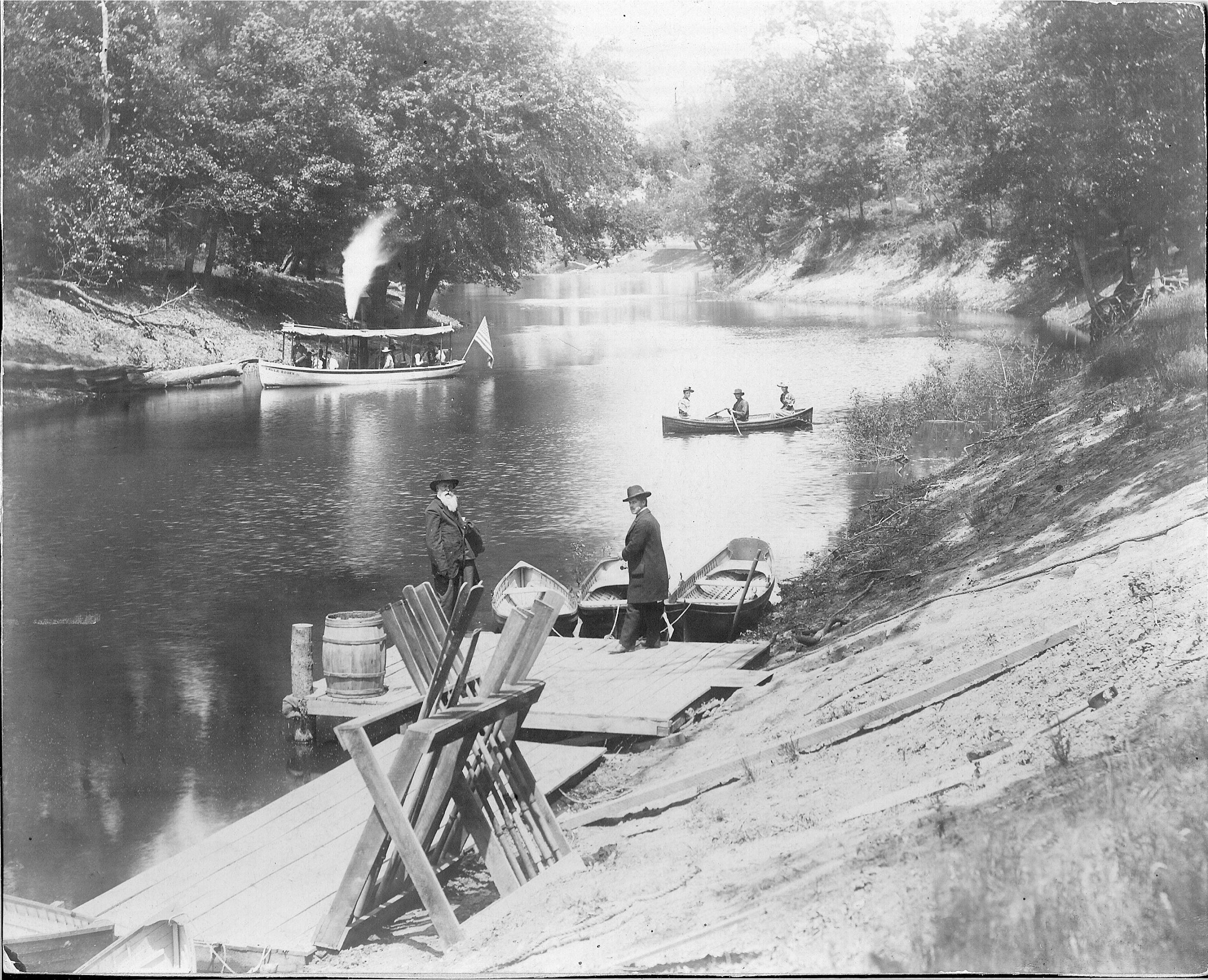
Glenwood Park’s steamboat in operation along the South Fork of the Sangamon River, 1890s (Sangamon Valley Collection)
Glenwood Park was a small resort that operated along the South Fork of the Sangamon River from the mid-1890s until the early 1900s. Facilities included a small dam, docks and rowboats, an excursion steamboat and a pavilion with a dance floor, eatery and bowling alley.
Despite its relatively brief life, Glenwood Park was a fond memory for many young people of the time. Illinois State Register reporter Betty Andruskevitch wrote about the park in 1950:
A covered bridge spanned a ravine jutting off from the south fork of the Sangamon where the dam was located and led into Glenwood Park. A little bridge was the doorway to the famous old picnic grounds, which attracted hundreds of recreation seekers.
Many a shy maiden and gallant young man spent a day filled with fun and romance in old Glenwood Park.
Ethelbert Kalb (1843-1903), a farmer, Civil War veteran and local officeholder, created the park on property owned by his family in 1895. He operated the resort until his death. A brother, George B. Kalb (1848-1922), then kept the park running for some additional years.
The park, which took in 50 acres of land along the river, was usually described as being about six miles east of Springfield on the old Cook Street Road (today the former park site is on Walnut Road near its intersection with Gaule Road).
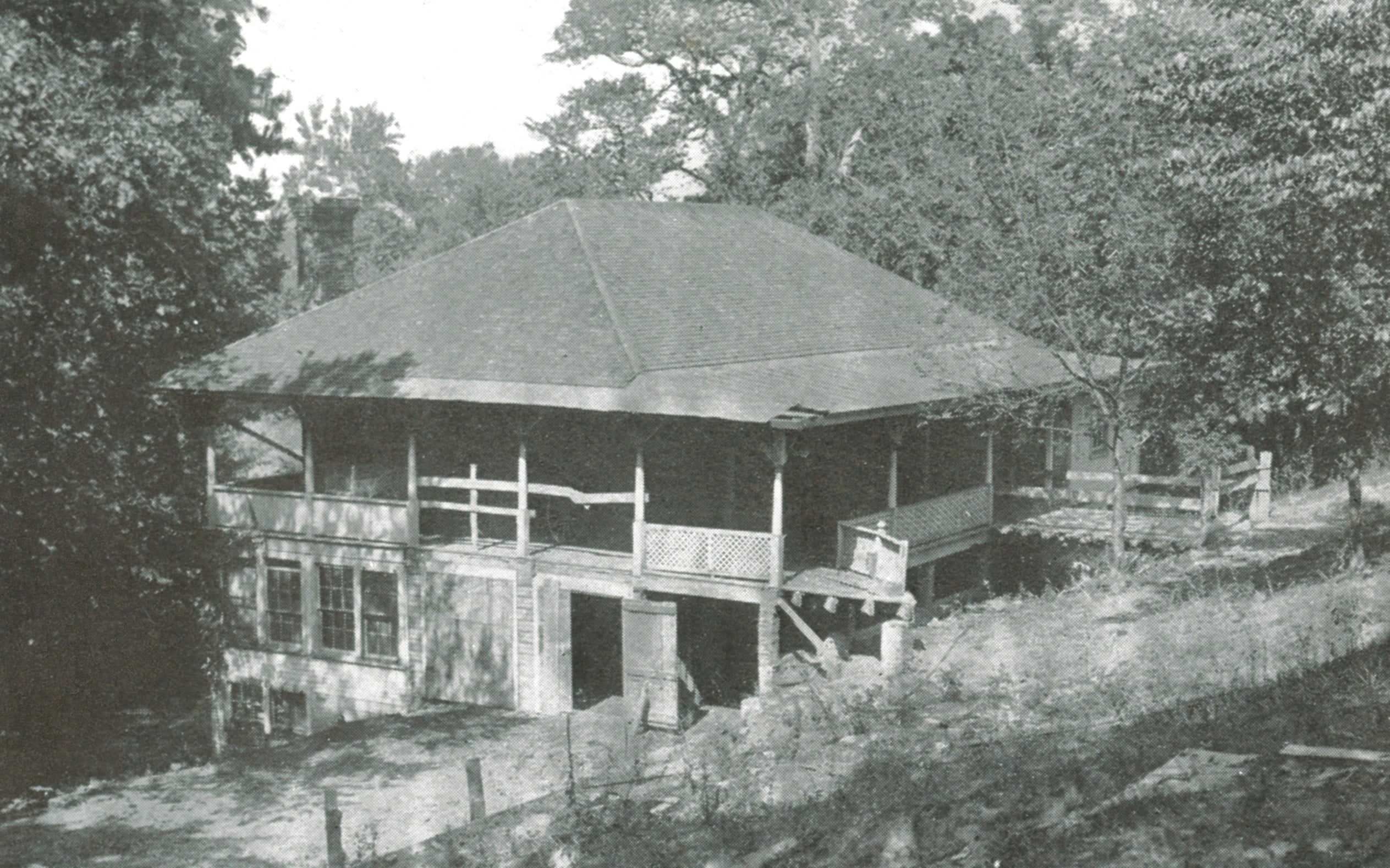
The Glenwood Park pavilion following the park’s closure (Orange Judd Farmer Pictorial Community Album of Rochester Township and Village, 1918)
An 1894 newspaper story, published while the park was still under development, made it clear that Ethelbert Kalb intended to make Glenwood Park a site for wholesome family entertainment.
The park will be maintained for the respectable class only, and the management will at all times cater to the very best element of society. It will be a place of refinement where ladies and children will always find perfect protection. It will be the place for picnics large and small, and outing parties generally. Reasonable charges will be made for the privileges and special attractions, but no charge will be made for admission to the grounds.
Springfield residents often traveled to Glenwood Park on the interurban train, which stopped about 100 yards from the park. If instead they arrived by horse and buggy, Glenwood Park boasted stables to care for the animals.
A wooden dam spanning the South Fork raised the river’s water level to accommodate the park’s boats and to trap fish.
Numerous newspaper articles described dances or picnics at the park. A steamboat ride cost 25 cents, and a fried chicken dinner was priced at 50 cents.
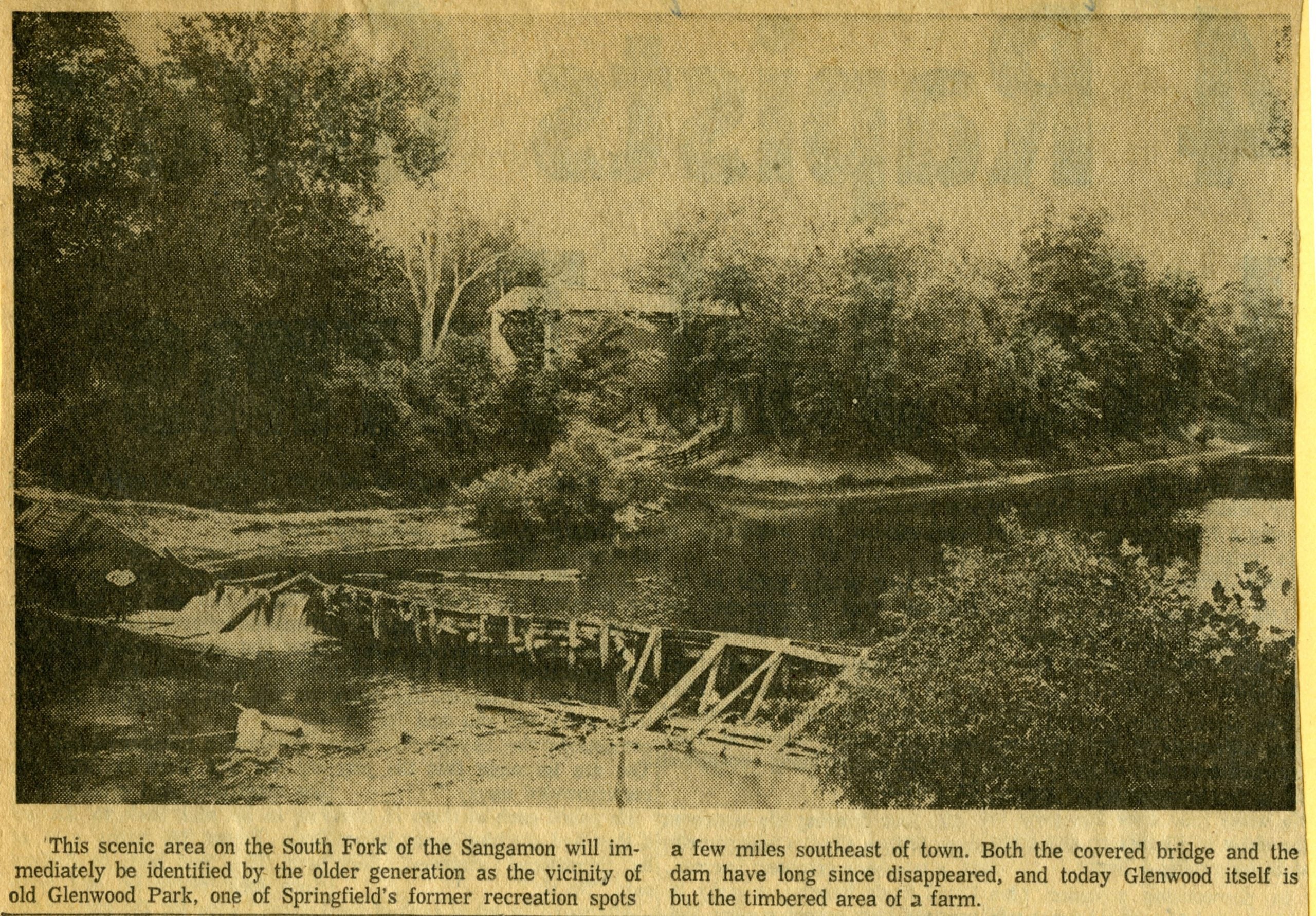
The Glenwood Park dam in a 1959 Illinois State Register clipping (SVC)
An especially memorable event occurred in 1896, when the river was high and Ethelbert Kalb was able to take a group of friends on a steamboat ride to Riverton and back, some 15 miles.
The park had some unpleasant memories as well. In 1895, a special deputy sheriff was appointed just to maintain order at Glenwood Park. A Springfield man drowned at the park in 1920.
And a killing took place there in 1910, after what was described as a wild “orgy.” At the time, the park’s caretaker lived there with his wife and 13-year-old daughter. The caretaker was entertaining two acquaintances, Bill Knight and Edward Johnson. Johnson allegedly tried to assault the young girl, and when Knight tried to protect her, Johnson pulled a gun and shot Knight to death.
At his trial, Johnson claimed the gun slipped from his hip pocket and went off accidentally. Jurors, in a verdict the Register said “caused general surprise,” found him not guilty.
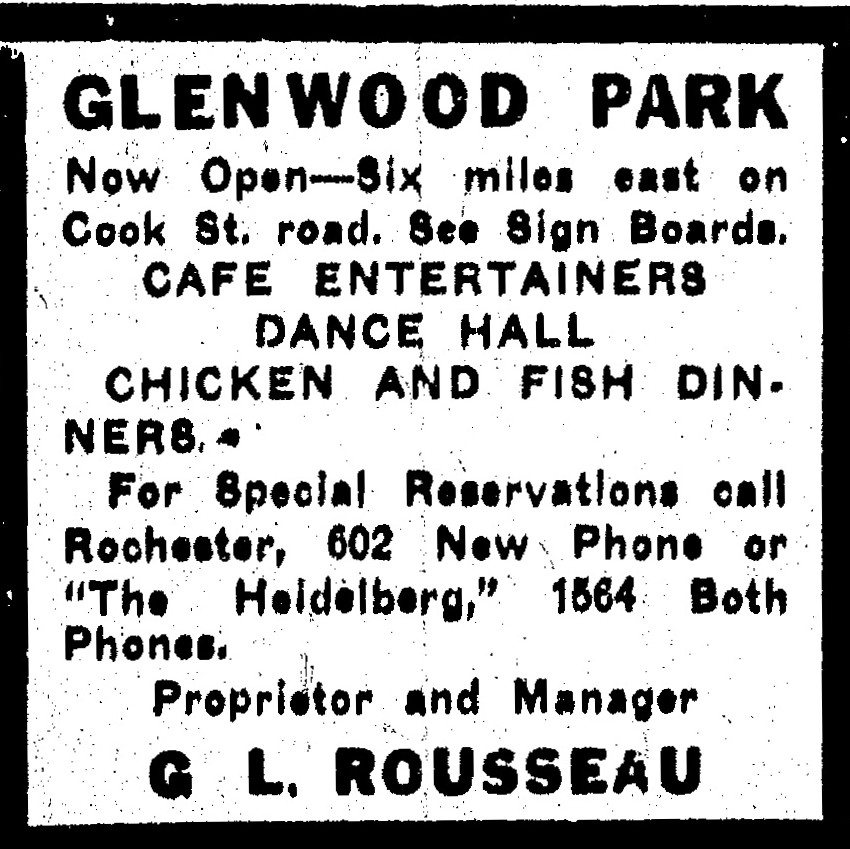 George B. Kalb tried to sell the facility in 1904, only a year after taking it over – “This is a money maker,” the sales ad said — but the park remained in operation, in some fashion, for years more. The last advertisements for Glenwood Park appear in Springfield newspapers in the summer of 1913, when Springfield saloonkeeper Gaston “Frenchy” Rousseau ran the operation. The 1918 Orange Judd Farmer Pictorial Community Album of Rochester Township and Village describes the park’s pavilion as “Now abandoned,” and adds that it was “remembered by the past generation as the scene of many ‘good times.’”
The last newspaper mention of activities at the park was published in 1922. The site seems to have been sold sometime after 1924. In 2025, the land once occupied by the park was a combination of woodland and a few homesites.
The Kalb family
Editor’s note: The rest of this entry is an updated version of an essay originally written in 2017 by Leslie Struble of rural Rochester.
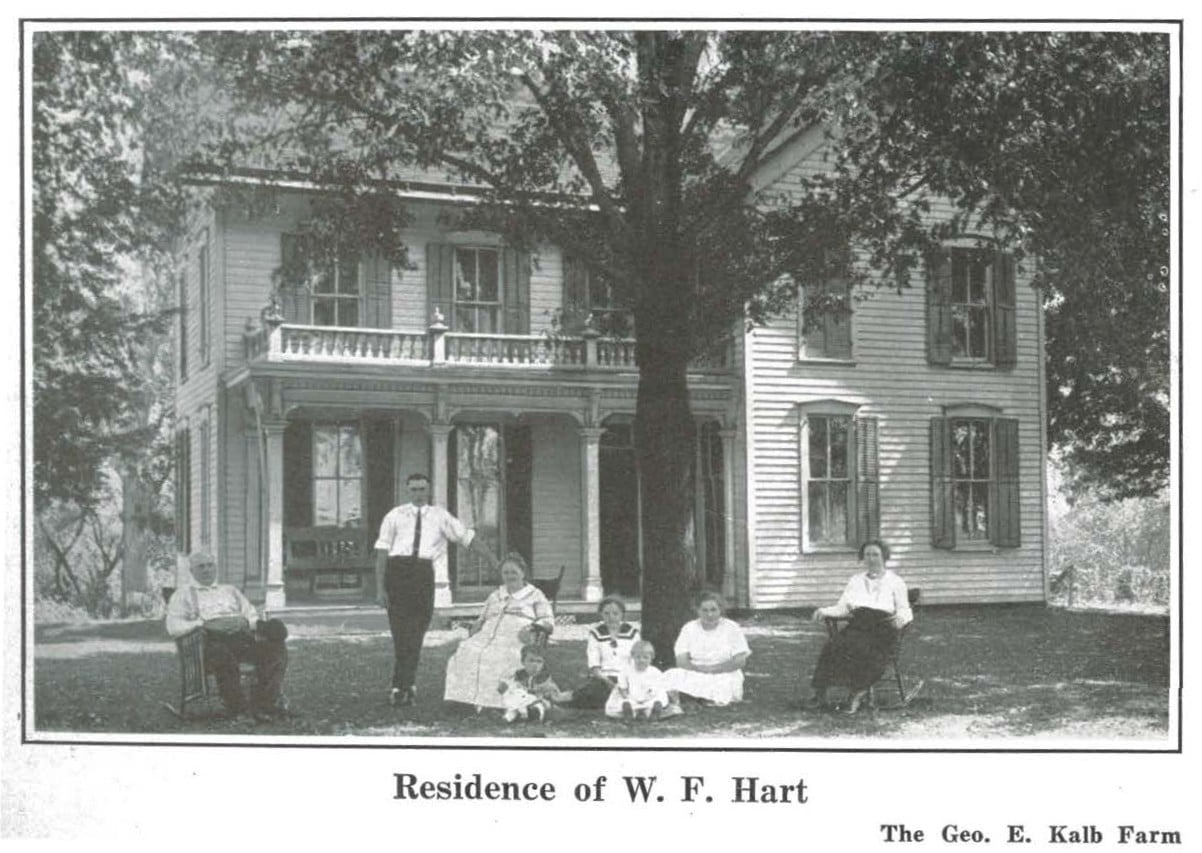
The Struble home photographed in 1918 for the Orange Judd Pictorial C0mmunity Album of Rochester Township and Village
My interest in the Kalb family and Glenwood Park developed during research into the history of my house, which I bought some 35 years ago with my late husband Bob. The house is several miles east of Springfield and a few miles north of Rochester in an area called Round Prairie.
This research was motivated by a newspaper article a few years ago about the efforts of the Rochester Historic Preservation Society to develop a walking tour of historic houses in Rochester. The houses in the tour were included in the Orange Judd Farmer Pictorial Community Album of Rochester Township and Village, published in 1918. This memorable book, a tremendous resource for people interested in the history of the area, was produced after the publisher sent a photographer to document houses in the township, usually with occupants sitting in the yard, and then compiled the photographs into a book. The old photograph of our house (immediately above) is from this book.
For my research I obtained deeds for every sale of our house and property (the property has shrunk a lot over the years, from a 40-acre farm to the current six-acre yard and pasture). I also obtained many newspaper articles from the predecessors of the State-Journal Register about the Kalb family.
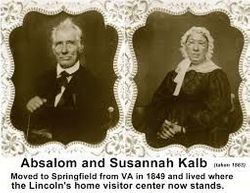
Absalom and Susannah Kalb (Findagrave.com)
The patriarch of the Kalb family in Round Prairie was Absalom Kalb (1787-1865), who moved to the area in 1849 with his wife Susannah (1789-1873) and several children. He was a wealthy farmer, a staunch Republican, and a long-time member of the Methodist-Episcopal Church. The 1894 plat map shows two nearby buildings, the South Round Prairie School and Round Prairie Chapel, both built by Absalom Kalb and bequeathed for these purposes. The house and the chapel longer stand, but the school has been converted to a home. Absalom Kalb later retired and moved to Springfield, where he died.
Absalom Kalb’s oldest son, Andrew (1812-93), also was a farmer. He built a log cabin and then a house (no longer standing) near that of his father. Andrew’s oldest son, in turn, was George E. Kalb (1840-1920). He built our house in 1879, probably in anticipation of his marriage to Elizabeth Taylor (1851-1934) in 1881. He was also a farmer and, like his grandfather, moved to Springfield after retirement and died there.
A lot more is known about Daniel, the second son of Absalom Kalb. Daniel (1815-1905) was variously a teacher, preacher, and farmer. He was a veteran of the Civil War. He authored sections of the 1881 History of Sangamon County, Illinois, an undertaking that probably reflected his education and is in part why we know so much about him.
Daniel Kalb built a house called Willowdale in 1876. With 15 rooms, this was one of the most prestigious homes in the area. Sadly, this house burned to the ground in 1903. No one was killed, but the loss of Daniel’s fine library was noted in a newspaper article about the fire. The house was rebuilt on the same site in 1905; the rebuilt house was still standing at Wright and Gaule Roads in 2025. Daniel died in this house; his funeral was said to have been attended by many people.
Ethelbert Kalb, the founder of Glenwood Park, was the oldest son of Daniel Kalb. Aside from farming, he founded and edited a weekly newspaper, the Rochester Item. Many articles from the Item, often by and/or about Ethelbert Kalb and frequently humorous in nature, were republished in the Springfield newspapers. Ethelbert apparently died in Willowdale (although this was the home of his father, the 1900 Census identifies Ethelbert as the head of the household that included his father and brother). His funeral was also said to be well attended.
One final note: Ethelbert’s daughter Laura married Alfred Tuxhorn, whose family also lived in Round Prairie. They briefly owned our house some years later, and they lived for many years in Willowdale. Their son Ethelbert later remodeled and lived in the South Round Prairie School.
Finding Glenwood Park
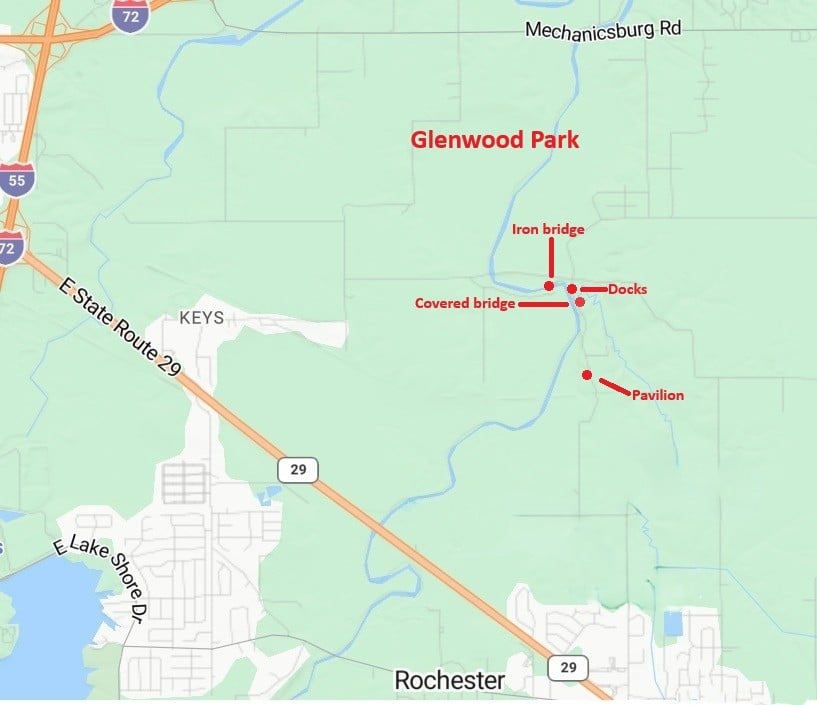
Glenwood Park locations (Leslie Struble/SangamonLink)
I was at Lincoln Library in Springfield looking for records about the Kalb family when the librarian in the Sangamon Valley Collection, the library’s local history section, asked if I had seen anything about Glenwood Park. I was intrigued – I had not heard of it, although it was located quite near my house, perhaps only a quarter-mile away as the crow flies. So I set out to learn more.
My first challenge was to find the precise location of the park, which I generally did by comparing old photographs with current ones.
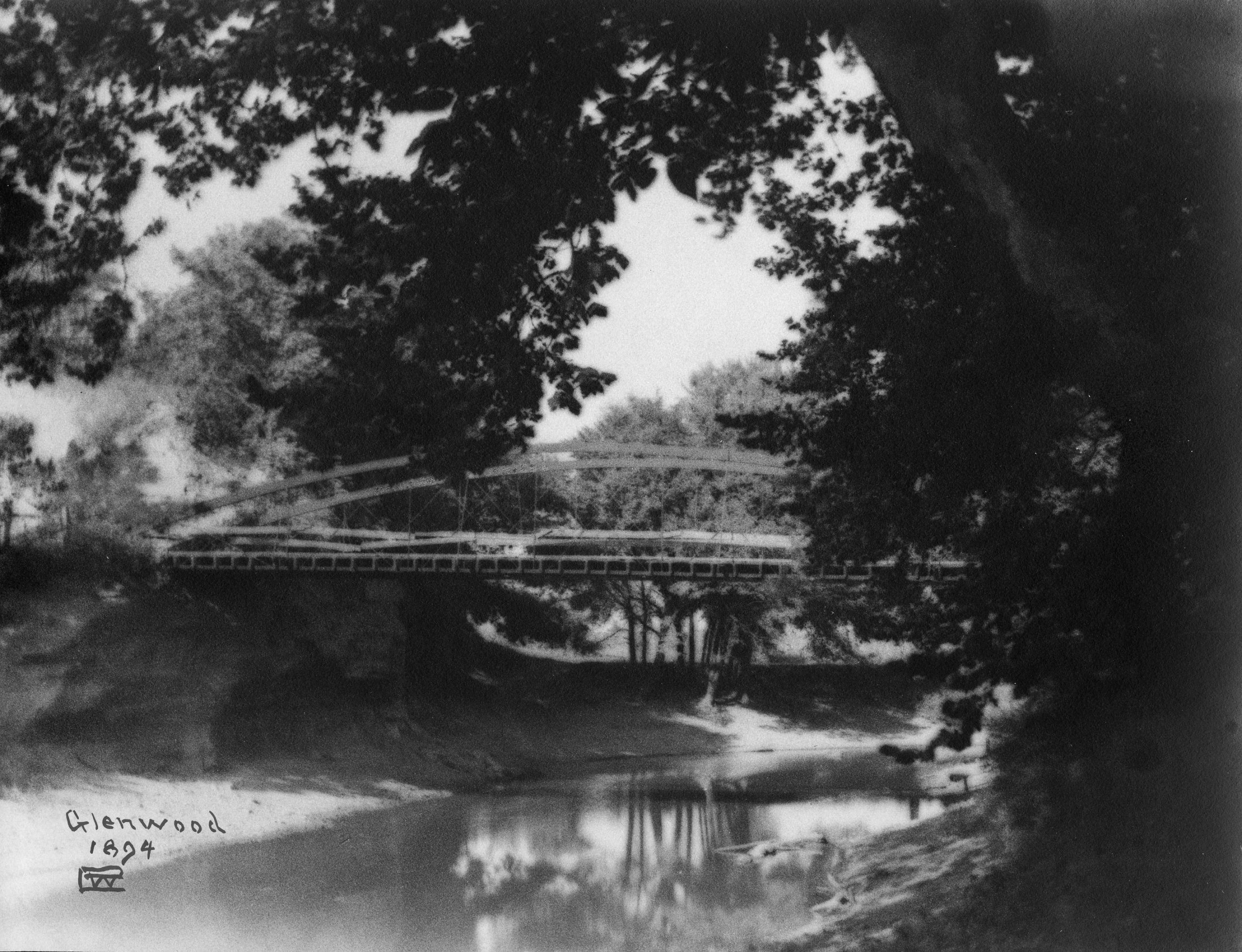
The iron bridge, 1894 (SVC)
I started with the iron bridge over the South Fork River, which can be seen in plat maps dating from 1858, the oldest one available, to 1962. An old photo of the bridge shows a rock formation under the bridge on the north side of the river. I located the same rock formation today, and, what’s more, there’s a concrete foundation nearby. So I’m confident I found the iron bridge site.
The iron bridge extended from the end of the present-day Bakutis Road (abandoned by the township some years ago) across the river to what is now Gaule Road just west of its intersection with Walnut Road. The present-day bridge on Gaule Road, perhaps one-half mile to the west, was built later.
The rock formation also allowed me to pinpoint the site shown in the photograph that begins this entry, the one showing Glenwood Park’s rowboat dock and the steamboat in action. The formation is in the background of the photo, and it also includes a hint of the iron bridge where the river turns out of the picture.
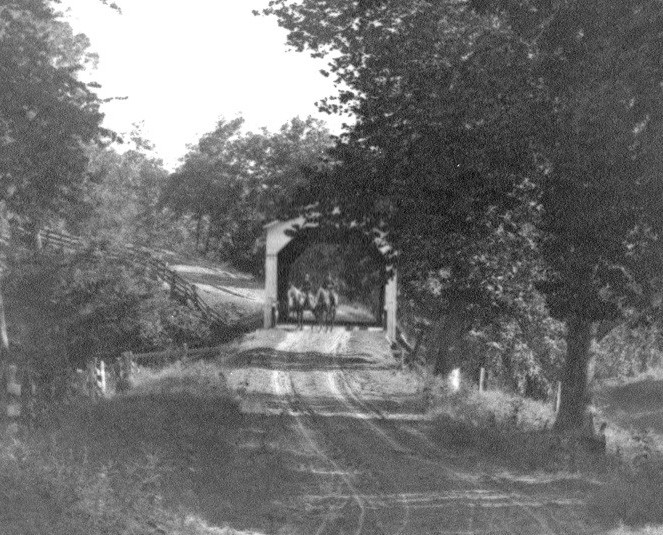
The covered bridge, undated (SVC)
I then moved on to the covered bridge, often said to be the entrance to Glenwood Park. The bridge presumably crossed the only creek in this area, Black Branch Creek, which comes up from Rochester and joins the South Fork just south of the present-day intersection of Gaule and Walnut Roads. South of the creek, the road climbs a slight hill. Again, the old photograph included enough clues to let me identify the site of the bridge, which is about a quarter-mile south of the intersection of Walnut and Gaule roads.
Glenwood Park also included a wooden dam that spanned the South Fork. In one of the old photos, the covered bridge and the creek are visible across the river. That allowed me to determine the dam was near Black Branch Creek and the turn of the river.
Glenwood Park’s primary structure was a pavilion, which had already been abandoned when a photo of it (in first section above) was taken about 1918 for the Orange Judd book. The photo, however, doesn’t include the river, leaving few clues to the building’s location. In attempting to find the site, I originally concentrated on the turn of the river, near the iron bridge, dam, and dock. The old photograph clearly shows a brick chimney on the pavilion, and I spent many hours walking the riverbank near the turn of the river looking for bricks from this chimney. I found nothing.
I finally put out a call for help to members of the Rochester Historic Preservation Society, and Dave Jostes said he knew where it had been, so he and I took a field trip one afternoon. We started at a house on the west side of Walnut Road about a half-mile south of Gaule Road and up the hill from the covered bridge. A hill extends down from Walnut Road to a broad, flat treed area along the river, and we walked from the house down this hill. Near the bottom we found bricks and an old concrete structure, which Dave remembered seeing as a boy. These appear to be the remains of the Glenwood Park pavilion. The slope of the hill is the same as that seen in the old photograph of the pavilion.
It turns out that the house on Walnut Road is also in the Orange Judd book (page 8) and is said to be at the park site, perhaps the caretaker’s house.
This research was possible only because the river’s path is basically unchanged from the early 1900s and perhaps earlier. I thought it interesting how many roads are also unchanged from that time – Falcon Road, Bakutis Road, the west end of Gaule Road, and Walnut Road.
In summary, I followed an interesting trail from our house to the Kalb family and from the Kalb family to Glenwood Park. However, very little of this trail remains. As far as I can tell, no Kalbs still live on Round Prairie or even in Springfield. Only a few physical artifacts of the park remain, and people’s memories of the park are diminishing with time.
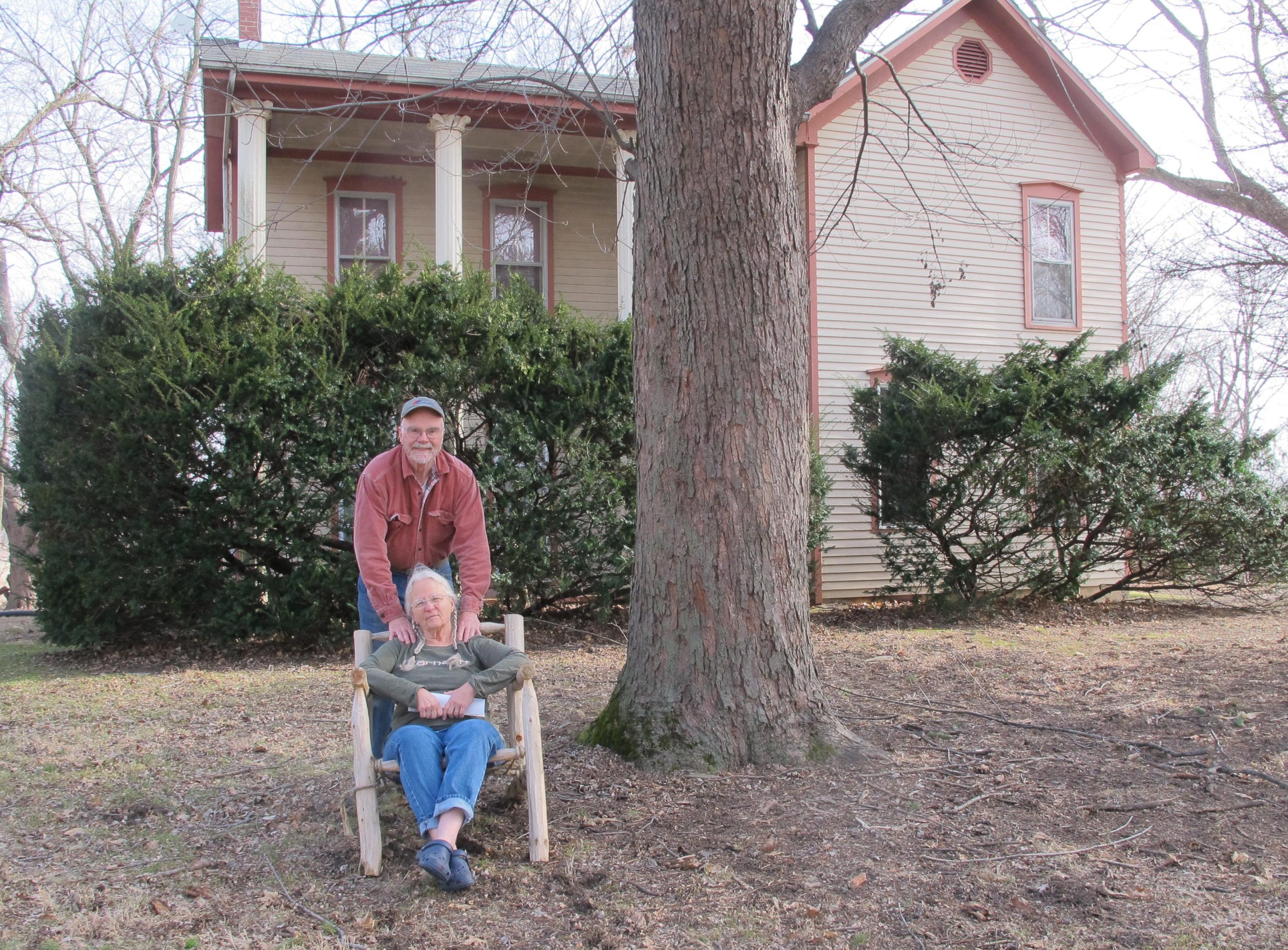
Bob and Leslie Struble (Leslie Struble)
Contributor: Leslie Struble
Leslie Struble has lived in Round Prairie since 1989. She retired as a professor in the Department of Civil and Environmental Engineering at the University of Illinois in Champaign-Urbana. For the last 15 years she has migrated between Illinois and Wyoming, where she has a cabin in the Shoshone National Forest.
References
Orange Judd Farmer Pictorial Community Album of Rochester Township and Village, published in 1918 by the Orange Judd Company of Chicago and reprinted in 1995 by the Rochester Historic Preservation Society. SangamonLink wrote about the RHPS’s updated Orange Judd tour, compiled by a committee headed by Ray Bruzan, in 2014.
 History of Sangamon County, Illinois (1881), Interstate Publishing Company, Chicago.
Copyright Leslie Struble. Published with permission by the Sangamon County Historical Society. Learn how to support the Society.
What a nice little history of my Kalb ancestors who came here from Loudoun County, VA in 1849. Absalom brought all of his children, grandchildren and other assorted relatives to Sangamon County, Illinois with him.
I corresponded with several Kalb family members when doing this research, but I’m sorry that I missed you. I do have additional information about your family that I am happy to share if you want to get in touch with me.