
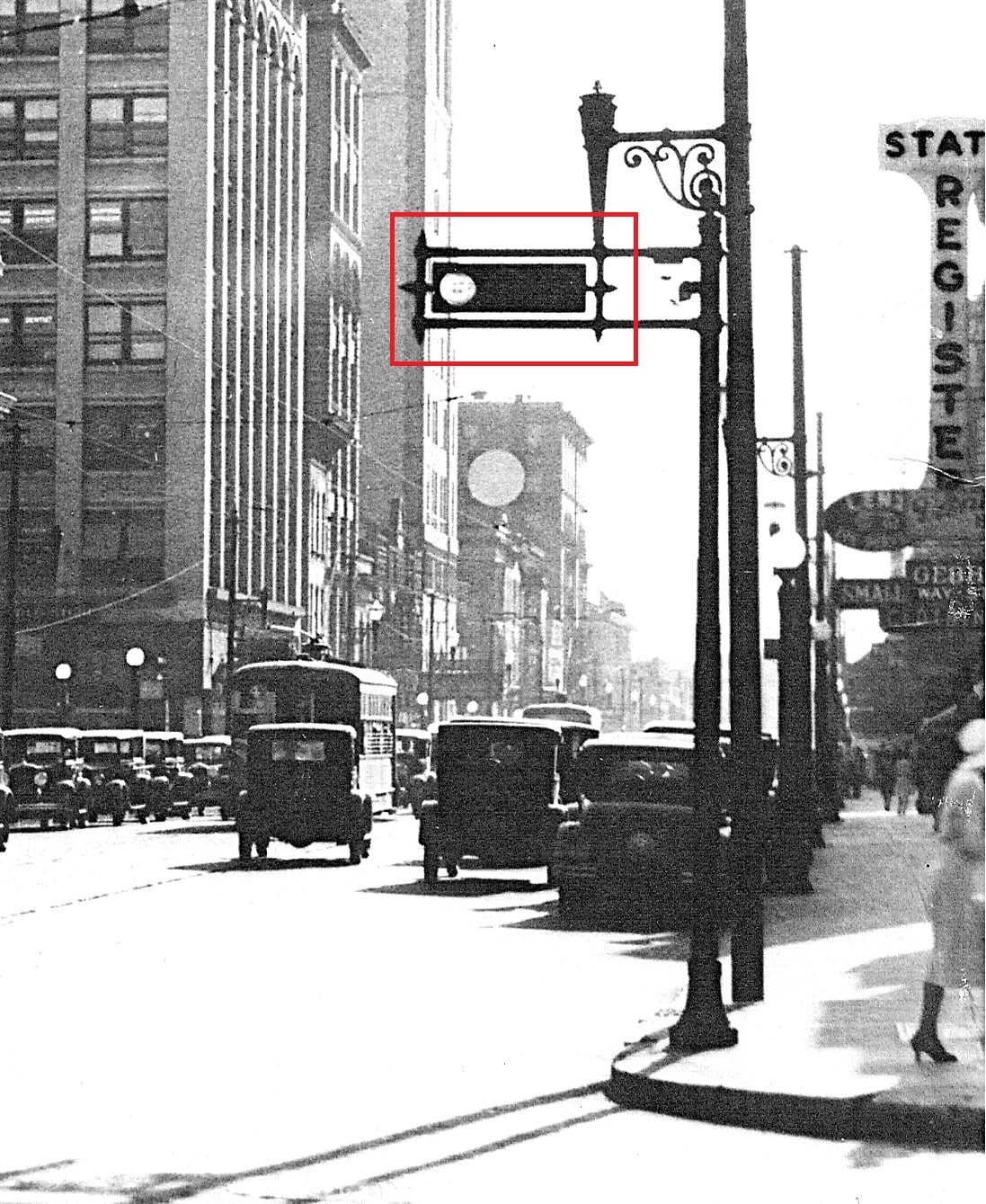
A street sign (outlined in red) mounted on a lightpost in the 1930s. View is looking west from the northwest corner of Seventh and Monroe streets (Sangamon Valley Collection)
When Springfield city officials installed 2,300 new street signs in 1920, they encountered a frustrating problem: small boys with brickbats.
It wasn’t the first time.
The city hadn’t installed new intersection signs in almost 20 years. But as automobile use increased, the Springfield Automobile Club and Springfield Improvement League argued that another set of signs was overdue.
The Illinois State Register claimed in 1919 that one of its reporters had been accosted by a lost out-of-towner. “Since they keep it a secret, do you mind telling me the name of this street?” the man asked, according to the story. (He was on Monroe Street downtown.)
The new signs, metal with aluminum lettering, were erected on every street corner in the city. On downtown corners, each signpost had four arms; elsewhere, the posts had only two arms. The signs, made by Union Iron Products of East Chicago, cost a total of $3,000.
Vandalism started as soon as the signs went up, the Register reported.
Before the men engaged in the placing of the signs had finished their work, they found that boys were following in their wake with shot guns, brickbats, sling shots and mud, defacing and destroying them. In some instances, they were even torn from their fastenings and thrown into the streets.
City officials turned to school principals and peer pressure, via the Boy Scouts, to battle the vandals, apparently with some success.
It turned out, however, that vandals weren’t the big problem with the signs anyway. It took only four years for the Illinois State Journal to editorialize again that “our streets are unmarked.”
“The enameled signs placed several years ago have rusted out and disappeared,” the paper said then. “… The streets not only must be marked but the markers must be of better material and displayed better than those we have been using in recent years.”
The 1902 street signs
The 1920 signs replaced a smaller number of signs installed in 1902, most of which had long since vanished. But vandalism bedeviled the city 20 years earlier too.
“This city is a big city now,” the Register had editorialized in 1901. “People who live in one part of the city cannot well find their way about in other parts because there are no street signs and they have to go begging for assistance. Strangers are utterly lost.”
City hall responded, but, as would be the case later, the 1902 signs “proved to be targets for the small boy armed with mud and bricks,” the Register said. That time, however, Police Chief Henry “Hank” Herring’s (1850-1909) order to arrest vandals brought quick results.
The Sixth Ward officers (the ward ran south from downtown – ed.) found a rich harvest and rounded up 13 boys and sent them to the station. As the big wagon rolled into the headquarters sobs could be heard, and when the miscreants were lined up before the chief, their sobs changed to loud weeping. Each one was ordered to sign a bond and one by one they were ordered to go home. They lost no time in making an exit.
The 1902 sign project uncovered other issues too. Before the signs were purchased, for example, aldermen had to sort out street names: the city had both a Lincoln Street and Lincoln Avenue, an Allen Street and Allen Avenue, and two Pine Streets. One-half of each pair was renamed, as were some smaller streets that actually were extensions of longer, better known thoroughfares.
 “Springfield has needed this improvement for a long time,” the Register editorialized when the work was done.
Original content copyright Sangamon County Historical Society. You are free to republish this content as long as credit is given to the Society. Learn how to support the Society.