
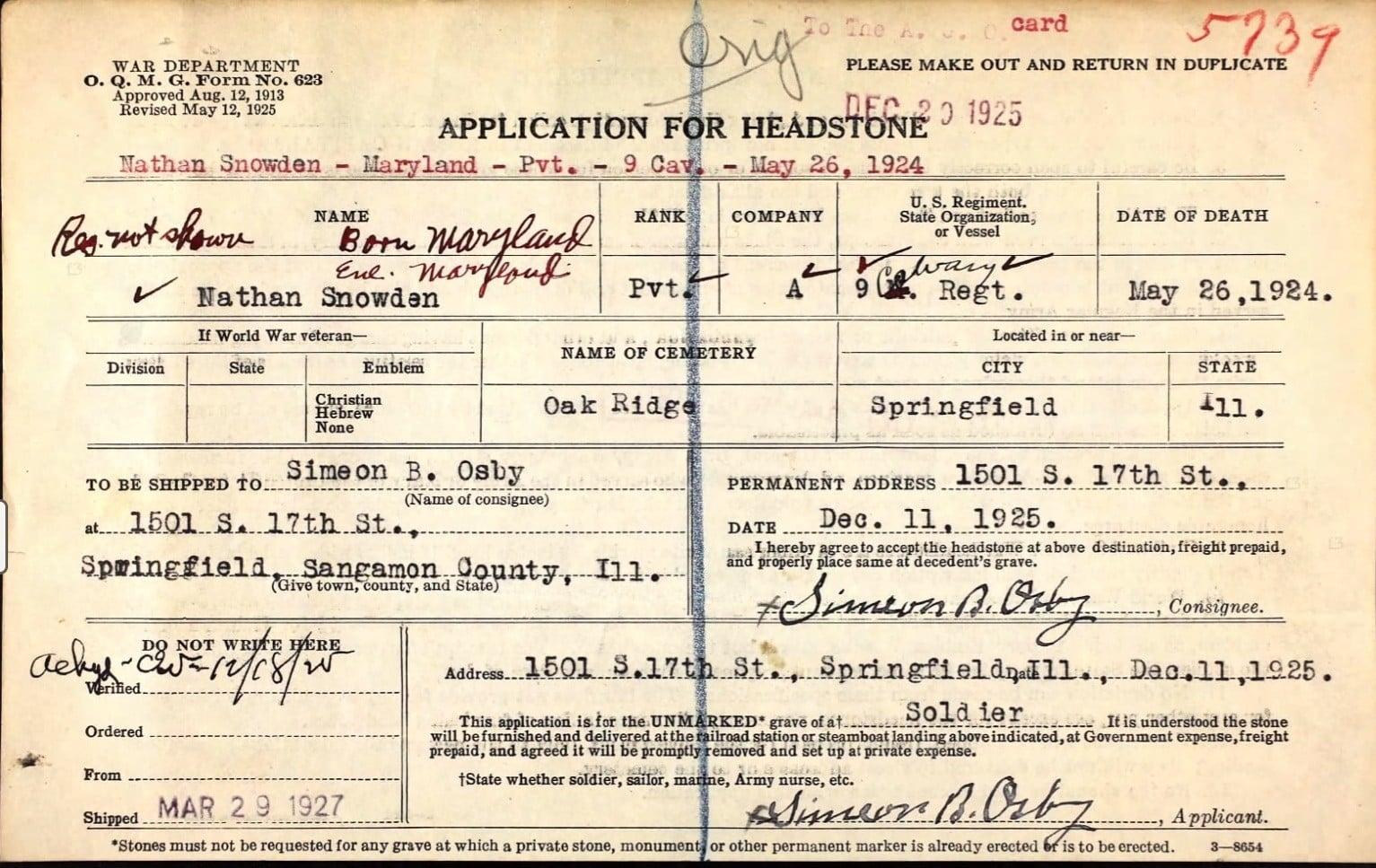
Simeon Osby Sr. sought a military headstone in 1925 for Nathan Snowden’s grave at Oak Ridge Cemetery. The stone was delivered in 1927 and restored in 2026. (U.S., Headstone Applications for Military Veterans, 1861-1985)
As a young man, Nathan Snowden (1854-1924) served five years in the 9th U.S. Cavalry Regiment, one of the famed “Buffalo Soldiers,” African-Americans who battled Apache warriors and, sometimes, white gunmen in the Old West.
He moved later to Springfield, where he became a plasterer and raised a family that also contributed to local history.
Snowden enlisted in the 9th Cavalry in Baltimore on Jan. 25, 1875. He was assigned to Company A. The regiment was deployed to New Mexico during Snowden’s five-year enlistment, including service at Forts Stanton, Bayard and Union.
It’s not clear whether Snowden was involved in any combat, but it was a busy time to be a Buffalo Soldier. The 9th Cavalry and its sister regiment, the 10th Cavalry, fought Mescalero Apaches during Snowden’s service. The African-American troopers also helped suppress the Lincoln County War among white ranchers; that dispute made Billy the Kid famous.
Snowden was discharged at Fort Stanton on Jan. 11, 1880. His discharge record describes his character as “good.”
Snowden was living in Springfield by 1883, when he married his first wife, Victoria Houston Snowden (1865-97). City directory records list him as “Col’d, Plast’r” (“Colored, Plasterer”) as early as 1887. Snowden’s plastering business was profitable – the State Capitol newspaper, an African-American publication, included a help-wanted notice in 1891:
N.T. Snowden, Contractor and Plasterer, and his men are over run (sic) with work. This is an opportunity for some of our young men to get a trade.
Snowden also was active in politics, serving on the executive committee of the Sangamon County Colored Republican Club and as a Sixth Ward delegate to the state Republican League convention in 1896.
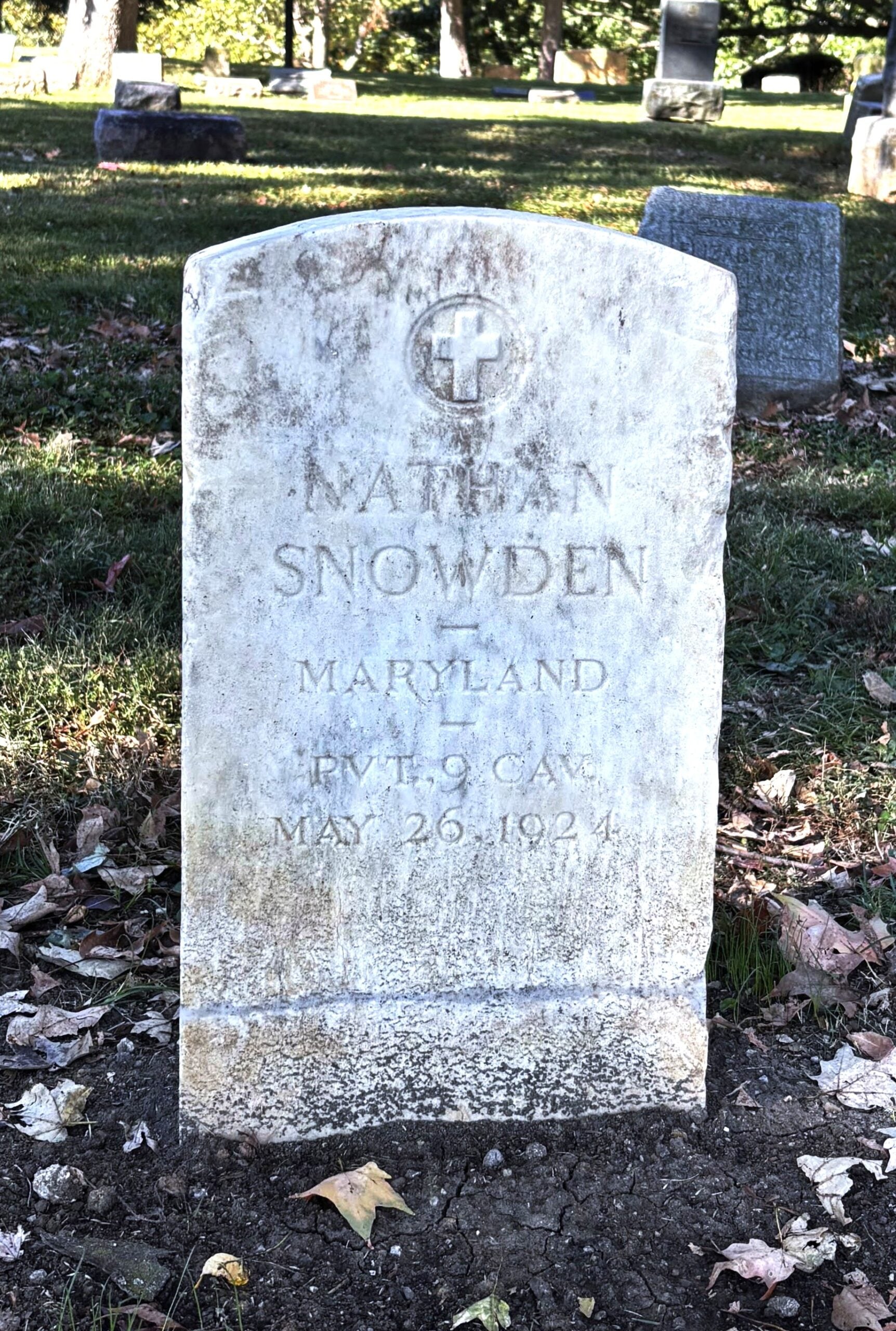
Nathan Snowden’s grave at Oak Ridge (SCHS)
Nathan and Victoria Snowden were the parents of eight children, five of whom survived to adulthood. After Victoria’s death, Nathan married Mary Anna “Annie” Brown (1859-1931).
Nathan and Victoria’s third child, Josephine Snowden Meek, was an academic star at Springfield High School but, under suspicious circumstances, fell short of being named class valedictorian in January 1907. Read about that controversy here.
The Snowdens’ descendants also include Vesta Nichols (1918-2007), a civil rights activist, vocalist and inductee into the Sangamon County Senior Citizens Hall of Fame. Nichols’ daughter, Nathan and Victoria Snowden’s great-granddaughter, Dr. Victoria Nichols-Johnson, was Springfield’s first female African-American physician. Nichols-Johnson served as chief of obstetrics and gynecology at Southern Illinois University School of Medicine and founded the Academy for Breast Feeding Medicine.
 Nathan Snowden is buried at Oak Ridge Cemetery. His military tombstone, installed in 1927, was restored in 2026. (Josephine Snowden Meek is buried in the same grave but with no tombstone.)
Hat tip: To Paul Golladay, who restored Snowden’s grave marker.
Original content copyright Sangamon County Historical Society. You are free to republish this content as long as credit is given to the Society. Learn how to support the Society.