
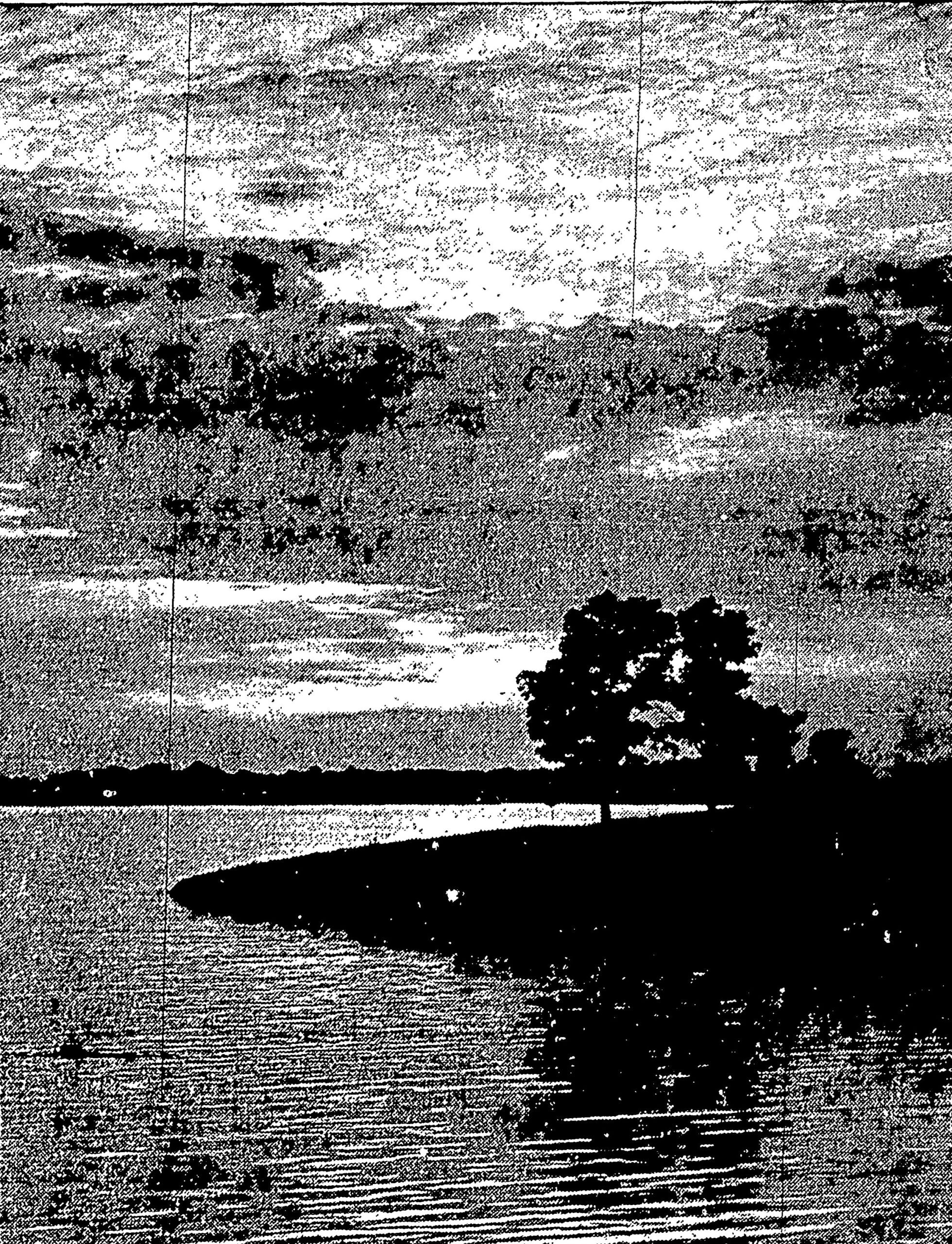
City Water, Light and Power and the Illinois State Register sponsored a Lake Springfield photo contest as part of the lake’s dedication in 1935. Mail carrier and hobby photographer Oren Hughes won $10 for this first-prize photo, taken from the Sixth Street bridge. (Courtesy State Journal-Register)
Willis Spaulding, Springfield utilities commissioner from 1911 to 1943, is rightly considered the father of Lake Springfield. But a less heralded public servant also deserves credit for helping decide where city residents get their water – and then where it goes when they’re done with it.
Springfield began to face the need for a better water supply in the early 1920s. A new lake was one of the most urgent recommendations in the 1925 West Report, an encyclopedic plan for city development over the next five decades.
“Springfield is highly favored by nature in her rich coal deposits,” wrote city planner Myron West (1880-1960) of Chicago. “What she needs to round out her heritage is an adequate water supply. … The impounding dam and lake which we propose will care for this situation and undoubtedly draw new industries to the city.”
West, however, presumed that water to fill the new lake would come from damming the Sangamon River northeast of Springfield. Most city officials and planners originally made the same assumption, partly because the existing Springfield waterworks was on the river and partly because Decatur had recently turned to the Sangamon to provide water for its own lake.
Spaulding, however, had his doubts about Springfield continuing to use Sangamon River. So he called on Wesley “W.B.” Walraven (1894-1953), chief engineer of the then-new Springfield Sanitary District (today’s Sangamon County Water Reclamation District), to study the city’s alternatives.
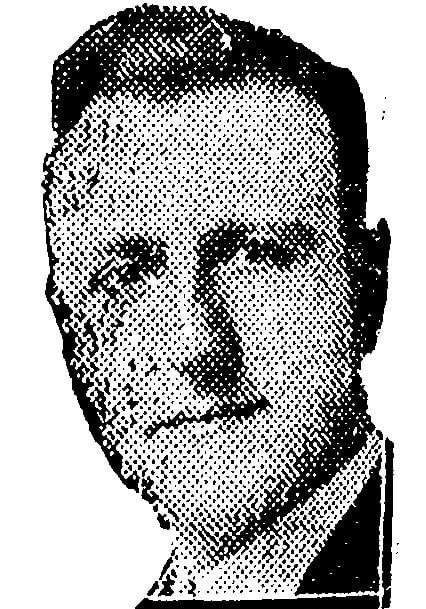
W.B. Walraven, 1928 (SJ-R)
“Mr. Walraven worked secretly for weeks on the project,” the Illinois State Register reported June 4, 1928. Walraven focused on three areas: the Sangamon River; the South Fork, a Sangamon tributary east of town; and the Sugar Creek valley southeast of Springfield.
Walraven drew no conclusions himself; he merely surveyed the properties and compiled data that was turned over to two independent engineering firms – Burns & McDonnell of Kansas City and Pearse, Greeley and Hanson of Chicago. Walraven’s report, however, is what ultimately led the city to create Lake Springfield in the former Sugar Creek valley southeast of the city.
As the Register summarized the studies by Walraven and the independent engineers:
Any one of the three will furnish sufficient water to forever meet Springfield’s needs for water supply and recreation, but the Sugar Creek proposition will give cleaner water at a much lower cost.” …
- Sangamon River Project – Cost upwards of $6,000,000. Land to be bought 16,500 acres. Lake would contain 11 square miles and would impound 13 billion gallons of water. Lake would rank low as a recreational center because of large amount of shallow water.
- South Fork Project – Would cost upwards of $3,500,000. Land to be bought 15,800 acres. Lake would contain 10 square miles and would impound 15 billion gallons of water. Would afford excellent recreational facilities.
- Sugar Creek Project – Would cost less than $2,000,000. Land to be bought 6,850 acres. Lake would contain 5½ square miles and would impound 10½ billion gallons of water. Would afford excellent recreational facilities.
The Sangamon River alternative had other drawbacks too. The topography wasn’t ideal, railroads and bridges would have had to be relocated, and the new lake would have flooded several coal mines. What’s more, Springfield would have had to deal with sewage flowing downstream from Decatur.
The South Fork avoided some of those problems, but a lake there also would have flooded some mine territory, and operating costs would have been higher because of the South Fork’s distance from Springfield.
The key engineering report, based largely on Walraven’s data, was done by Burns & McDonnell. It concluded:
To accomplish the dual purpose of providing a water supply and a recreation lake, Sugar creek is considered the most favorable stream for development.
The Sugar creek valley at the site of Lake Springfield is … admirably adapted for the impoundment of water. The valley is flat, rising only two a feet a mile for the first six miles back of the dam site. Broad flood plains carved out by the meandering of the stream permit deep wide basins bordered by relatively steep bluffs.
Springfield voters approved a $2.5 million bond issue for the lake in June 1930. It took 2½ years to buy all the land (a final total of 8,500 acres, 4,300 acres of which was flooded). Work on Spaulding Dam began in spring 1933, and water impoundment started that December. Because of the Midwest’s Dust Bowl drought, however, it took until May 1935 to fill the lake.
“During this slow process, opponents of Willis Spaulding call the lake ‘Spaulding’s Folly’ and joke they could soak up all the water with sponges,” City Water, Light and Power said in a timeline created for the lake’s 75th anniversary in 2010. “Spaulding has the last laugh when, on May 2, the lake finally reaches full pool (560 feet above sea level) and the first water spills over the dam.”
on Oct. 19, 1936, when the lakeside water purification plant went into operation on Oct. 19, 1936, when city residents finally began to drink Lake Springfield water.
Springfield Sanitary District
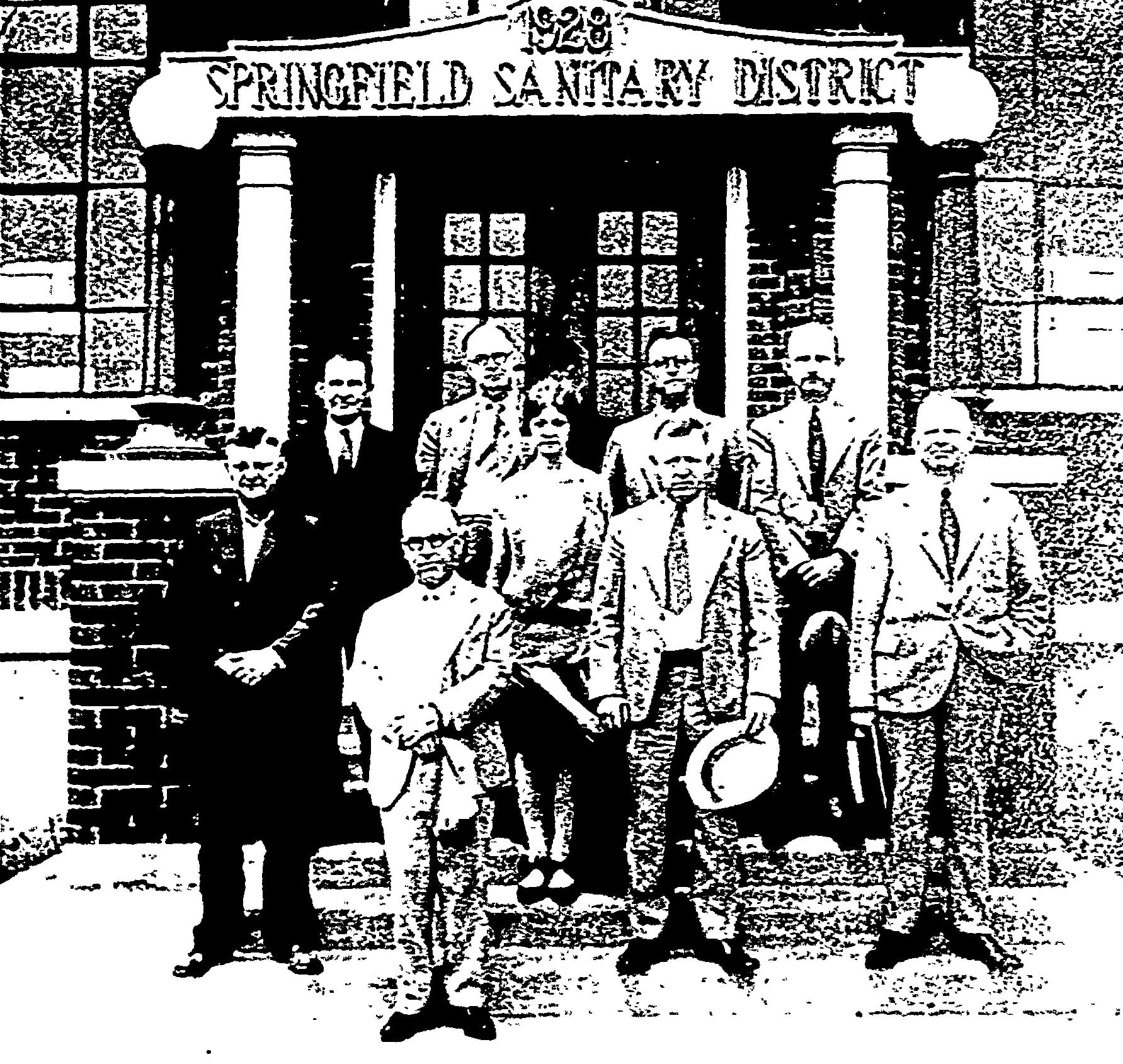
Springfield Sanitary District officials pose in front of the new treatment station, July 1929. W.B. Walraven is second from the right in the back row. (SJ-R)
Willis Spaulding probably turned to W.B. Walraven for help in planning Lake Springfield because nobody else knew more about Sangamon County waterways.
Like most central Illinois communities, Springfield had been releasing its sewage, untreated, into nearby waterways for almost a century by the 1920s. Spring Creek on the city’s west side and Sugar Creek on the east, “have been transformed into open sewage canals,” Walraven said in an article he wrote for the Illinois State Journal in 1928.
In 1921, the Register described the uncovered sewer that ran along the south edge of the city’s then-new Douglas Park (Duncan Park today):
“Turn a searchlight on the slums of London or the ‘back-alley’ district of New York, where living conditions are made practically unbearable by the filth of a big city, and the expose would show but little worse conditions than that which exists in the Capital City of Illinois today,” the paper said.
Springfield City Council members started discussing the need to treat the city’s sewage in July 1923. Spaulding again took the lead, declaring, “It is a disgrace and a shame for Springfield to pollute the Sangamon river and Spring creek.”
The council’s first step was to hire the engineering firm of Dawson and Walraven (Walraven’s partner was William E. Dawson, 1882-1962) to study the problem. Walraven subsequently was hired as the district’s chief engineer.
The council went on to schedule two referendums in 1924, one to create a sewage treatment district and the second to pay for it. Walraven became the face of the effort. Aside from being quoted in dozens of newspaper stories, he also wrote articles explaining the reasons for a sanitary system and how it would work.
The 1928 essay mentioned above was one. Another was a lengthy article Walraven wrote before the bond referendum in November 1924. In it, he outlined eight reasons why Springfield needed to build a waste treatment system.
(I)t would, first, protect our water supply; second, remove the menace to our health now caused by the foul sewage discharged at the city’s borders; third, avoid costly damage suits and waste of public funds; fourth, permit the use of Springfield’s beautiful environs for recreation and pleasure; fifth, establish a definite sewerage plan to follow as the city grows; sixth, build permanent improvements to serve not only you but future generations; seventh, advance the growth of the city by removing the barriers which now exist on the southeast and northeast sides of the city; eighth, stop the pollution of our creeks and Sangamon river and to restore fish life; ninth, apply the golden rule as regards our neighbors along the Sangamon valley.
Voters overwhelmingly approved both propositions. Construction began in June 1925, and both the collection system and the Spring Creek treatment plant were in operation by 1929.
With time off for service in World War II – he served as a colonel in the Corps of Engineers – W.B. Walraven remained the sanitary system’s chief engineer until his death in 1953.
 The renamed Sangamon County Water Reclamation District added a second treatment plant on Sugar Creek in 1973. As of 2026, the district served more than 150,000 residents of Springfield and seven neighboring communities.
Original content copyright Sangamon County Historical Society. You are free to republish this content as long as credit is given to the Society. Learn how to support the Society.