
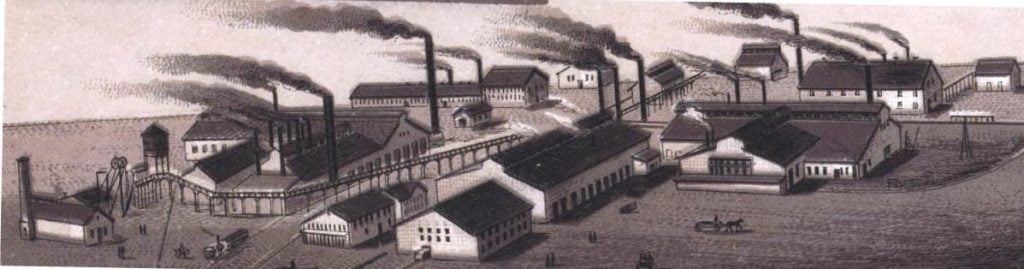
Springfield Iron Co. circa 1890 (Souvenir of Springfield, H.E. Barker, courtesy Sangamon Valley Collection)
“Lofty stacks of the mills arose in the distance like armored sentinels over the concourse of men and metal, while clouds of soft coal smoke mingled with that of the vicinity coal mines and settled over the district. The adjacent countryside presented a succession of productive farmsteads. Winding streams and hardwood groves traced the vast fertile prairie.”
That’s how L. Obed Renne (1873-1968), a Springfield native transplanted to California, began his reminiscences of the Springfield Iron Co. 30 years after he worked there. Springfield Iron, often called “the rolling mill,” produced railroad rails and other products from the 1870s into the early 1900s. The mill, with 1,000 or more employees when running full blast, was one of the city’s major manufacturers for most of that period.
Renne wrote about his experiences at Springfield Iron in an article for the Illinois State Journal’s 100th anniversary edition, published on Nov. 8, 1931. He worked at the rolling mill starting about 1890.
A well packed cinder pavement led to the entrance of the mill yard, where a plain two-story brick building stood which housed the company office and stores of general merchandise. Within the high board fence enclosure of forty-five acres, spacious substantial structures of the various mills and shops were grouped about the yards and rumbling machinery sent forth its quiver and hum. Stacks of billets, hills of white sand, slag, scrap iron and hematite flanked the grounds like frontier ramparts. In the warehouse, tiers of bars, rails, rods, splice and track bolts were ready to be transported into the fields of utility.
Thirty years have not effaced the memory of those masters of iron and steel who constituted the personnel of the Springfield Iron works, which was locally known as “the mill.” To and from the mill they tramped, their clothing pitted by sparks, their rough hobnailed shoes in some cases supplemented by leather flaps, (they) pounded the earth as though Titans were testing the stratum of the globe.
The most vivid elements of Renne’s essay – it took up most of two newspaper pages – involved the characters who populated the rolling mill.
‘Punch kids’
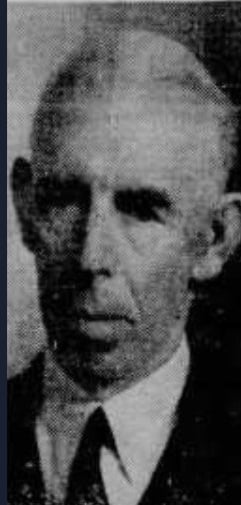
L. Obed Renne, undated (Ancestry.com)
Some of what Renne wrote is difficult to follow more than 125 years later, like the names he gave for some of the jobs at the plant: “heater’s helpers,” “telegraphers” (they used tongs to handle hot iron; the job had nothing to do with communications),” “hookers,” “straighteners,” etc.
“Punchers” and “slotters” were machinists who produced railway splices with the help of a half-dozen “punch kids,” 12-year-old boys who transported unfinished and finished splices around the mill. Punch kids, Renne wrote, imitated the older workers in both costume – hobnailed shoes, leather flaps, and triple-decker lunch pails – and tough demeanor.
Sometimes a scrap would ensue and the rough and tumble fight would be obscured by pulverized iron scale. A black eye – a bloody nose – a shirt torn from a wiry little body would result. Some mother’s child lay bleeding in the dust.
But these were slight affairs and at such times the angry voice of the puncher or slotter might be heard crying out, “Get to work, you damn little devils.”
Sometimes a finger would be torn open by the rough splice – an arm or a foot jammed – and thus blood from these laboring midgets baptized the steel that went to bind together a vast area of the republic.
Punch kids were paid seven cents an hour, Renne wrote. But when they got some free time, they often spent it playing practical jokes and tormenting new employees. “Their vitality was like an endless roaring torrent,” Renne wrote of the punch kids. “It never abated.”
‘Jerry the Bum’
“Jerry the Bum” has left an indelible impression upon my mind as I contemplate the big mill days. This mysterious derelict had ceased to comingle with humanity.
Jerry was rather small and slight, with short black beard. His nondescript clothing served as pajamas and for all occasions. In winter he slept on some old rags in a narrow space between two furnaces.
Jerry the Bum never spoke to anyone. If a mischievous boy would snatch his derby and hand it back to him, or if one of the crew approached him and said, “Hello, Jerry,” the response was always the same; a few short nods, a few short rapid steps.
How did he subsist? At times, he could be seen heating something in a tin can on top of a “buggy” of hot cinder. Occasionally he would accept a handout from one of the workers.
‘Pig Iron Paddy’
“Pig Iron Paddy’ – no other name given – was a giant Irishman whose job was to use a sledgehammer to pulverize scraps of iron and broken castings into pieces small enough to go back into the furnaces.
The very mill would vibrate from his powerful blows. Never would he distort his broad face with a smile. The pungent odor from the ammonia works, just north of his casting pile, may have infused some of its acrid quality into his constitution. However, his work was a serious matter – he had no time for play.
Renne and a co-worker named Walt once came across a few potatoes in a freight car sidetracked at the mill. Opportunistically, they scavenged the potatoes and put them, covered in sand, into a furnace that was in the process of cooling down.
When our “spell” came, we went to investigate and found the potatoes had all been taken out. Sitting on his wheelbarrow hard by, Paddy was just finishing the last one, which was mellow and steaming. Said we, in unison, “We put those potatoes in the furnace to bake for our lunch.”
Paddy brushed a few crumbs from his knees, and rising, took hold of his sledge and remarked in his sonorous voice, ‘Oo loike baked potatoes.”
We hesitated for further explanation, when, with a powerful swing of his sledge, Paddy shattered a big casting, thus dismissing the conference.
Jack Griffiths, general superintendent
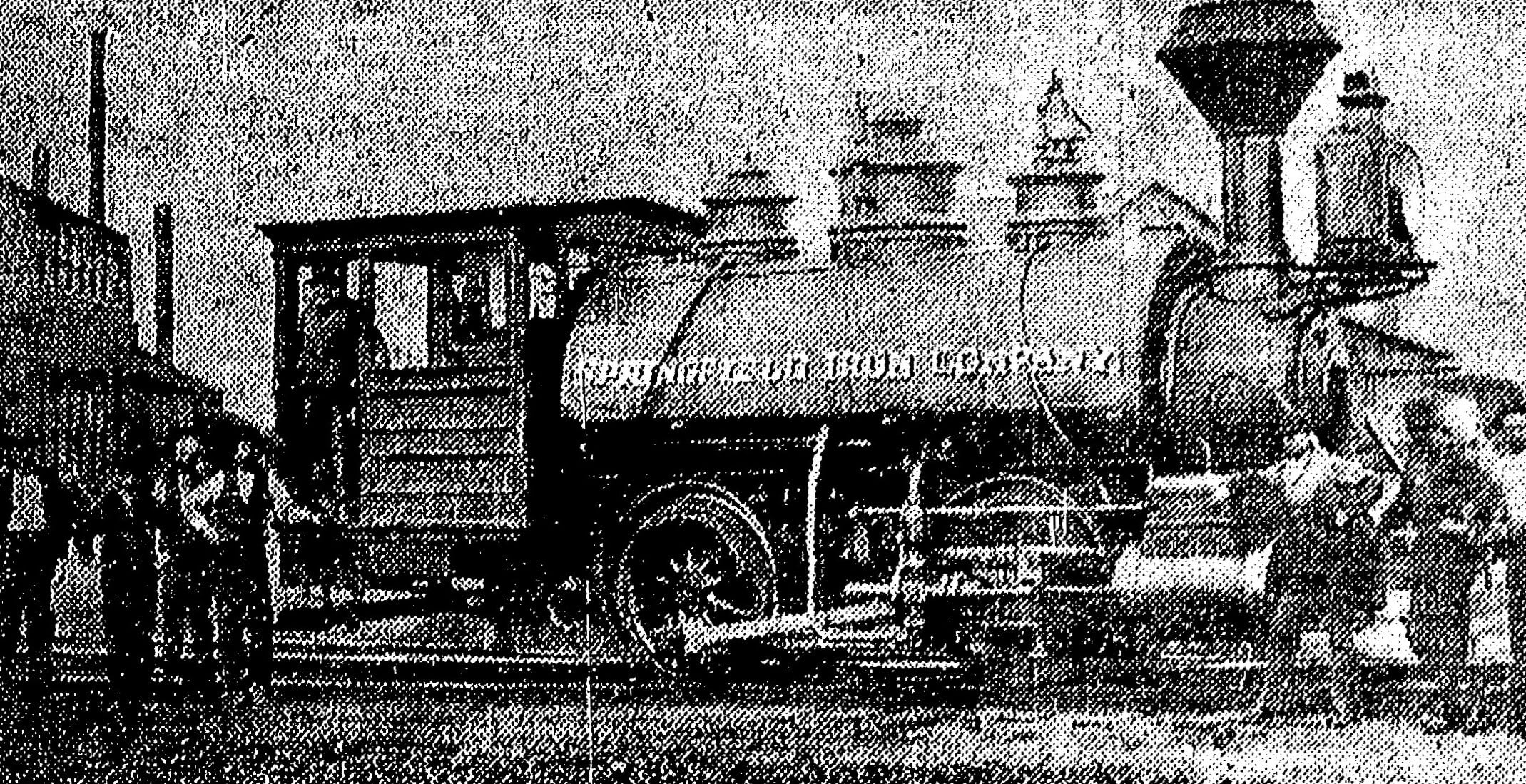
Springfield Iron’s “dummy engine,” which moved rail cars aroung the plant. Undated photo republished in 1931 (Courtesy State Journal-register)
Charles Ridgely (1836-1910) was president of the Springfield Iron Co., but he seldom visited the plant. Instead mill management was left to John “Jack” Griffiths (1845-1900), a former “heater” who was quickly promoted to foreman and then, in 1885, to general superintendent. Renne admired Griffiths.
Mr. Griffiths was a stern man with resolute mouth which a short, thin mustache did not conceal. In summer, on the job, his arms were bare in the typical fashion of the crew. His grim countenance, that never relaxed, revealed an impelling spirit under which Napoleon would have quaked. Tenacious as a bulldog, deferential to no one – if it were a member of the board of directors or a laborer beside him – Griffiths’ attitude was ever the same. His pre-eminence was outstanding.
During the decade I worked at the mill, … I never knew of Mr. Griffiths’ speaking to anyone except when directing the work. His statements were brief, clearcut, authoritative. Exacting in his requirements of others, he was no shirker himself. I have seen him take the tongs at the rolls, or stripped to the waist, help run off a heat at a scorching furnace in midsummer, while his thick hairy torso, tortuous as an oaken stump, rained perspiration.
Jack Griffiths was a constant, proficient man in his management of a great enterprise, the products of which support railways, bridges and towering structures. He was a master of men; disorder resolved into concord in his presence. It seemed the heavy steel plates under his feet felt his invincible personality. The fact was evident that, with all his apparent deplorable lack of sympathy or sense of humor, Mr. Griffiths was a man of indomitable courage, profoundly loyal to his task.
When Renne went to work at the rolling mill, he originally was assigned to the “big mill punch,” which intimidated him, partly because of the punch kids’ reputation for harassing newcomers. For unexplained reasons, however, Griffiths intervened.
Shortly after the foreman took me to the punch to start work with the crew, Griffiths came directly toward me. I was afraid he was going to take me by the ear when, to my great relief, he put his hand on my shoulder and said, “Come with me and I’ll give you a better job.” He took me to the threading room of the bolt shop and gave me what was, aside from the saturating oil, a better job.
As he walked away, I cast a glance at him, the personification of power, and felt that I had been favored by a great monarch.
When the mill closed for the first time in 1894, Griffiths moved to East St. Louis to oversee the Tudor Iron Works, but he returned to Springfield when the plant reopened as a Republic Iron and Steel operation in 1897. He remained general superintendent until he fell ill in 1899.
Griffiths’ son David (1875-1907) replaced his father as superintendent but held the job only until the plant suspended operations again in May 1900. The younger Griffiths was the newly elected mayor of Springfield when he drowned in 1907. Griffiths Avenue on the city’s northeast side, which runs near the former site of Springfield Iron, is named after David Griffiths.
Republic shut down the Springfield rolling mill for good in 1903.
Renne’s article also profiled several other plant supervisors, among them day foreman John Mitchell (1845-1918), “a tall, angular grandfather (who would) lift an incorrigible clear of the ground and shake him severely”, and night superintendent Henry “Hank” Herring (1850-99), a refined type who Renne said “might have been taken for a college president.”
 Louis Obed Renne wrote that he worked at the mill from 1890 to 1900, although that presumably included an interruption during the mill’s 1894-1897 shutdown. He later moved west, working in Idaho and Washington state as a carpenter and teacher of mechanical arts. Renne was living with his daughter in Palo Alto, California, when he died. He is buried at Oak Ridge Cemetery.
Original content copyright Sangamon County Historical Society. You are free to republish this content as long as credit is given to the Society. Learn how to support the Society.