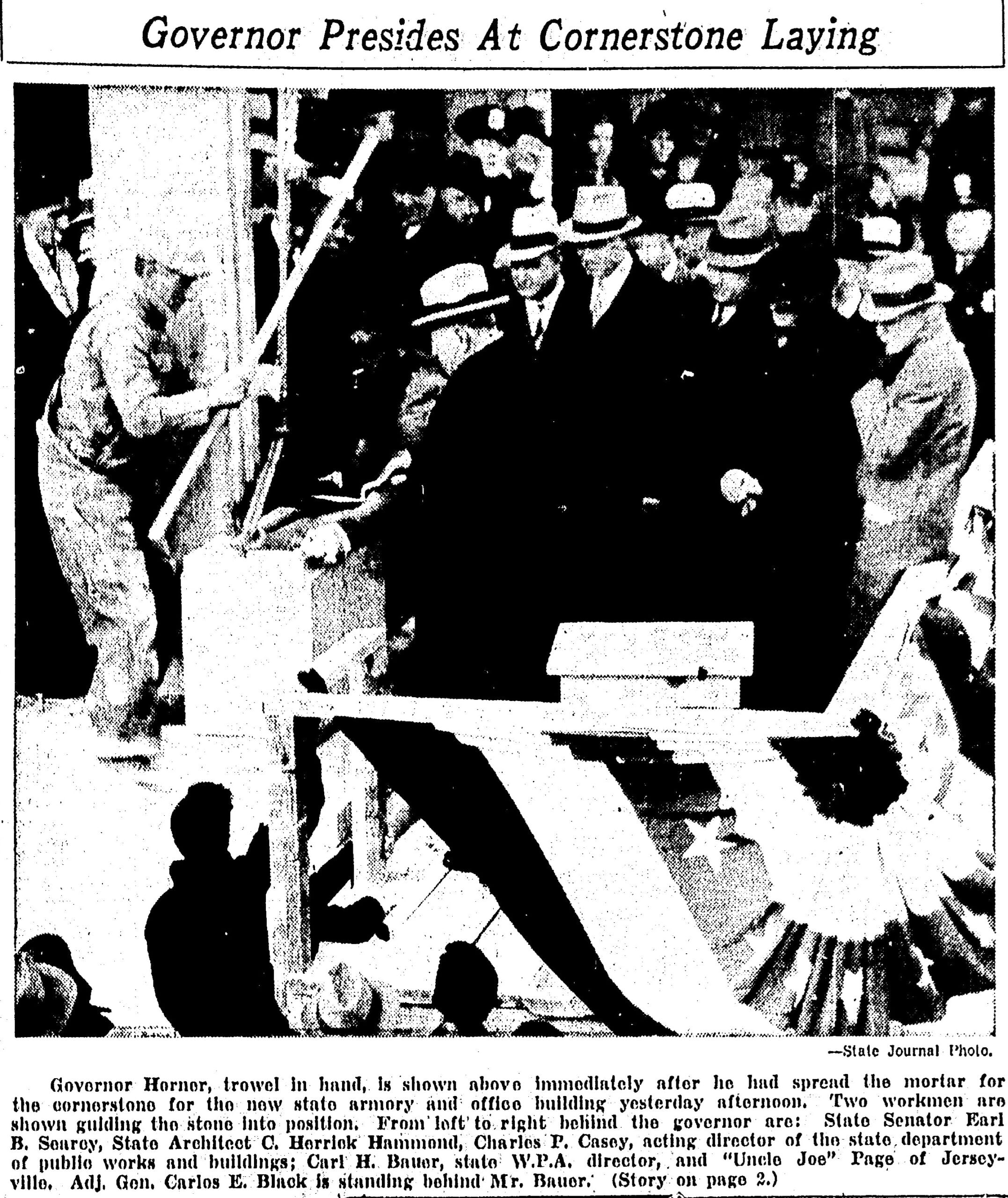
Dignitaries crowd around as Gov. Henry Horner lays mortar for the Illinois State Armory cornerstone, 1936. A workman stands by to ensure the stone is level. (Courtesy State Journal-Register)
Gov. Henry Horner personally laid the first trowel of mortar for the cornerstone of the Illinois State Armory on Nov. 27, 1936.
The 90-year-old Armory, undergoing massive reconstruction following decades of disuse, was renamed the Jim Edgar State Office Building in August 2026.
In laying the cornerstone, Horner noted that the Armory sat on the same site as the former Illinois State Arsenal, which was destroyed by an arson fire in 1934.
“This new armory marks the fruition of our desire and our efforts to replace the old and destroyed building with a structure of which the citizens of Springfield and of the state can justifiably be proud,” he said. “In that respect, I think we have been successful.”
As the names suggest, both the Arsenal and the original Armory served as headquarters for the Illinois National Guard. When it opened, the Armory also housed law enforcement agencies, such as Illinois State Police, corrections and parole supervision. But a hodgepodge of other offices also occupied parts of the 300,000-square-foot building: old age assistance, fire prevention, liquor control, even the state seed inspection laboratory.
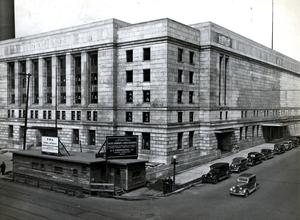
Armory under construction, mid-1930s
The most imposing part of the new building, however, was its huge drill floor/auditorium. With balconies, the auditorium could seat up to 6,000 people. That spaciousness made the Armory Springfield’s all-purpose venue for large-scale indoor events for 50-some years.
The Armory was the site of governors’ inaugural balls (though not Horner’s, because the building was still far from complete when he was sworn in on Jan. 11, 1937), beginning with that of Gov. Dwight Green on Jan. 13, 1941.
It also hosted all manner of theatrical and musical productions, from pop concerts to circuses, and of many city of Springfield functions, such as mayoral swearings-in. It was at the Armory where the city gathered March 14, 1970, to formally accept the award as an All America City from Look magazine and the National Municipal League.
Among people who appeared at the Armory were Willy Brandt, the Cold War mayor of Berlin, boxing great Muhammad Ali, and Dr. Martin Luther King Jr. Both John F. Kennedy and Richard M. Nixon spoke there as presidential candidates, and former president Harry Truman was guest speaker at an Armory banquet in the 1960s.
The Armory is probably most widely remembered as a sports arena. The boys’ basketball City Tournament was held there for many years, along with qualifying games in the state tournament. The Illinois State Armory also was the site of amateur boxing matches, which attracted large crowds into the late 1950s. Armory seating was racially segregated during the building’s first few years, but local African Americans forced that policy to change in the late 1930s.
Over the years, however, the Armory suffered from lack of maintenance and changing state office needs. The Illinois National Guard eventually moved to facilities at Camp Lincoln. The building was taken over by the Illinois State Police, but in 2008, that agency moved most of its operations out of the Armory to the former Franklin Life Insurance Co. building, which the state purchased for the purpose.
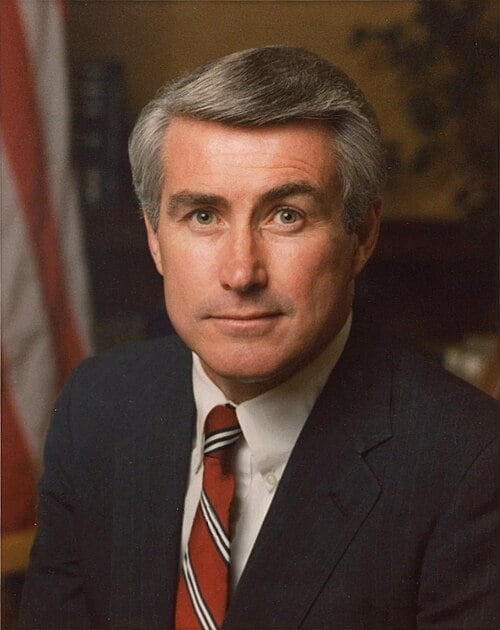
Jim Edgar, 1989 (Wikipedia)
The Armory sat neglected and vacant until the 2020s, when the state began a $26 million stabilization project. As of 2026, work was still under way to add a seventh floor of offices and massively renovate the entire interior. When complete, the rebuilt Armory was expected to house staff members of various state agencies, including the departments of Central Management Services and Commerce and Economic Opportunity, and the governor’s office.
The $126 million project was projected to be done in 2028.
Jim Edgar (1946-2025), a Republican, served as a state representative from 1977 to 1979 and as secretary of state from 1981 to 1991. He was governor from 1991 to 1999.
The Armory has been designated an official City of Springfield landmark by the Springfield Historic Sites Commission. Designed by State of Illinois architect C. Herrick Hammond, the structure is a good example of Art-Deco architecture, typical of the late 1920s and 1930s.
The cornerstone
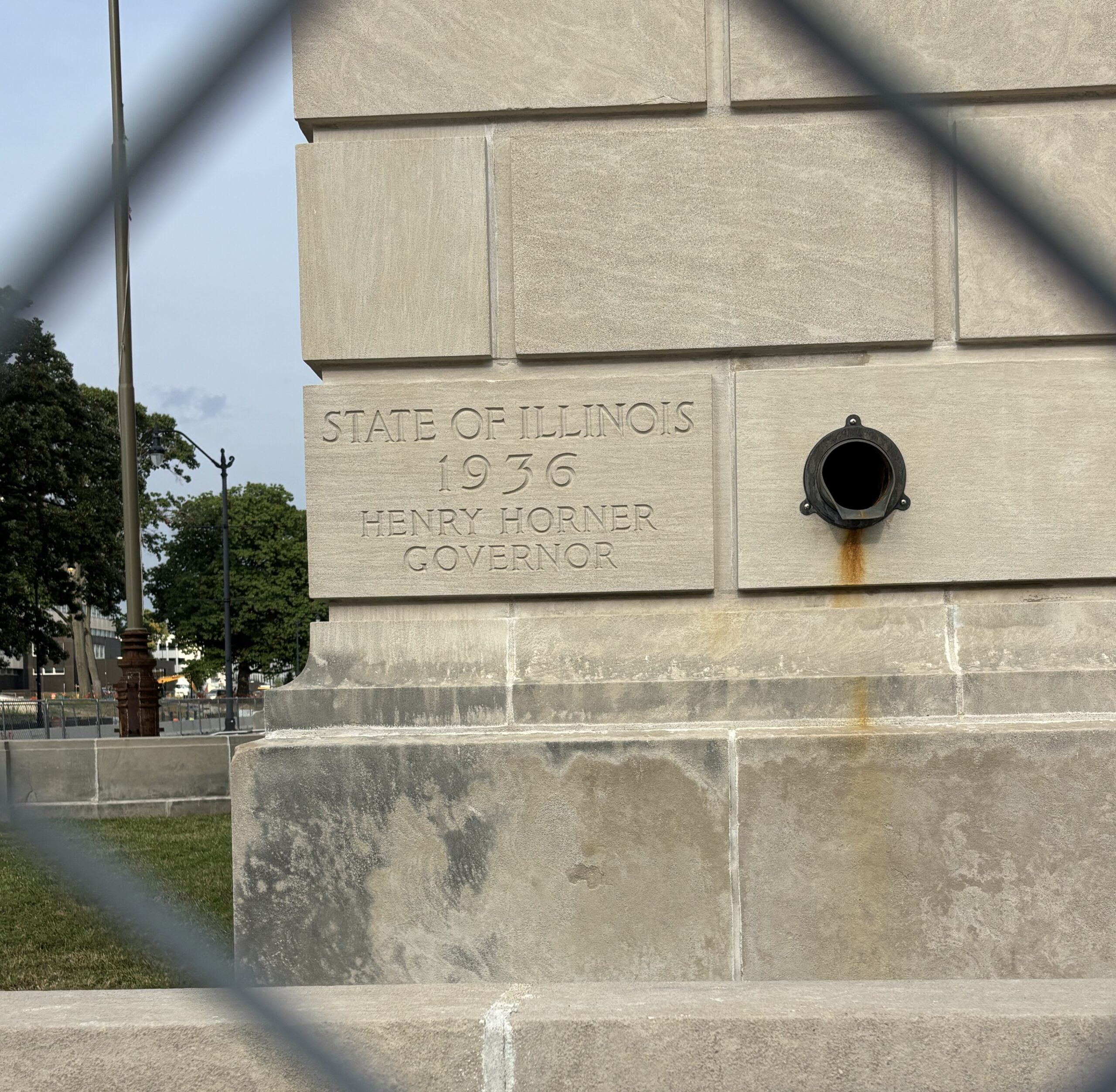
Cornerstone seen through construction fencing, 2026 (SCHS)
The contents of the cornerstone Horner helped install, according to a 1937 newspaper report:
- Photos of Abraham Lincoln, Horner, President Franklin D. Roosevelt and a half-dozen other state dignitaries
- A copy of the 1935-36 Illinois Blue Book
- A copy of The A-B-C of Illinois State Finance by Illinois finance director K.L. Ames Jr.
- Individual copies of the Illinois State Journal and Illinois State Register
- A copy of Here I Have Lived, a book about Springfield during Lincoln’s residency, by Paul Angle
- A photostat of a contract for stone used in construction of the Old State Capitol
- A roster of Illinois National Guard officers
- A compilation of data on the state’s $15 million mid-1930s building program
- “And other miscellaneous articles.”
 Note: This is an expanded and updated version of a 2013 SangamonLink entry. The original contributor was James Krohe Jr.
Original content copyright Sangamon County Historical Society. You are free to republish this content as long as credit is given to the Society. Learn how to support the Society.