

Emergency responders carry a fire victim down back stairs at the Carver Convalescent Center on May 6, 1972. (Courtesy State Journal-Register; photo by James Galloway)
This entry was updated in 2026 with information about one of the fire victims, Brunette Warfield Leland. SangamonLink is indebted to Duane D. Perry of Indianapolis, a relative of Leland, for giving us access to his research. (The revised entry also added several photos, including the one above.) — Ed.
Investigators never agreed on the cause of the fire that killed 10 residents of a shabby nursing home on May 6, 1972.
The number of deaths make the fire at Carver Convalescent Center, 1527 E. Washington St., the worst fatal catastrophe in Sangamon County history.
Among those expressing condolences was President Richard Nixon, who later intervened to speed up enactment of new federal nursing home rules that had been partly inspired by the Carver tragedy.
Nine people died in the nursing home itself; one other succumbed a day later at St. John’s Hospital. All were victims of smoke inhalation. Those killed were:
Hurtis Hall, age 66; Thomasella Newbern, 70; Cleopatra “Cleo” Evans, 71; Ora Watson, 88; Estella Sanford, 66; Lizzie Greenup, 98; Burnet Leland, 76 Brunette Leland, 81; Belle Culp, 76; Henry Johnson, 74; and Dora Williams, 52.
Another resident, Ponto Burgett, about 71, was critically injured in the blaze, but survived. Burgett died in 1988.
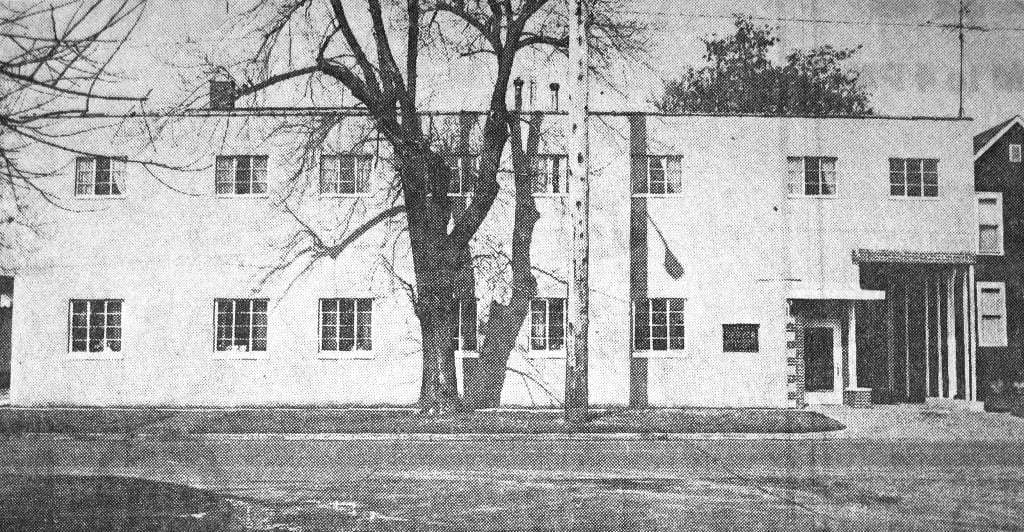
The Carver Convalescent Center in 1970 (SJ-R)
The Carver Convalescent Center received its corporate charter in April 1952; the original developers were Duane Traynor, John B. Hendricks and Conrad Noll Jr. The source of the name is unclear, but it’s likely the Carver center was named in recognition of famed African-American scientist George Washington Carver. It served exclusively Black residents.
The original building was a private home, apparently constructed for the family of Thomas McGrath, a coal miner, in the early 1890s. It went through a series of hands before the Carver home opened in July 1952. At the time, it had capacity for about 22 people.
At some point in its early existence, Byron Weisbaum (1911-98), a physician, and his wife Marilyn (1922-94), a registered nurse, became owners of the facility. In January 1954 they sought and apparently received city council approval to build an expansion that would accommodate 25 more residents.
The original part of the building was wood frame construction; the newer section had masonry on the front and west side, but the home was “basically an old two-and-a-half story L-shaped frame house,” assistant state fire marshal Joseph Patton told reporters the day of the fire.
In its early years, the Carver Convalescent Center was the only local nursing home that accepted African-American residents, according to statements made after the fire, and it was supported by Springfield’s Black community. For Christmas 1952, for instance, the Shriners’ Kamar Temple 56, an African-American temple, donated two clock radios to Carver. The home “currently provides for 22 patients, none of whom had a radio,” according to an Illinois State Register item about the gift. Obituaries for Carver residents who had passed away often emphasized their local and family ties.
By the early 1970s, however, many Carver residents had been transferred there from state institutions, like Jacksonville’s former hospital for the insane. Thirty-eight of the 40 residents at the time of the fire were public aid recipients.
Illinois State Register reporter Dolores “Dolly” Katz visited Carver as part of a February 1970 investigation of local nursing homes. Her description painted a bleak picture of Carver:
One of Springfield’s worst, this all-Negro home is dark and dirty. The ward-like rooms are crowded and bare, the recreational facilities nonexistent. In the kitchen, the painted wall over the stove is cracked, blistering, and peeling. The white owner has 300 nursing home and sheltered care beds in Illinois and Indiana, with four new (homes) going up. He says he makes a profit on Carver’s only because the building is paid for. All of the patients are on public aid. “These people have never had it so good,” the owner said. He refused to permit photographs of the home, and ordered this reporter and a photographer out of the home, saying “I expect nothing good from you.”
(The man Katz called the owner was Albert A. Berg (1912-77), a nursing home entrepreneur whose wife, Dorys, was Byron Weisbaum’s sister. The business relationship between the Weisbaums and Berg is not clear.)
Marilyn Weisbaum succeeded Berg as Carver administrator in December 1971. After the fire, a number of officials said she had begun to improve the facility. They also said an evacuation plan worked out between Carver and the Springfield Fire Department in March 1972 had kept the death toll from being even higher.
The building had been inspected by the state fire marshal’s office the day before the blaze and by the state Department of Public Health the day before that, and no major violations were found. However, Carver was already operating under a provisional license, because it was not certified to provide the level of care many of its residents needed. Under a state Public Health timetable, those residents were to be transferred elsewhere by 1975.
Firefighters arrived at the house minutes after an automatic alarm went off at Firehouse No. 1 at 5:35 a.m. May 6.
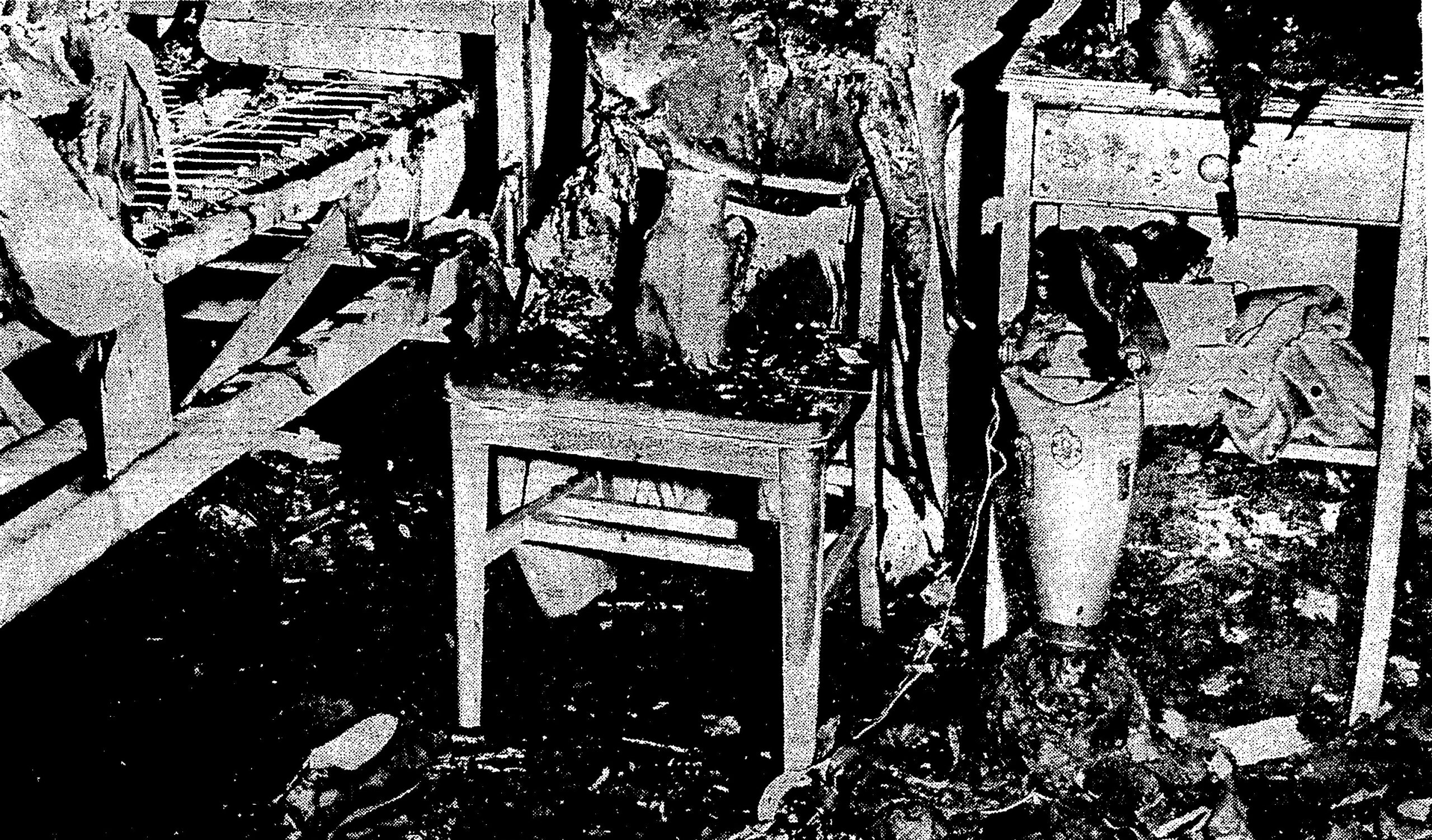
Fire damage inside a resident’s bedroom. An artificial leg sits next to a burnt chair. (SJ-R/Galloway)
“When we arrived, the second story was completely engulfed in flames,” Assistant Fire Chief Elmer Cartwright told the Illinois State Journal’s Mike Clark. “We carried and dragged them out bodily, old, incapacitated-type people who weren’t able to take care of themselves at that stage.”
Marilyn Weisbaum had recently had moved Carver’s incapacitated residents to the first floor. However, all those killed slept on the second floor.
It took several days to confirm the names of two of the victims, and Sangamon County Coroner Norman Richter said it was even harder to locate relatives.
“One man hadn’t seen his aunt for 47 years and a woman hadn’t seen her aunt for 50 years,” he said.
The fire reduced the second floor of the Carver home to rubble. As a result, officials never determined the cause of the blaze, and there was a difference of opinion between city and state authorities over where it began.
City fire investigators said they had determined the fire started in a second-floor eating area above the kitchen. It was used by patients who were unable to get to the first-floor kitchen.
Investigators from the fire marshal’s office, however, suspected arson. They said they believed the fire had begun at the base of a stairway at the rear of the home and that it might have been set deliberately, possibly by a man who had been turned down for a job there. The man underwent a lie detector test and psychiatric exam, but results were inconclusive, according to William Ascher, the Springfield Police Department’s chief of detectives.
The two aides who were in the home May 6 supported the city’s version of events. Rachael Brooks said she went up the back stairs after the home’s fire alarm sounded and found smoke on the second floor. She then helped three residents down the front steps and left the building herself.
Beulah Washington said when she went up the front steps, she saw the fire in the ceiling. Washington got two men onto a second-floor deck near the rear fire escape, but couldn’t carry them any further. Heat from the fire forced her to crawl down the escape herself. Firefighters rescued one of the men from the deck. The other, Henry Johnson, apparently re-entered the building and was killed.
The coroner’s jury returned an open verdict, meaning they could not determine the fire’s cause.
The Rev. Theodore Rose was one of a group of black ministers and others who, 10 days after the fire, urged a more aggressive investigation, including participation from Blacks. He said then one of his church members, a woman who he said had worked at Carver, had told him about potential dangers at the home:
- When the television was turned on, people had to watch the ceiling to see if it was smoking from bad wiring;
- When a man who played music for the residents plugged in an amplified instrument, sparks would fly from the outlet.
- There was grease and urine on the floor of the home “and roaches everywhere.”
Byron and Marilyn Weisbaum said none of that was true while Mrs. Weisbaum was in charge of the home. They promised to look into whether such conditions had existed earlier, but newspaper files indicate no followup was ever published.
As survivors of the fire left the hospital, they were transferred to other nursing homes. Adele Karlson, head of what was then called Aid to Retarded Children and The Little Red School House, a facility that served the mentally disabled, led a fund drive to replace their possessions. (Several Carver residents attended the Little Red School House’s adult programs.)
She said the money would be used, for example, to buy one man a new artificial leg and another a pair of glasses. One man simply wanted the $4 he had lost, “which meant a lot to him,” Karlson said.
Longer term, the Carver Memorial Peoples Foundation and Springfield and Sangamon County Community Action, with federal and city help, established the Carver Health Clinic in the former Immanuel Lutheran School, 1522 E. Matheny Ave. The clinic eventually became part of services provided by the Springfield Health Department (which since has been merged into the Sangamon County Department of Public Health).
On the federal front, the Nursing Home Fire Safety Act of 1973 authorized loans to help nursing homes buy and pay for sprinklers and other fire safety equipment. Nixon pushed the Department of Health, Education and Welfare to publish the necessary regulations quickly following a December 1973 meeting with Don Barry of Springfield, then president of the American Nursing Home Association, and two other ANHA officials.
The hulk of the Carver Convalescent Home was demolished on city orders in December 1972.
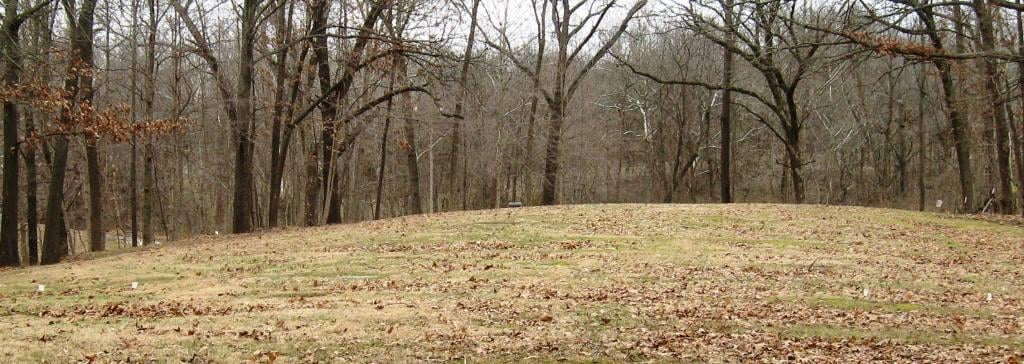
Six victims of the fire are buried at Oak Hill Cemetery, Clear Lake. The six white marker flags barely visible in this photo were placed there temporarily for the Sangamon County Historical Society in January 2017. (SCHS)
The victims
Little is known about the backgrounds of the 10 Carver fire victims.
Hurtis Hall, a promising clarinetist during his years in the Springfield public schools, as a young man listed his occupation as “traveling musician” in city directories. In the 1930s, however, he was in and out of the Jacksonville State Hospital for the insane. He is buried at Oak Ridge Cemetery.
Thomasella Newbern is buried in Greenwood Cemetery, Decatur, where her son and daughter-in-law lived.
Cleopatra “Cleo” Evans lived for 55 years in Taylorville and had family there. She is buried in Taylorville’s Oak Hill Cemetery.
The only information available about Ora Watson is that she obtained a Social Security number in Arkansas in 1965. Her burial place is unknown.
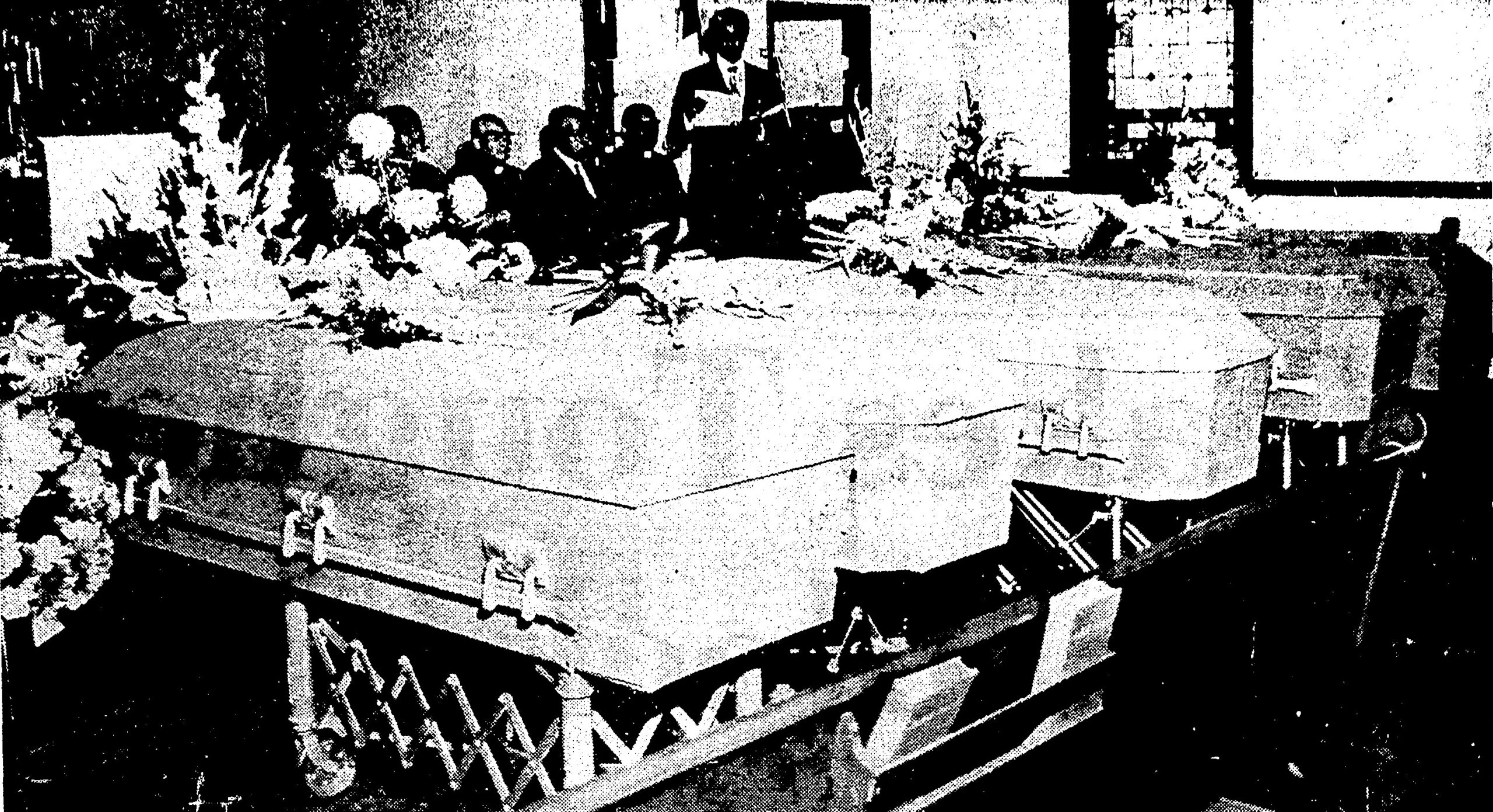
The Springfield Ministerial Alliance held a joint funeral for five fire victims on May 10, 1972. (SJ-R)
The other six victims of the Carver fire are buried in unmarked graves in Oak Hill Cemetery near Clear Lake in Sangamon County. A joint funeral was held for five of them on May 10, 1972, at St. Paul AME Church in Springfield.What is known of the six:
- Estella Sanford was a Missouri resident when her Social Security card was issued in 1953-54. She lived on East Monroe Street in 1966, when she was struck and injured by a motorcycle, according to Illinois State Journal stories. She was hospitalized for a month. Her sister, Hattie Washington of Springfield, died in 1965.
- Lizzie Greenup (maiden name possibly Cummings), the oldest of the victims, married and had two children in Jacksonville before she was committed, sometime before 1910, to the Jacksonville State Hospital. U.S. Census records indicate she was a patient there at least through 1930. Her husband and children moved to the Oakland, Cal., area following her commitment.
- Belle Culp was arrested in 1922 on a charge of assault with a deadly weapon. She had been boarding with a couple on North Lincoln Avenue while she cared for an invalid woman. Culp was accused of shooting the woman’s husband after he objected to her leaving dirty dishes in the sink. Newspaper files don’t say how the case was resolved, but, during an inquiry into her sanity, Culp was found to have smallpox, the Illinois State Journal reported.
- Henry Johnson, who was nicknamed “Little Henry,” was considered mentally “slow,” according to testimony at the coroner’s inquest into the fire.
- Dora Williams was an Oklahoma resident when her Social Security card was issued sometime before 1951.
The 10th victim
When this entry was originally published in 2017, the last sentence read, “No information is available about Burnett Leland,” the 10th fire victim.
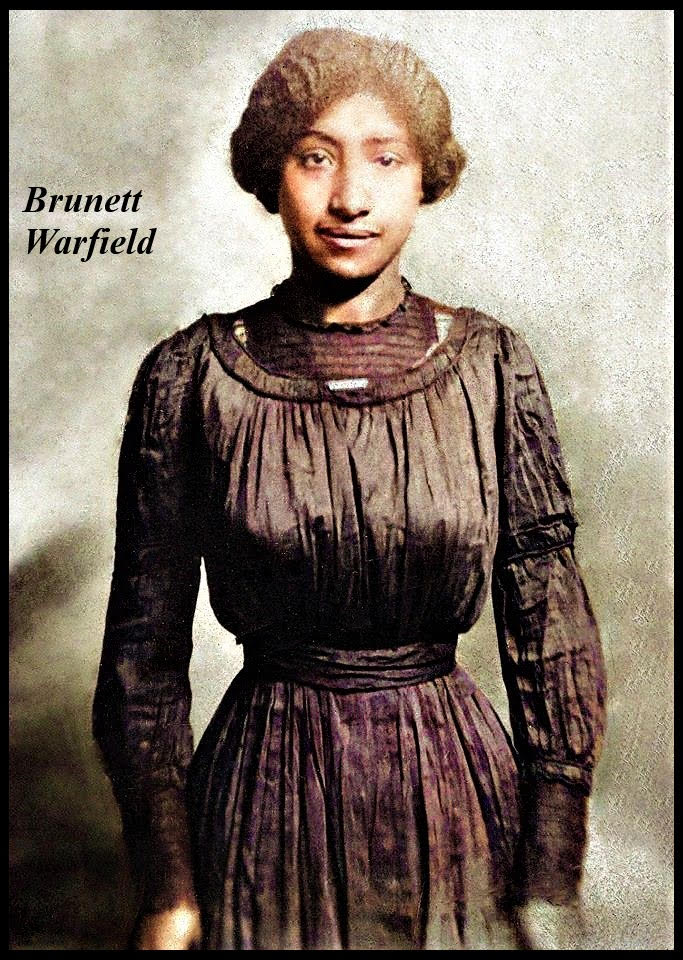
Brunette Leland, undated but apparently from the early 20th century. This image may have been digitally enhanced. (Copyright Duane D. Perry; used with permission)
The problem, it turned out, was that Leland was misidentified in 1972 by both public officials and newspaper reports. Her name actually was Brunette Leland (maiden name Warfield), and she was 81 years old, not 76 as reported, when she died. (It wasn’t even clear from newspaper articles about the fire that Leland was a woman; the stories didn’t say her gender, and one early report gave her first name as “Barnett.”)
That lack of information changed in March 2026, when Duane D. Perry of Indianapolis contacted SangamonLink. Perry, a distant cousin of Leland and his family’s genealogist, is working on a book about the Warfield/Pryor family history.
Leland was born Brunette (sometimes spelled Brunett) Warfield on July 15, 1890, in Owenton, Ky., to Lydia Moseby and Henry Warfield. According to the 1900 Census, she and two younger brothers, Owen and Harry, were living with their grandmother, Latecia Moseby (1874-1937), in Decatur, Ill. Brunette, age 9, was in fifth grade.
Brunette Warfield married her first husband, Charley Porter, in Decatur in 1907. However, she was declared insane in September 1907 and committed, for the first time, to the Jacksonville State Hospital.
It isn’t clear how long she remained in the hospital, but by 1914, Brunette was living in Fort Wayne, Ind., with her father, Henry Warfield (1860-1925), and stepmother, Frances (1880-1975). The Fort Wayne city directory lists her as Brunette Warfield, suggesting she and Porter had been divorced. At any rate, she married again in December 1915, this time to John Leland (or Lealand), a 44-year-old chef. According to Perry’s research, the couple adopted young Albert Callahan that July.
The next time she appears in records is in the 1920 Census, when Brunette Leland is again listed as a resident of the Jacksonville State Hospital. It’s unknown exactly when she entered the institution or why. Census records, however, show she lived there at least through 1950, the last Census for which records have been made public.
Under fire for “warehousing” mental patients, Illinois began transferring Jacksonville State Hospital residents into community facilities and nursing homes in the mid-1960s. The hospital’s population fell from 3,000 to 800 between 1961 and 1971, and Leland no doubt moved to the Carver Center sometime during that period.
Much remains to be learned about Brunette Warfield Leland, but Perry’s research suggests her death was the tragic end of a life of struggle and difficulty.
Sadly, the same probably was true of most of the other Carver Convalescent fire victims.
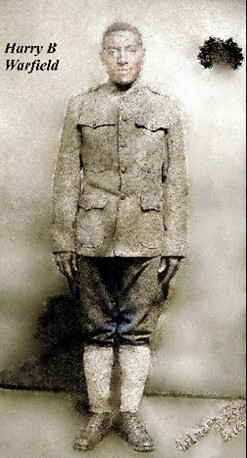
Harry Warfield in uniform (D.D. Perry)
Footnote: Brunette Warfield’s brothers
The older of Brunette Warfield’s brothers, Owen Reese Warfield (1892-1930), married Amanda Pryor (1899-1965) in Peoria, Ill. Amanda’s brother, Leroy “Roy” Pryor Sr. (1888-1946), was the grandfather of the late comedian and Peoria native Richard Pryor.
Harry Warfield (1895-1918) served as a private in the all-Black 370th Regiment of the U.S. Army in World War I. He died of pneumonia in France and is buried at Arlington National Cemetery.
Warfield lived in Decatur, Ill. before enlisting in the Army. After the war, he was honored as the namesake of the former Harry Warfield Post 727 of the American Legion, Decatur’s African-American Legion post.
Hat tips: Many thanks to Duane Perry. Thanks also to Brent Wielt of the Macon County Conservation District for informing SangamonLink of the Harry Warfield American Legion post.
 Note: Many internet sources say, incorrectly, that the Carver Convalescent Home burned on May 5, 1972. The actual date was May 6.
Original content copyright Sangamon County Historical Society. You are free to republish this content as long as credit is given to the Society.