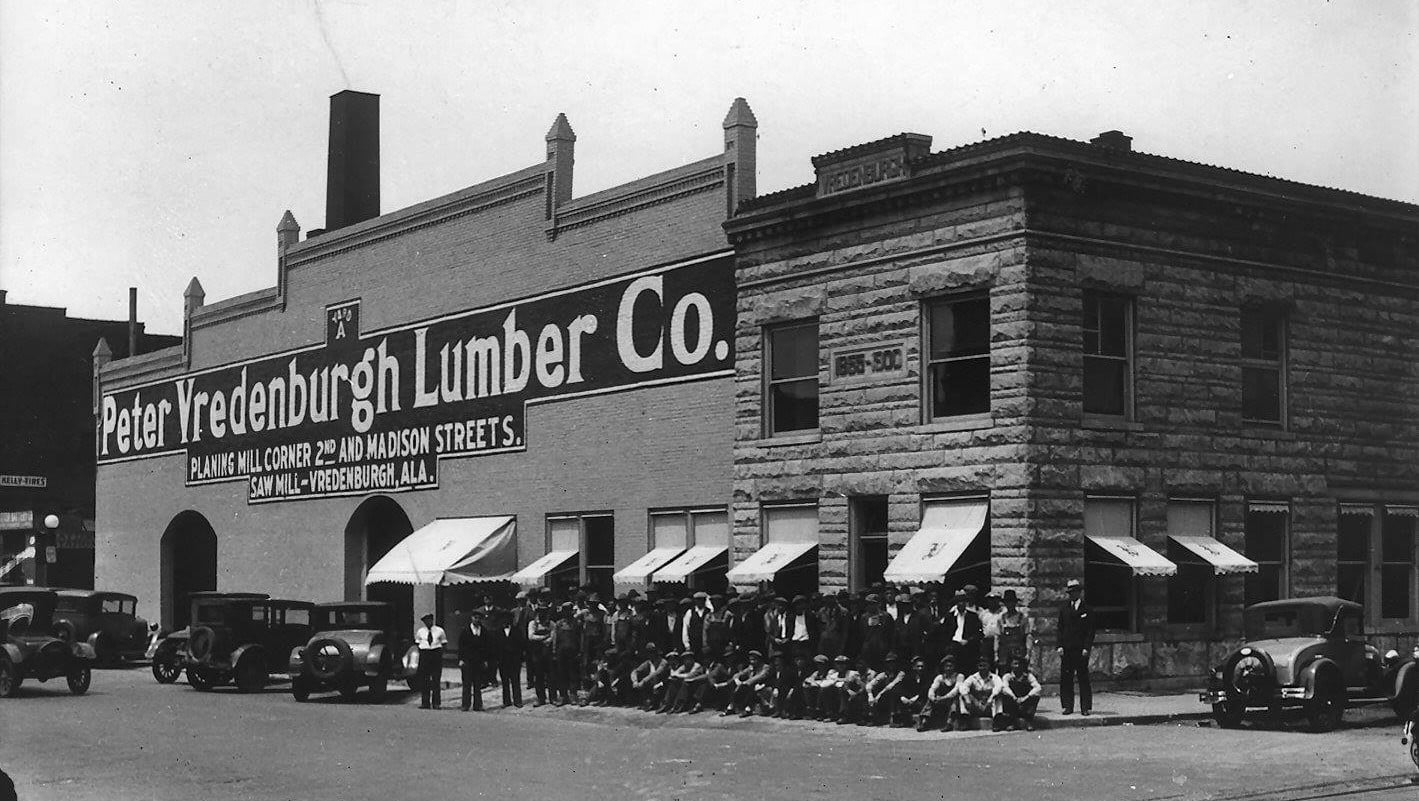
Peter Vredenburgh Lumber Co., 1920s (Springfield Rewind)
The Vredenburgh family operated lumber businesses in Springfield for 145 years. One of the main reasons for the Vredenburghs’ success, though overlooked in Springfield, was the logging empire the Vredenburghs built in the forests of southern Alabama.
That venture even included a company town: Vredenburgh, Ala.
John S. Vredenburgh (1809-79) farmed near Curran when he first moved to Sangamon County from New Jersey in 1832. In 1855, he and Edward R. Ulrich (1829-1909) founded a lumberyard at Third and Jefferson streets (pioneer Springfield businesswoman Henrietta Ulrich, Edward’s mother, was a silent partner in the enterprise).
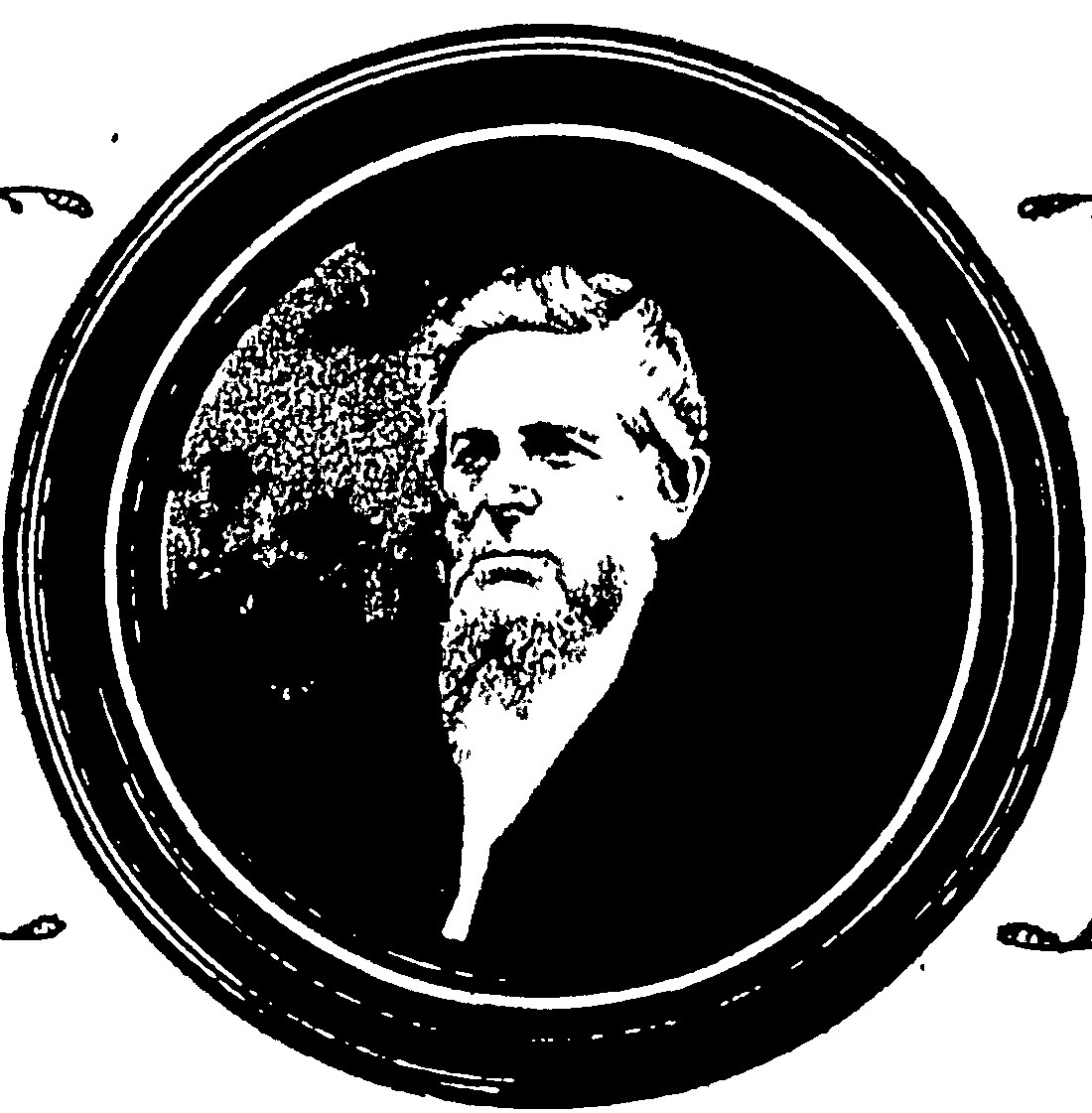
John S. Vredenburgh, 1931 company advertisement (Courtesy State Journal-Register)
Vredenburgh served a single term as mayor in 1864-65. In that role, he delivered the city’s official statement when President Abraham Lincoln was assassinated in April 1865.
“The startling intelligence this morning from the seat of government in Washington (turned) by a sudden revulsion the joy of a nation to deepest mourning, and (caused) in the hearts of all sober and reflecting men a fearful looking for of judgment,” he said. “We of this city have special cause to mourn, for he was one of us …”
John Vredenburgh’s oldest son, Peter (1837-1925), bought the Ulrichs’ share of the lumberyard in 1864. As his father aged, Peter took full control of the business, which was incorporated in 1900 as the Peter Vredenburgh Lumber Co. The younger Vredenburgh diversified the company’s marketing, adding finished wood products and other building materials, such as Portland cement, to its raw lumber sales. With his own son, Peter Jr., Vredenburgh also turned to Alabama as the lumberyard’s primary source of raw timber (see below).
The Peter Vredenburgh Lumber Co. remained in business downtown until 1982, ultimately taking over virtually the entire block between Second, Third, Jefferson and Madison streets.
“The father-to-son succession continued into the 1980s,” State Journal-Register business editor Tim Landis wrote in 2000, “through Peter Vredenburgh, Thomas Vredenburgh II (1878-1950), W. Ogden Vredenburgh (1900-75) and eventually to Thomas W. Vredenburgh (1934-2007). It was Thomas who announced the closing of the retail lumber operation at 229 E. Jefferson in 1982, citing ‘economic reasons.’”
One company offshoot, Vredenburgh Home Builders Co., developed the Sherwood, Northgate and Sunset Acres subdivisions. Another, Vredenburgh Components, continued to manufacture roof trusses at a westside Springfield location until it too was sold in 2000.
In 2025, Isringhausen Motors occupied the old Vredenburgh site downtown, while law offices were located in the former Vredenburgh mansion at 1119 S. Sixth St.
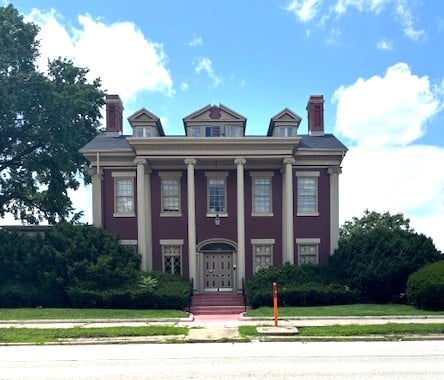
Former Vredenburgh mansion, 2025 (SCHS)
Ogden Vredenburgh was the last family member to own the Sixth Street house. He sold it in 1956 after moving to Wheeland Haven, his wife’s similarly lavish home in Riverton.
Collectible furniture and artwork had been dispersed via a three-day private sale several years before, but the Illinois State Journal reported that Ogden Vredenburgh included one condition in the contract to sell the home: “Vredenburgh reserves the right to remove from the premises, by mid-April, the two stone lions which for years have guarded the entrance to the formal gardens on the Fifth St. side of the house.”
Vredenburgh, Ala.
The Vredenburgh family’s Alabama timber empire wasn’t a secret in Springfield – Peter Vredenburgh Jr.’s original move to Alabama in 1903 got a three-sentence story in the Illinois State Register – but its extent wasn’t widely understood, either. For instance, while Peter Sr.’s obituary called the Alabama connection “probably the most important undertaking of Mr. Vredenburgh’s life,” the story gave only the barest details.

Four generations of Vredenburghs. From the top step, the first two are Peter Sr. and Peter Jr. The younger two probably are Peter Jr.’s older son Sellers and his son, Sykes Tucker Vredenburgh.* (Legacy magazine, Monroe County Heritage Museum)
In fact, the Vredenburgh Saw Mill Co. was a huge operation, clearing some 90,000 forested acres over five decades in business and producing as much as 50 million board-feet of lumber per year. Besides Vredenburgh Lumber in Springfield, the sawmill shipped carloads of lumber all over the U.S.
The business was the brainchild of Peter Vredenburgh Jr., with the help of $50,000 in seed money provided by his father. The younger man eventually set his sights on heavily forested Monroe County in southwest Alabama, about 100 miles north of Mobile. (The fictional town of Maycomb, Ala., setting for the classic novel To Kill a Mockingbird, is based on Monroeville, the county seat and the childhood home of Mockingbird author Harper Lee.)
Legacy, the magazine of the Monroe County Heritage Museum, devoted an entire issue in 1994 to Peter Vredenburgh Jr., the Vredenburgh Saw Mill Co., and Vredenburgh, Ala., the namesake community Peter Jr. created in the Alabama woods.
“Peter Vredenburgh Jr. was 37 years old when he incorporated his sawmill town in 1912,” Legacy reporter K.T. Owens wrote.
Vredenburgh wanted to send the finest lumber possible to his father, so he first decided his village must be designed and landscaped to perfection. He hired a gardener from Mobile to help with the town’s layout so that the majority of the original trees could be incorporated into the pristine setting.
Plants indigenous to the area and state were also used. Each house had its own rosebush.
In the memory of Sue Finklea Turner, a Legacy writer whose family was acquainted with Peter Jr., he came across as a jovial, courtly man whose “fat, pear-shaped middle would shake all over” when he laughed.
Nobody called Mr. Vredenburgh a “damn Yankee,” like they did some Northerners. He was always handing money around for every little thing anybody did for him. Folks in the country liked that.
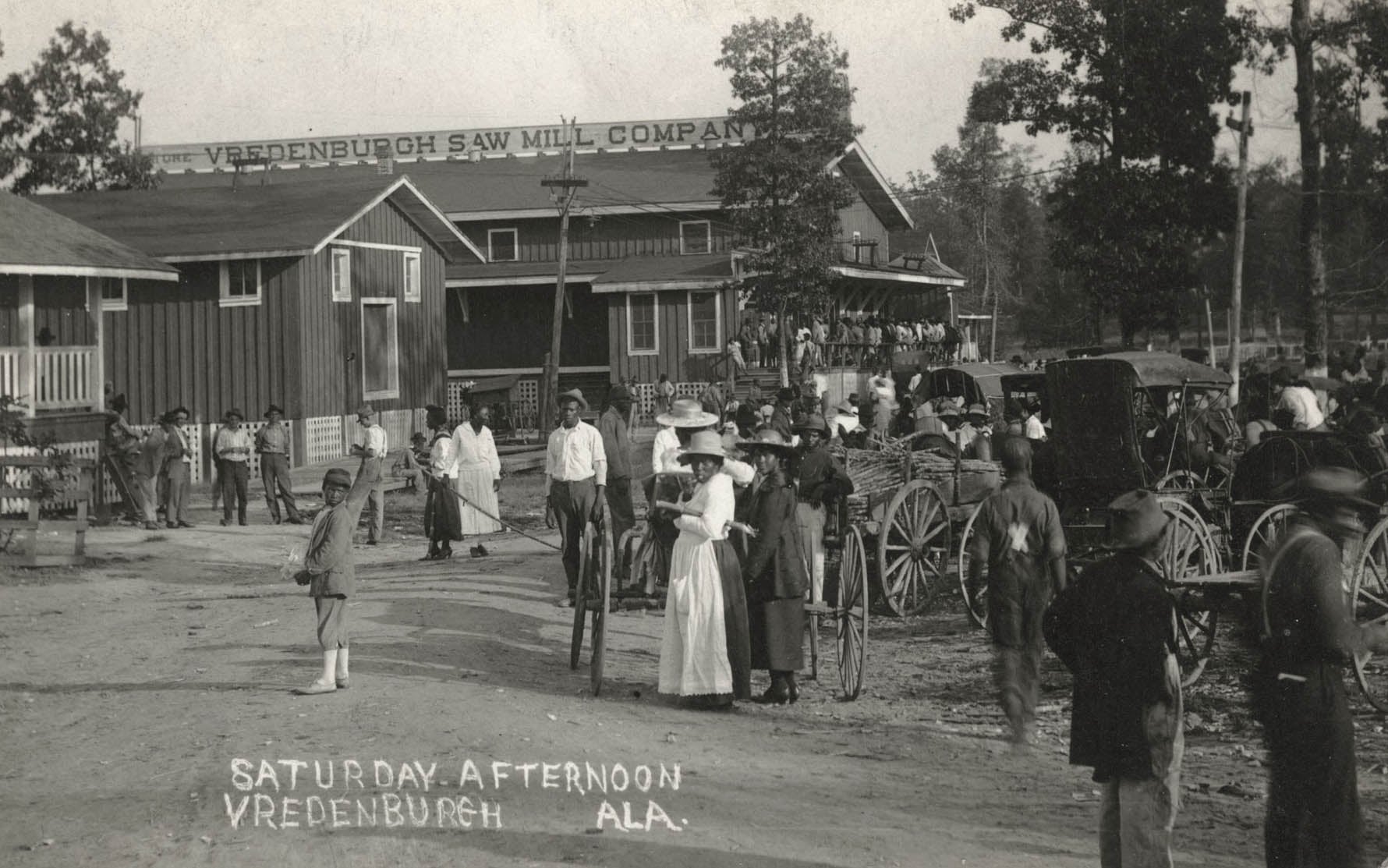
Although undated, this photo of Vredenburgh, Ala., appears to have been taken early in the town’s existence. (From The Vredenburgh Searcher, a website dedicated to the history of people named Vredenburgh. It is unclear how, or if, the website’s owners are related to the Springfield Vredenburghs)
Vredenburgh, Ala., seems to have been a prototypical company town, although perhaps a more pleasant one than most. Sawmill workers lived in inexpensive company housing (segregated by race) and were paid partly in company “checks” – metal tokens that could be spent only at the company commissary. The mill provided schools (also segregated), a church, a park, a company physician, free outdoor movies and cheap rail excursions on Sunday. In the summer, Peter Jr. put college athletes on the payroll so they could play for the company baseball team.
The town’s population was estimated at 1,800 in 1944.
The Vredenburgh operation logged tens of thousands of acres over the years. When one timber area was exhausted, the entire cutting crew would move to the next. The “steel gang” laid a temporary rail line to the timber face, woodcutters and their families rode boxcars to the new site, and the boxcars were converted into their homes for the interim.
Nelle Stinson-Smith, whose father scaled logs for the Vredenburgh Saw Mill Co., wrote about that process in the Legacy special edition.
The size of the house and the number of boxcars of each family depended upon the number of children in the households.
Our family, being small, had three boxcars. Two boxcars on each side were the bedrooms with a partition between them, which was the living room. At the end of the living room was another partition, and this was the dining room. The third boxcar placed across the dining room was the kitchen. We had a front and back porch.
The families living in the camp paid either $1 or $2 a month for house rental and about 50 cents a month for care from the company doctor that made regular visits about twice a week.
Common laborers, most of them Black, were paid as little as $1 day for 11½-hour shifts in the forests or at the mill.
“Ain’t nobody going to leave,” Legacy quoted one former millworker. “There ain’t no jobs anywhere else either.”
For a period in at least in the early 1920s, the Vredenburgh Saw Mill Co. contracted to have prison inmates do some of the hardest work, such as on the steel gang and hauling logs. Legacy magazine included an editor’s note:
According to Monroe County Convict Records between the years 1920-1924, 39 convicts were sentenced to hard labor at Vredenburgh. Five convicts were “white” males, one was “Indian” and two were female “Negroes.” The remaining 31 were listed as “Negro.”
Their offenses ranged from violation of prohibition law to second-degree manslaughter.
The sawmill company stopped contracting for convict labor in the fall of 1925, about when Peter Jr. turned over management to his two sons, Peter III (1904-56) and Sellers (1897-1987). They made other changes too. Instead of leasing timberland, their father’s primary approach, Peter III and Sellers began buying forested property. And instead of clear-cutting, which was depleting the mill’s lumber sources, they began selective harvesting of trees and started replanting logged-out areas.
Those and other modernizations kept the Vredenburgh family in charge of the Alabama business until 1954, when they sold the sawmill and timberland to International Paper. The mill finally shut down in the early 1980s.
 As of summer 2025, according to the Encyclopedia of Alabama, the forests around Vredenburgh were being sustainably managed by the Wilmon Timberlands company, headquartered in Vredenburgh, and the area had been designated “a TREASURE Forest.”
Vredenburgh, Ala.’s population in 2020 was 191, 160 of whom were African-American.
*Legacy magazine identified the Vredenburghs photographed on the steps as Peter Sr., Peter Jr., Peter III and Peter IV. The older man on the top step is clearly Peter Sr. However, he died in 1925, and Peter IV wasn’t born until 1926. Sellers Vredenburgh’s son Sykes, however, was born in 1920. Sykes almost surely was the child at the bottom of the steps, making it very likely that the third adult was Sellers.
Original content copyright Sangamon County Historical Society. You are free to republish this content as long as credit is given to the Society. Learn how to support the Society.
Outstanding bio of a Springfield family I knew very little about. Thanks!!